
Seven years ago, when I lived in Stratford, V&A East was barely a dream. It was 2020, the early stages of COVID and a really a weird time. Attempting to contain the spread of the coronavirus, the government had mandated that people could only leave their houses once a day to exercise, otherwise they had to stay at home. That meant no socialising outdoors, and strictly no sitting on a park bench unless you were exercising – figure that one out.
Exercising (of course), I would cycle through Queen Elizabeth Olympic Park in Stratford, or walk over during my afternoons – sick of being indoors. At the time a whole section of the Park seemed like a wasteland – vast areas were cordoned off, assigned, ready and waiting to be developed. You could hardly imagine then that this dormant, dusty place held the promise of the bustling, built future I found myself walking through in May. I was on my way to the newly opened V&A East, which had risen up phoenix-like, to see its opening exhibition; The Music is Black: A British Story.

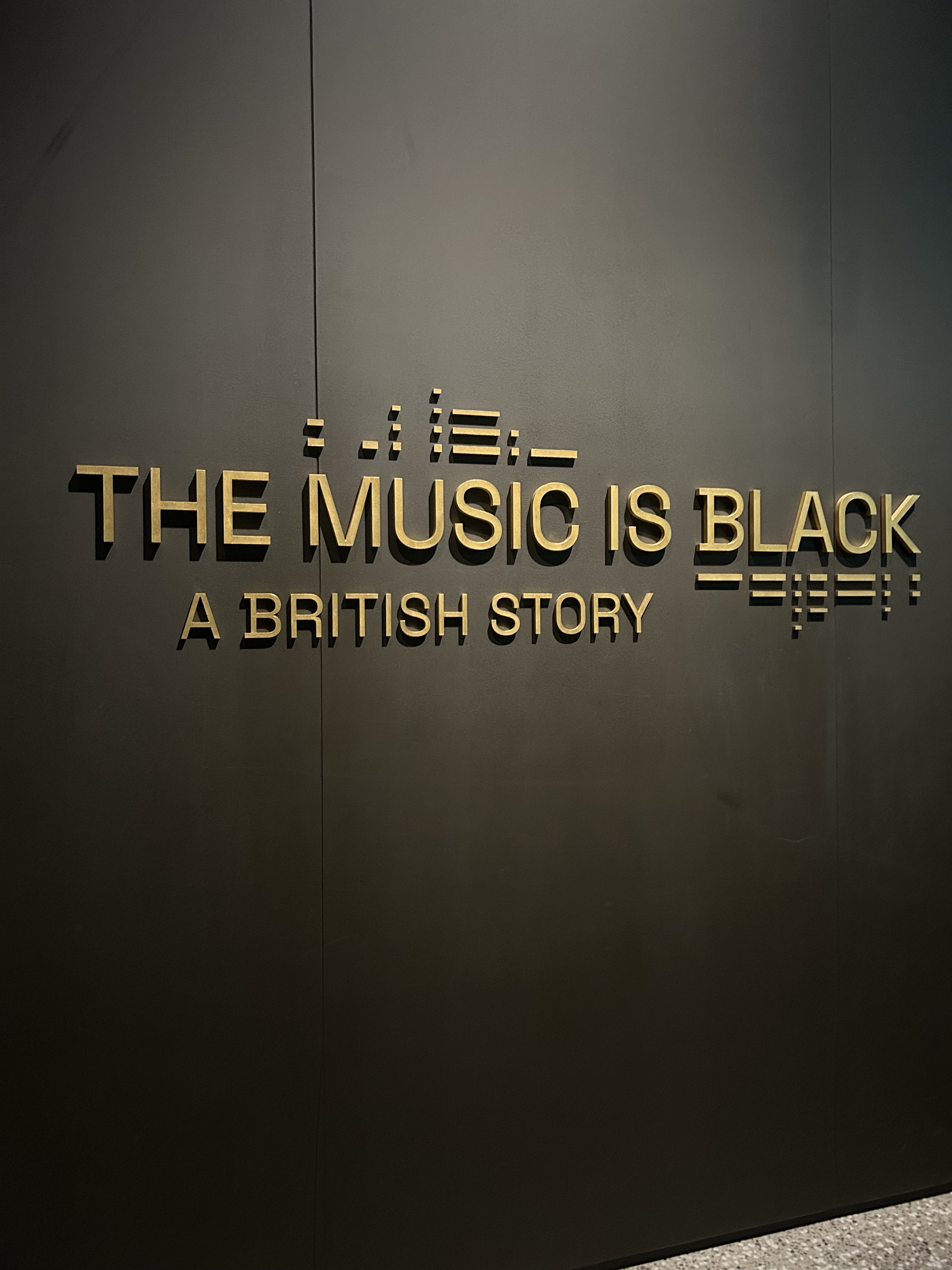
Much of the music the exhibition celebrates is what I grew up listening to, so it felt really special to be there. I’d been looking forward to it for ages. The sounds of soul, acid jazz, jungle, drum and bass, trip hop, UK Garage and more besides, blasted from the small stereo in my bedroom, the headphones of my walkman, and later my mini-disc player. They carried me through school, university and beyond; in the background as I did my homework or studies and providing a soundtrack to so many significant moments and experiences. Perhaps because the music, with cultural roots disparate to mine, articulated something that felt vital and important, which I connected with – it confronted me and inspired me. Not only that it taught me about numerous lived experiences in Britain which were different to my own – and challenged notions of what might be ‘typically British’ including the formality and ‘stiff upper lip’ of so much of the British Establishment. It was an education, musically and otherwise.
Music in general was beginning to capture my imagination. On a Sunday night I would sit recording my favourite songs off the Top 40 (primed to press stop and record just in time to cut out the DJ), I was going to dance classes every evening after school, learning instruments, playing in groups or orchestras, and singing in choirs. Music was becoming a big part of my life and I was always listening out for those tracks and artists that I really enjoyed – I still am.

At primary school, we would spend break times making up dances in the playground to our favourite tunes which included pop, hip hop, rap, and inevitably, Michael Jackson – a genre all his own. He was a musical superhero to us, even if his fame-fuelled antics were becoming ever-stranger by the day. And while American culture had a huge influence on all of us growing up during the 80s (music, TV, fashion, footwear…), the London I was growing up in thrummed with sounds that had been inspiring and shaping Black British music for years. This was especially true each year at the Notting Hill Carnival, when generators and sets of speakers were loaded onto the backs of lorries and stacked up to make sound systems, sending their bass-heavy beats, with reggae and dub and more – reverberating through the local neighbourhoods. Caribbean culture was celebrated – especially at Carnival time – and I couldn’t wait to join the party.

While in my own family and culture there was little self-expression, in what felt like a truly organic put-the-music-on-and-just-start-dancing sense, elsewhere all I seemed to do was put on music and dance. The more rhythm and bass and groove it had the better and I sought it out. One of my first-ever albums was a gift from my older cousin: Soul II Soul’s Club Classic Volume 1 which she copied onto a blank cassette tape for me one summer afternoon. Holding it in my hands felt like I’d won the lottery. I listened to songs like Keep on Moving so much the cassette almost wore out. As I discovered more music I collected it wherever I could; copied, bought or borrowed – always asking for a new album for Christmas or birthdays. Among my growing stack of tapes and CDs was Aswad, Neneh Cherry, the Young Disciples, Incognito and then later came Goldie, Massive Attack, Smith and Mighty and Roni Size. I was so taken with the Bristol Sound that I moved to Bristol. And after graduating from the university I soon grew to properly appreciate the history and sounds of reggae, ska and two-tone thanks to one of my first jobs. One of the managers at the deli I worked in would play anything and everything from Trojan Records on the shop stereo whenever I was on shift with him – taking it upon himself to explain the music and its musical lore to me. And while working there one day I found myself making a deli sandwich for Mushroom from Massive Attack, and being so awestruck – even when he asked if we had any Marmite (sorry no) – that my knife sliced through the ciabatta I was cutting together with my hand – ouch.
And so it was that I arrived at the gallery entrance at V&A East to don my Sennheiser headphones, (which would sense my location in the space and trigger different tracks), and headed in through the doors to learn, reminisce and rediscover so much of the music I still love.
The Music is Black is on at V&A East until 10 January 2027.
© Alexandra Noel. All rights reserved.