Recently my Instagram feed has been awash with videos of Céline Dion dancing and singing with fans in the street outside her Paris hotel. She is there for her residency at Plénitude (formerly Paris La Défense) Arena.
In one video, she emerges from her hotel looking immaculate – with a neat bun and beautifully tailored clothes – and starts dancing, arms open in an imagined embrace towards her fans. In another, she’s swaying barefoot on the bonnet of her car, beckoning them to keep singing as she joins in. She is full of joy and delight, enjoying every moment. Read more at Woman Alive
Seven years ago, when I lived in Stratford, V&A East was barely a dream. It was 2020, the early stages of COVID and a really a weird time. Attempting to contain the spread of the coronavirus, the government had mandated that people could only leave their houses once a day to exercise, otherwise they had to stay at home. That meant no socialising outdoors, and strictly no sitting on a park bench unless you were exercising – figure that one out.
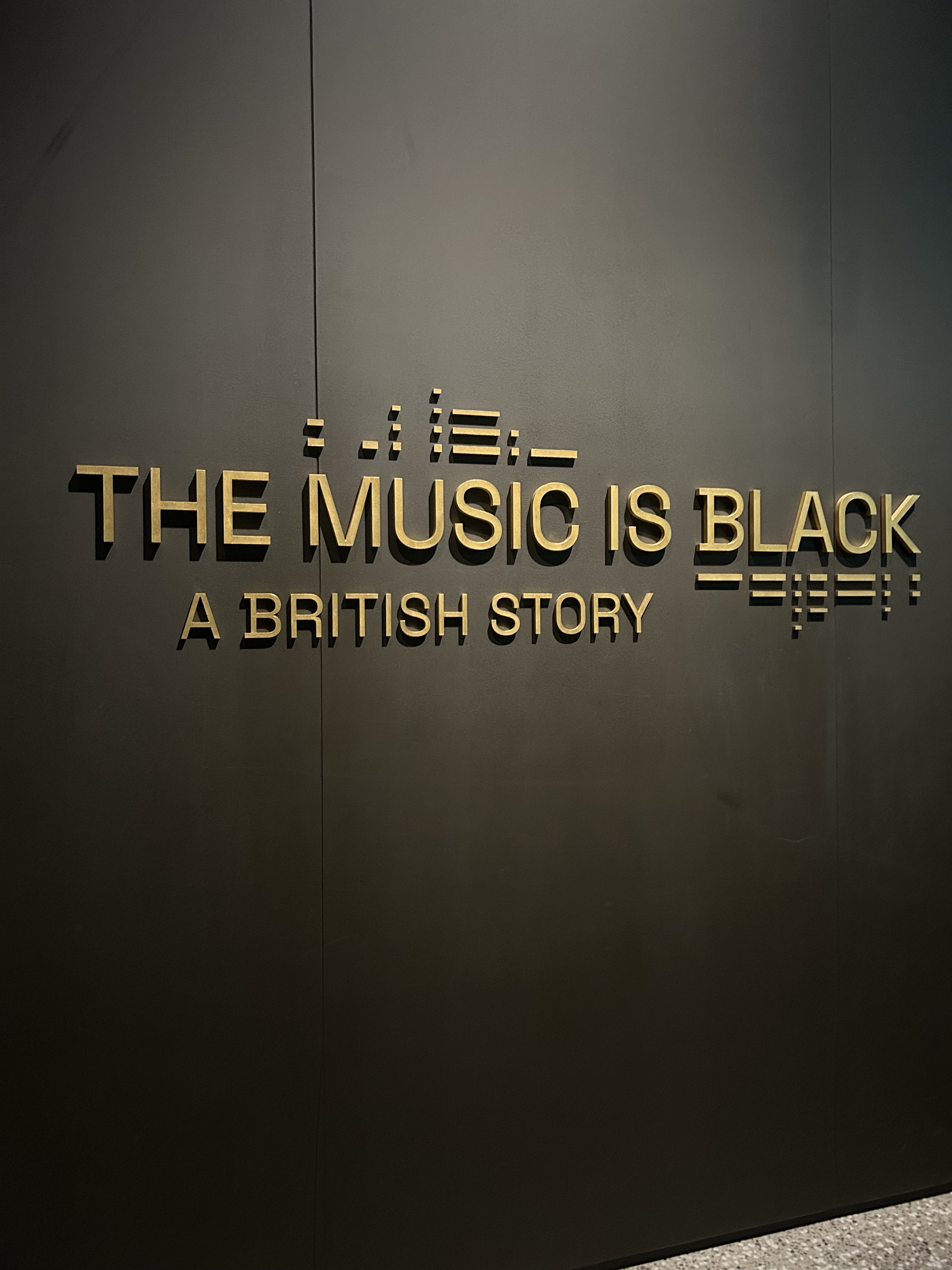
Exercising (of course), I would cycle through Queen Elizabeth Olympic Park in Stratford, or walk over during my afternoons – sick of being indoors. At the time a whole section of the Park seemed like a wasteland – vast areas were cordoned off, assigned, ready and waiting to be developed. You could hardly imagine then that this dormant, dusty place held the promise of the bustling, built future I found myself walking through in May. I was on my way to the newly opened V&A East, which had risen up phoenix-like, to see its opening exhibition; The Music is Black: A British Story.
Much of the music the exhibition celebrates is what I grew up listening to, so it felt really special to be there. I’d been looking forward to it for ages. The sounds of soul, acid jazz, jungle, drum and bass, trip hop, UK Garage and more besides, blasted from the small stereo in my bedroom, the headphones of my walkman, and later my mini-disc player. They carried me through school, university and beyond; in the background as I did my homework or studies and providing a soundtrack to so many significant moments and experiences. Perhaps because the music, with cultural roots disparate to mine, articulated something that felt vital and important, which I connected with – it confronted me and inspired me. Not only that it taught me about numerous lived experiences in Britain which were different to my own – and challenged notions of what might be ‘typically British’ including the formality and ‘stiff upper lip’ of so much of the British Establishment. It was an education, musically and otherwise.
Music in general was beginning to capture my imagination. On a Sunday night I would sit recording my favourite songs off the Top 40 (primed to press stop and record just in time to cut out the DJ), I was going to dance classes every evening after school, learning instruments, playing in groups or orchestras, and singing in choirs. Music was becoming a big part of my life and I was always listening out for those tracks and artists that I really enjoyed – I still am.
At primary school, we would spend break times making up dances in the playground to our favourite tunes which included pop, hip hop, rap, and inevitably, Michael Jackson – a genre all his own. He was a musical superhero to us, even if his fame-fuelled antics were becoming ever-stranger by the day. And while American culture had a huge influence on all of us growing up during the 80s (music, TV, fashion, footwear…), the London I was growing up in thrummed with sounds that had been inspiring and shaping Black British music for years. This was especially true each year at the Notting Hill Carnival, when generators and sets of speakers were loaded onto the backs of lorries and stacked up to make sound systems, sending their bass-heavy beats, with reggae and dub and more – reverberating through the local neighbourhoods. Caribbean culture was celebrated – especially at Carnival time – and I couldn’t wait to join the party.
While in my own family and culture there was little self-expression, in what felt like a truly organic put-the-music-on-and-just-start-dancing sense, elsewhere all I seemed to do was put on music and dance. The more rhythm and bass and groove it had the better and I sought it out. One of my first-ever albums was a gift from my older cousin: Soul II Soul’s Club Classic Volume 1 which she copied onto a blank cassette tape for me one summer afternoon. Holding it in my hands felt like I’d won the lottery. I listened to songs like Keep on Moving so much the cassette almost wore out. As I discovered more music I collected it wherever I could; copied, bought or borrowed – always asking for a new album for Christmas or birthdays. Among my growing stack of tapes and CDs was Aswad, Neneh Cherry, the Young Disciples, Incognito and then later came Goldie, Massive Attack, Smith and Mighty and Roni Size. I was so taken with the Bristol Sound that I moved to Bristol. And after graduating from the university I soon grew to properly appreciate the history and sounds of reggae, ska and two-tone thanks to one of my first jobs. One of the managers at the deli I worked in would play anything and everything from Trojan Records on the shop stereo whenever I was on shift with him – taking it upon himself to explain the music and its musical lore to me. And while working there one day I found myself making a deli sandwich for Mushroom from Massive Attack, and being so awestruck – even when he asked if we had any Marmite (sorry no) – that my knife sliced through the ciabatta I was cutting together with my hand – ouch.
And so it was that I arrived at the gallery entrance at V&A East to don my Sennheiser headphones, (which would sense my location in the space and trigger different tracks), and headed in through the doors to learn, reminisce and rediscover so much of the music I still love.
“Olivia Rodrigo’s third album, released on 12 June, is the unexpected outcome of listening to her gut. Now 23, she already had two critically acclaimed albums, Sour (2021) and Guts(2023), under her belt as she set about writing her new album. She was also in a brand-new relationship, and not just any relationship. She was happily in her first proper ‘adult’ relationship, and it promised to deliver all the inspiration and stimulus for an album dedicated to the heights and depths of being in love. Or so she thought.” Read more at Woman Alive…
Something was going on in 1976. 50 years ago, it was like things really took off, and I don’t just mean Concorde’s first commercial flight. And while Concorde was ultimately decommissioned, other ideas and initiatives launched that year have endured. Among them; the Olivier Awards, Aardman Animations and yes, even the Undercroft Skate Space on the Southbank. Iconic in their own way, all of them celebrate their 50th anniversaries this year. And it doesn’t stop there. 1976 signalled such a coalescence of creativity, innovation and energy that its momentum has kept on rolling – permeating society and shaping culture right up to the present moment.
Let’s look at some more iconic beginnings from the year that made us.
Punk Music
You can’t talk about 1976 without talking about Punk. And the UK simply wouldn’t be the same without it. This year marks 50 years since Punk burst onto the music scene with the release of The Damned’s single New Rose. Shortly followed by the Sex Pistol’s Anarchy in the UK released a month later. It’s important because Punk music set in motion a profound shift in approach: inspiring a movement where everyday people realised they could just do it themselves. They didn’t need to wait for permission to follow their dreams or watch on as others ran away with things. Punk music expressed a frustration with the status quo and sparked a sense of anarchy towards established systems and ways of doing things – in its wake a raft of activity followed. Punk was characterised by grassroots energy and a DIY ethos which would not only influence music all the way into the Trip-hop of the 90s and beyond, but very quickly overlap with fashion, art, politics and social justice to become a cultural movement that would change society forever.
Photo by Gu00f6khan Baykal on Pexels.com.
The Body Shop
1976 was also the year the Anita Roddick founded the Body Shop – a ‘small green shop’ in Brighton with a big mission to disrupt and change the beauty industry through making cruelty-free products. This was groundbreaking – a major contrast to the accepted and all-too-common practice at the time of animal testing. And although this continues in very limited ways, the Body Shop, together with Anita Roddick’s campaigning and activism did much to challenge and reduce its practice. The Body Shop started small – a way for Roddick to support her family through owning her own business and making her own products. But she restructured the business so that further shops could be added through franchise. Although the brand was hit by controversy when she sold it to L’Oriel for millions of pounds, in its heyday and throughout the 80s and 90s, it exerted a huge influence on a generation of beauty shoppers, who for the first time were forced to consider the way their products were made and better ways of engaging with the beauty and cosmetics industry.
Dame Anita Roddick outside the Body Shop via thebodyshop.com
Apple Computers
In 1976 Apple Computers was launched by a three college drop-outs in Steve Jobs’ parents’ garage. It’s hard to imagine that Apple – as cutting edge and culture-defining as it is – has been around that long: 50 years. If there was ever be a set of products that would go on to change society, it would be Apple’s products. With their alternative version – and vision – of the personal computer Apple created a brand synonymous with style and creativity. So beautiful that Apple would easily find its products featured in TV shows and films. And so versatile and user-friendly that there was little argument in the necessity of owning an iMac, iPad and iPhone… And it was Apple’s iPod that changed the music industry in 2001 with “1,000 songs in your pocket”. Forget the need for a cumbersome walkman that you invariably had to hold or clip on; an iPod slid right in to your pocket leaving your hands free. This was thanks to Steve Jobs being joined by product designer Jony Ives in the early 1990s – a collaboration of shared ethos, marketing and design flair which would win consumers’ hearts and minds. Apple knew how to create sleek products that attracted generations of loyal customers and created a whole new way of engaging with technology.
Photo by Armand Valendez on Pexels.com.
Rough Trade
Rough Trade launched in 1976 – another small shop, for music this time, on Kensington Park Road near Notting Hill. On its website Rough Trade hails the 1970s as a decade of “restless creativity” where music crossed borders and embraced multiple genres. While these genres developed as distinct in themselves, others soon took hands with each other, re-forming into new genres like Two-tone (combining Punk, Reggae and Ska) imbibing the fresh sounds of a new multicultural Britain, and challenging existing ideas of the time. It proved music wasn’t neutral. Nor were fashion and art, which characterised the emergent scenes almost as much as the music itself. Genres arising from Punk carried its DNA and just like it, soon became cultural agitators and disruptors too. But it was the music that fuelled the movement. Later, in the 90s, this same DNA would inspire the Trip-hop which drew on Punk, Dub, Reggae – to name a few – mashing them together like a musical collage to create something entirely new. For its part, Rough Trade has stayed synonymous with musical discovery ever since, championing artists, new sounds and physical media like vinyl, ever since 1976. And on annual days like Record Store Day – we get to celebrate what independent shops like Rough Trade do best: bring people together around music.
The interior of a Rough Trade record shop via MusicWeek.
My parents
1976 was also the year my parents got married. Yes, they will be celebrating 50-years-married later this year: their Golden Wedding Anniversary. And in theory – although I was all but a twinkle in their eyes (I appeared a few years later), I owe a lot to 1976 too. My existence was already being cued up as they walked down the aisle and said their vows. It was certainly a year that shaped me – quite literally – without it I wouldn’t exist at all. But it also shaped so much of the thinking and culture that we experience today and get to enjoy about our society. Punk especially signalled the freedom to try – to do it yourself and have a go. Not only does this encourage creativity, it also took power back from the Establishment and put it into people’s hands, igniting a sense of innovation and change that would ripple out across the decades right up to the present moment. And pervading so much of our culture, it’s hard to imagine what being ‘British’ is without it.
Not my actual parents on their wedding day…via Pexels.com.
In summary, it’s fair to say that life would look very different today were it not for the events of 1976. The wider socio-political context at the time, marked by upheaval and a whole set of frustrations, forced the need for change. Importantly this was change that started at a grassroots level – galvanised not only by music, but by the creativity and sense of permission it gave; soon becoming a wider movement with an unstoppable momentum. What a legacy it has given us. And if it was possible then, is it still possible now? Here’s hoping. We need it now more than ever.
Massive Attack’s debut album Blue Lines is 35. Wow.
Blue Lines is one of those albums that shaped my taste in music. As a teenager, Trip-hop just grabbed me and inspired me, together with the whole ‘Bristol Sound’ that Blue Lines embodied. It was a sound I felt I knew already from the music I had been into from a young age but it had never been imagined quite like this. It had all the influences I loved and it had that propulsive beat. Plus plenty of heart and soul. It had something to say too, it wasn’t neutral – I felt it stood for something important.
It would end up inspiring me beyond just listening to the music. At 18 I moved to Bristol for university – in large part because of the Bristol Sound and the whole Bristol music scene. I wanted to be part of it all. And I was, both as a music-lover exploring the music scene at club nights and gigs, and later as a musician – in a small way – playing local gigs at venues on the Bristol ‘circuit’. I’d often see Bristol’s musicians, including members of Massive Attack, around the city – but that’s just Bristol for you.
BBC6 Music have been covering Blue Lines’ anniversary and the legacy of this album. Listening to their ‘Deep Dive into Blue Lines‘ documentary on BBC Sounds I was reminded that Punk (along with Reggae, Dub and sound-system culture) hugely influenced Massive Attack’s sound, and the approach of a whole generation of Bristol musicians. In Cameron McVey’s words (who together with Neneh Cherry urged Massive Attack into the studio to record): “everyone I know from our generation in the Bristol scene got the first impetus from Punk to actually ‘have a go’. For me Massive Attack is a continuation of that smash and grab ethos of Punk where you take ideas and ideals from right, left and centre [and] mash them around into a weird kind of montage”. Punk’s influence cannot be underestimated – its DIY approach gave people such a sense of permission – and without that we wouldn’t have so much of the music and culture we’ve enjoyed over the last 50 years.
Up to the present day the sound of Bristol is influenced by a sense of resistance. Even though the music now differs from the ‘Bristol Sound’ of the 90s and noughties it carries this spirit within it. It is the sound of Bristol – quite literally.You can read more about the Bristol music scene: from Trip-hop to post-Punk and everything in between, (including the Punk that preceded it) in this piece I wrote on evolving the Bristol Sound. The common thread running through it all is Bristol’s spirit of resistance, which cannot be divorced from its music. Time and place – and the people involved with all of their own experiences – are critical. You wouldn’t have Trip-hop or the ‘Bristol Sound at all; were it not for when it all occurred and where – a collision of influences and people and experiences. It tells the story of the past and present, of a particular place and time – all distilled in and through the music.
On the 80th Anniversary of D-Day, I look back at the part my grandfather – Derek Prentice, played in D-Day, by announcing it to the world.
British troops landing on the beaches in Normandy on D-Day– Reuters
On 6th June 1944, as people in the UK were getting up and going about their morning routines; on the radio they would have heard news of the D-Day landings, broadcast to them by the ‘BBC Home Service’. It informed them of the extraordinary events that had taken place during the night, while they were still soundly asleep. However, this wasn’t the first announcement of D-Day.
Hours before, as 6th June 1944 was just beginning, and as the armada of ships and planes were making their way across the Channel, BBC newsreader Derek Prentice announced the first news of D-Day. It was broadcast to vast numbers of dedicated listeners on the ‘BBC Overseas Service’. As the broad term denoted, it reached audiences beyond Britain’s shores – all around the world. Derek Prentice was my grandfather.
Afterwards, he was told that his D-Day broadcast must have had 100 million listeners, reportedly the biggest radio audience in history at the time.
My grandmother shared this story with the BBC’s WW2 People’s War project in 2014. Throughout the war, Derek’s BBC news bulletins were broadcast across Europe and the world, to countries including India, Mauritius, Canada, the USA, Australia and New Zealand. Always beginning with the words: “This is London calling”.
To his global audience he was a well known and familiar voice during the war, synonymous with the BBC. In Europe his name was so recognisable that it was used to send messages amongst the resistance. In the book ‘Facing Fearful Odds’, journalist John Jay (writing about his father’s experience of captivity, escape and resistance during WW2) tells of a prisoner of war camp in Setzdorf where one prisoner had acquired a radio receiver. Possession of such devices was punishable by execution.
Jay describes how the POWs there had “managed to tune in to the BBC European Service, with its announcement: ‘Here is the news read by Derek Prentice’.” He continues: “Prentice had gained legendary status in occupied Europe, where people used his name as code. Whispered questions such as ‘Have you heard from Derek today?’ would be an invitation to disclose the contents of BBC broadcasts. At Setzdorf, the main points of each transmission would be scribbled down and distributed”, as look-outs kept careful watch for the guards.
In other parts of the ‘British Empire’ including Canada and Australasia, people listened anxiously for news of the allies’ position and progress in the war. For them Derek was the voice of Britain. With a reassuring and authoritative quality, his voice signalled to listeners around the world that victory would come sooner or later. As the war raged on, claiming millions of lives – people needed hope. He read the BBC news throughout, right up until the end of the war.
Derek Prentice at the BBC microphone – a treasured family photograph.
Prior to working at the BBC, my grandfather had been an actor. His interest in theatre had begun during his time studying French and German at New College, Oxford (which followed his schooling at Winchester College). He initially became an engineer upon graduating, but he was so passionate about acting that he was able to persuade his parents to support this true vocation. Years later, working in London – including the West End – he was put out of work by the outbreak of war in 1939, when the theatres closed. As a linguist, he first went into censorship; then turned his acting training, and vocal talent to radio. He got a job with the BBC where he frequently worked the nightshift as a news reader. One particularly treasured family photograph shows him at the BBC microphone. After the war, he returned to acting, working across theatre, radio, film and television.
He was a hugely popular newsreader and his many fans across the world would send letters and gifts to him and his young family (his wife, Katherine and their two daughters) in beleaguered Britain . He would share these gifts with his colleagues – there was more than enough to go around. Other published reminiscences we have found echo that he was a recognised and much-loved radio voice of the time.
My mother and I have been trying hard to track down the original recording of that D-Day broadcast. Our many attempts to obtain a copy included approaching the BBC, who were very helpful but unable to locate the original recording. However, recently in April this year, we reached out again to the Australian Broadcasting Commission, who had featured the broadcast in a programme marking the 70th anniversary of D-Day in 2014. We were delighted to be told this time that they could make their recording of that original shortwave radio broadcast available to us. And with the BBC’s permission they have just released a copy of it for our personal use.
It’s wonderful to hear my grandfather, who I never met (he died before I was born), announcing such a pivotal moment in history; one we now know would lead to the end of WW2.
Walking through the City on a cold February day, with Liverpool Street station behind me; I look for glimpses of the Barbican’s unmistakeable brutalism peering out between the surrounding glass and steel. Its architecture a monument to post-war rebuilding and a vision of 1980s aspirational living (it opened in 1982), it serves as a counterpoint to the austerity that revealed itself in the ‘winter of discontent’ of 1978-9. The late 70s were largely characterised by an influx of migrants, trade union strikes, brewing racial tensions and anti-government protests; creating an atmosphere not dissimilar to that of the last few years, and paved the way for the nascent Thatcherism that soon followed.
On an otherwise-average weekday, the Barbican is buzzing when I arrive. Navigating the Escher-like maze of walkways, hallways and stairways is easier than it seems. Soon I find the Barbican Music Library – a quiet haven sequestered within the main library. Here is the reason for my visit: a lovingly curated exhibition charting the rise and influence of Two-tone; the multicultural music genre which signalled that racial integration was not only possible – it was serious fun.
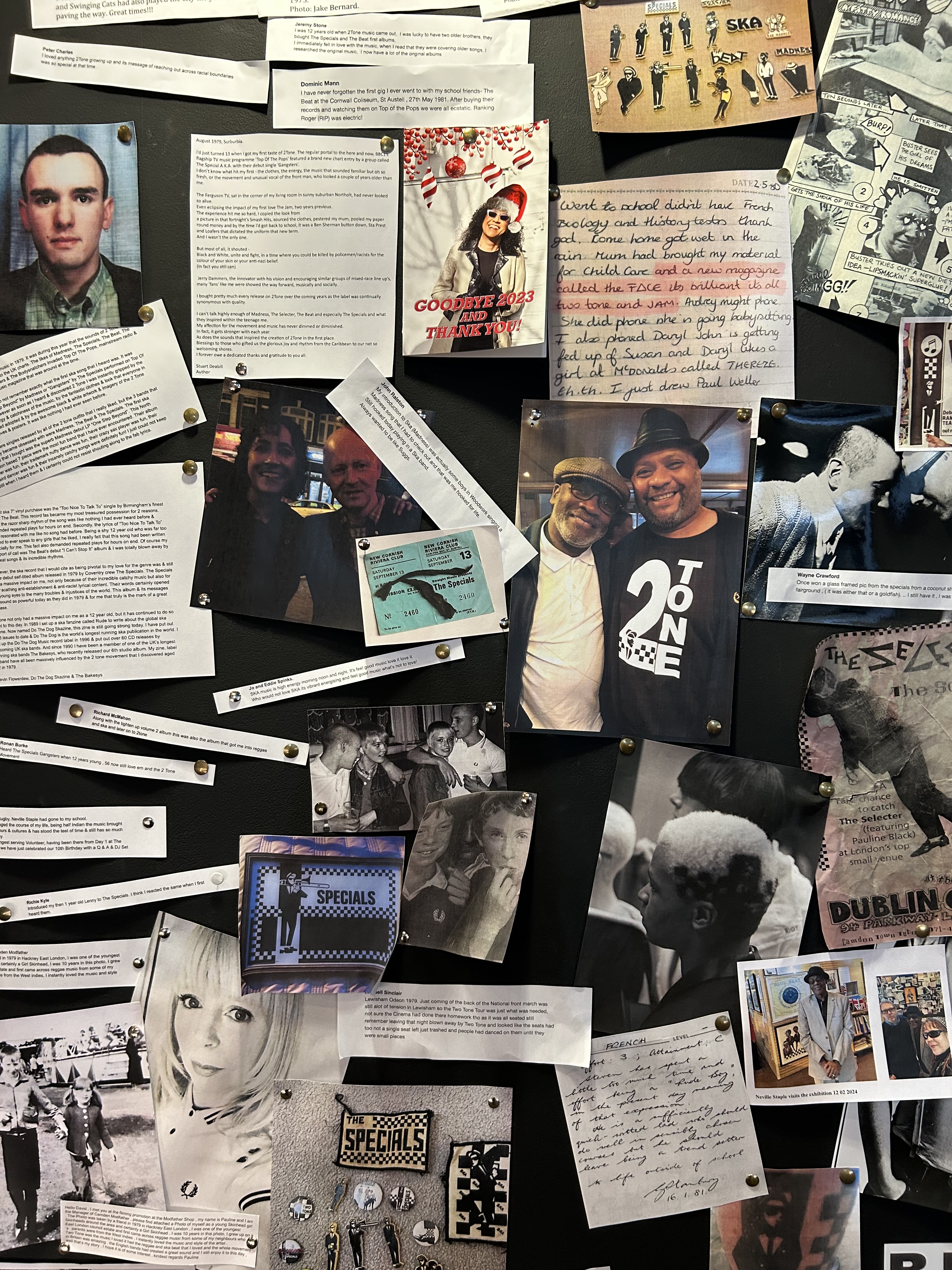
The exhibition celebrates Two-tone music and the whole cultural scene that surrounded it; featuring an impressive array of memorabilia, stories and reminiscences from musicians, writers and plenty of fans. These are not only to be found in the displays – where individual stories tell of unforgettable experiences, but also in the pages of the visitors’ book packed with more memories of those times. The evident gratitude people feel for the exhibition and the opportunity to collectively remember, makes it clear that this is something special.
It also serves up a rich slice of recent British history and pays tribute to those who travelled to the UK from the Caribbean to support the war efforts of the first and second world wars, and to rebuild war-torn Britain afterwards. Amongst this contribution to British society, was the music which laid the foundations for Two-tone and more besides.
2 Tone Records – the eponymous music label, was launched by Jerry Dammers of The Specials in 1979. Based in Coventry it attracted groups and performers who had embraced Jamaican ska, rocksteady, reggae and dub – brought to the UK from the Caribbean, and combined it with Punk, and New Wave, music synonymous with the UK . This fusion came to define the two-tone sound. Though the label itself was short-lived (closing in 1981 after only two years); it left an indelible mark on the UK’s musical, and socio-political landscape.
Delving into the wider context: war-time evoked strong feelings of patriotism across the British empire of the time. And thousands of men from the West Indies volunteered to fight against Britain’s enemies, eager to contribute to the war effort. Expecting to join established British regiments, they were kept back from active combat in WW1, and instead assigned to labouring and logistical roles until King George V intervened. As a result the British West Indies Regiment was formed as a distinct unit. Remarkably 15,600 men enlisted from across the Caribbean forming 11 battalions; with Jamaica contributing the majority. Three battalions were deployed to Egypt. While playing a ‘supporting role’ in the theatre of war, they fought the Ottoman Turks in Palestine and Jordan, distinguishing themselves by their courage and skilfulness in the particularly challenging desert conditions. This marked a turning point in British military history, including and recognising the essential contribution of non-white troops to the overall war effort.
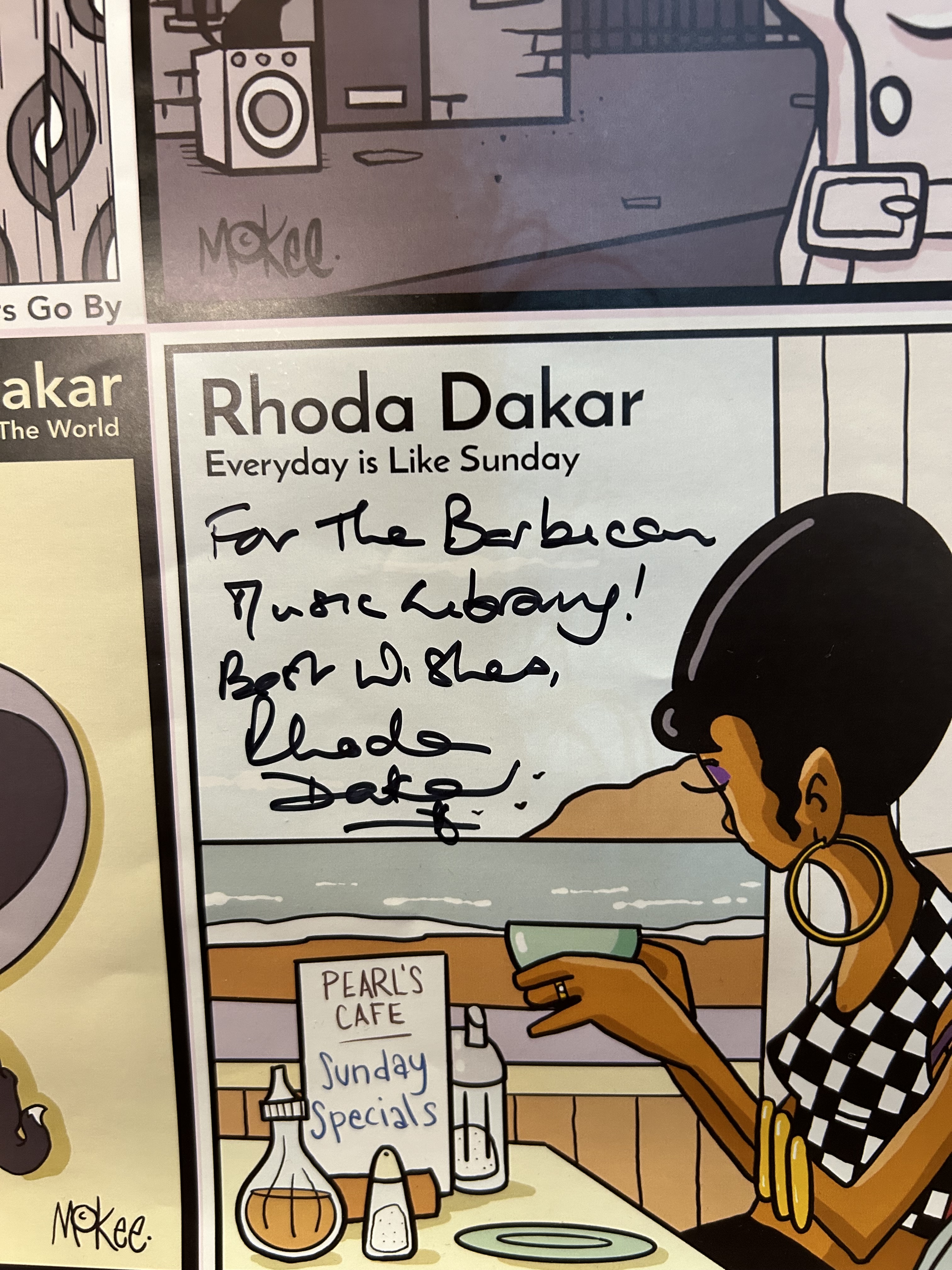
Lead singer of the Bodysnatchers, Rhoda Dakar – a major contributor to the exhibition, shares her family’s story – especially that of her father Rudolph Dakar, known as André. It is intrinsically woven through the events of wartime Europe: “My father, having joined the British West Indian Regiment and gone off to Europe to fight in WW1, returned to Jamaica with his Military Medal but never settled. He arrived in London but left to travel around Europe; France, Belgium, Italy and all the way to Hungary.”
In the 1920s André and his french-speaking Belgian wife – a pianist, settled in Paris where he built his music career, penning lyrics and writing songs. In the Paris of the 20s and 30s he was celebrated alongside other artists and luminaries of the time such as Louis Armstrong and Josephine Baker – his contemporaries in the Paris jazz scene. However, the outbreak of WWII forced him and his wife to the UK (he held a British passport). However, they weren’t received or celebrated in the same way they were in France. Rhoda describes his comparison of Paris and London: ‘He always said “in France if you speak French, you’re a Frenchman. In England you’re just another black man”’.
Nonetheless, André Dakar made his way in London, and became a well-known figure emceeing a music night called The Antilles, and subsequently hosting a jazz club in Piccadilly. Rhoda remembers that he was always impeccably turned out. He was also fully furnished with stories of the politicians, actors, journalists, artists and musicians he encountered, including the occasional clandestine visit from a royal. During the 50s and 60s he turned to film and television which included appearing in The Avengers and Danger Man.
Another featured story is told by the broadcaster, writer and DJ, Tony Minvielle. His dad arrived in 1960 from St Lucia, securing a job as a printer – unusual for a person of colour – and was working his way up to becoming a Master Printer, attending the London College of Printing. His mum arrived in 1961 (also from St Lucia) and became a seamstress. But in 1966 his father was hit by a car, and tragically died of his injuries. This left his mum (then only 23) to raise Tony on her own, who managed with the help of several ‘aunties’ and working multiple jobs, but it wasn’t easy. When she faced racism she face it head-on, with an approach of “no messin’”. Soul and reggae music was always playing on their ‘radiogram’ at home; and Tony recalls how joyful and soothing he found it.
In their reminiscences, fans of Two-tone recall the influx of Jamaican culture into the UK, and how it made an indelible mark on life in London, and other cities – like Bristol – with significant Caribbean communities. Memories include hearing Ska and Bluebeat blaring from windows in London’s east end, seeing “snappily dressed [Jamaican] rude boys hanging out on street corners” speaking in Jamaican patois – and being irrepressibly drawn to the culture, readily adopting its style and music.
Photo by AuthorPhoto by AuthorPhoto by AuthorPhotos, recollections and memorabilia at the Barbican Two-tone exhibition
Many recollections focus on 1979, when Two-tone music burst onto the UK scene. Highlights were of seeing The Specials – either live, or on Top of the Pops, and how they embodied this new youth movement combining British and Jamaican heritage; the music, the clothes and the sensibilities – bringing the two cultures together (which the documentary ‘Dance Craze’ details). And this in stark opposition to the extreme nationalism and racism promoted by the National Front and similar organisations.
It can’t be emphasised enough how important Two-tone was to society at the time – both politically and socially. Britain in the late 70s was a burgeoning multicultural nation. But for the most part young people weren’t overthinking things; they were just mixing and absorbing each others’ cultures. Many of those who got into Two-tone, already had their musical roots in Punk – and were open to exploring new sounds. In fact, embracing a changing UK was to increase the energy, vitality and political relevance of Punk. David Burke who curates the exhibition with Mark Baxter shares that: “If punk was my first crush, then ska and soul would be my life partner, my religion and my guide, to hopefully living a life that embraced all cultures and influences.”
The name ‘Two-tone’ was derived from the racial mix of the groups, as well as the black and white outfits they wore; emblematic of their mission and values. It offered a beacon of hope amidst the racial tensions. But the vision of multiracial harmony epitomised by the bands just couldn’t be matched by their audiences. Fights would regularly break out in venues, often sparked by interlopers who fundamentally disagreed with what they were witnessing on stage – and who resisted it as a genuine vision for life in the UK. Rhoda Dakar tells of a gig she performed with the BodySnatchers which had to end abruptly because of fighting in the audience. Events like this would eventually signal the end of Two-tone, because they couldn’t continue on.
In the end several bands, including the BodySnatchers, broke up in despair of the situation. And 2 Tone Records shut down in 1981. But as this exhibition shows, its legacy remains; not only in the music and memories, but in a set of values which welcomes immigrants to the UK, embraces their multicultural influences, dares to create something new, and in so doing adds a greater richness to society.
TANGK album cover artwork. Courtesy of partisanrecords.com
Opener ‘Idea 01’ sets the tone with a lighter more lyrical feel. Dispensing with the reinforcing guitar-on-bass-on-kick-drum which characterises their distinctive sound; the open syncopated rhythm is disarming. Piano carries more of the percussive weight of this album too, also marking a more melodic direction. It builds to such a dense flurry in places that it’s almost overwhelming.
They continue their use of distortion, synths and electronic sounds from their previous album, Crawler. It intensifies with ‘Gift Horse’ – less raw, and more richly layered. The texturing creates a polyphonic soundscape, a welcome reprieve from the singular pile-driving rhythms, no longer needed to drive their point home.
But still marching forward nonetheless, always in motion.
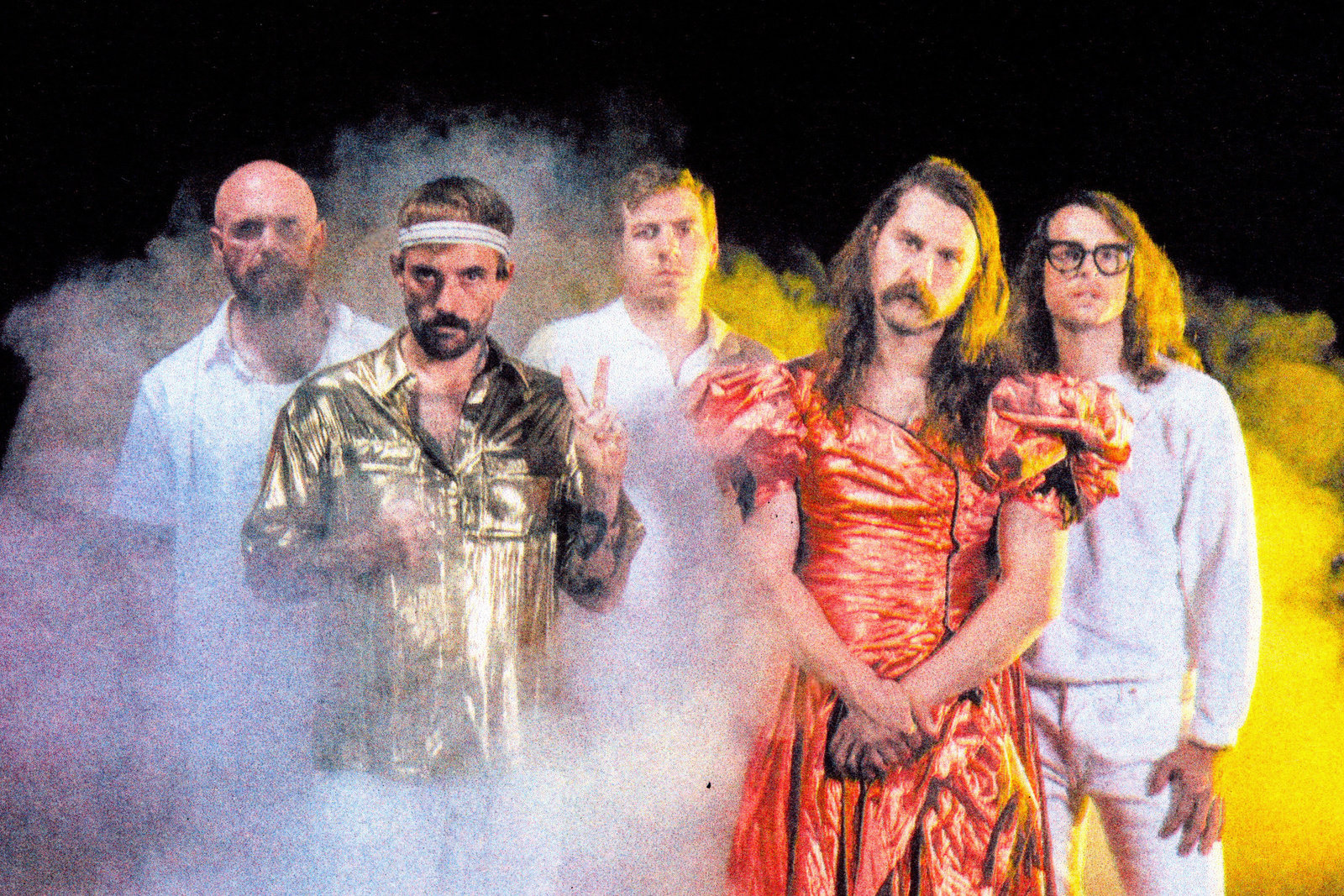
Lead singer Joe Talbot is singing these days too, rather than shouting. His melody lines soar above the instruments. You can’t talk about IDLES without Talbot. He is the driving force and energy. A relentless kick drum in human form, he’s evidently more at rest now. More reconciled. No longer caught up in the thick of his trauma and triggered anxiety.
Their music has found its soul – looked itself in the mirror and discovered an interior life. Even in the high energy songs, there is a meditative quality. And there’s unquestionable joy too.
‘Pop Pop Pop’ makes you want to dance. Could that be said about their previous albums? Jumping, stomping perhaps… but dancing? No. It soars, it inspires: “Love is the thing”, Talbot sings.
‘Roy’ is a nostalgic 50s ballad, tempered by heavily distorted guitar. There are shades of rock and roll and references to the Kinks in song ‘Hall and Oates’. While ‘Grace’ channels Manic Street Preachers and Radiohead.
Talbot sings in a purring falsetto showing his vocal versatility to imbue lyrics with any emotion he chooses. You lean in as he repeats, “Love is the thing”.
Nostalgia is there in ‘Dancer’ too, a collaboration with LCD Soundsystem. The rush of strings at the outset evokes romantic old musicals, soon interrupted by thudding drums and pick-struck bass – “cheek to cheek and hip to hip” (a chorus of voices sing). Though the darker themes still tug, this album undoubtedly expresses a newfound freedom.
On ‘Gospel’ it’s hard not to picture late-night sessions at an old piano. It’s a more soulful sound, worshipful even. There’s an ethereal bitter-sweetness too.
Is Talbot still angry? I don’t know. But it’s more reflective now, empowered, repentant – the sober judgement that comes after the big fight. This is where you make your decisions and set your intentions. You have found your clarity.
‘Jungle’ combines all these elements, with a characteristic sense of urgency. “Save me from me, I’m found I’m found I’m found”, Talbot sings inferring a spiritual journey. From cosmic abandonment to coming home. Finally feeling heard, ‘Gratitude’ picks it up with driving metronomic beats, and thrashing guitars.
The final song ‘Monolith’ imposes itself with distorted piano and guitar strings struck like deadened bells. Metallic and space-like, it has an otherworldly quality. It ends implausibly with saxophone – a subtle reference to John Coltrane.