The Music is Black

Seven years ago, when I lived in Stratford, V&A East was barely a dream. It was 2020, the early stages of COVID and a really a weird time. Attempting to contain the spread of the coronavirus, the government had mandated that people could only leave their houses once a day to exercise, otherwise they had to stay at home. That meant no socialising outdoors, and strictly no sitting on a park bench unless you were exercising – figure that one out.

Exercising (of course), I would cycle through Queen Elizabeth Olympic Park in Stratford, or walk over during my afternoons – sick of being indoors. At the time a whole section of the Park seemed like a wasteland – vast areas were cordoned off, assigned, ready and waiting to be developed. You could hardly imagine then that this dormant, dusty place held the promise of the bustling, built future I found myself walking through in May. I was on my way to the newly opened V&A East, which had risen up phoenix-like, to see its opening exhibition; The Music is Black: A British Story.

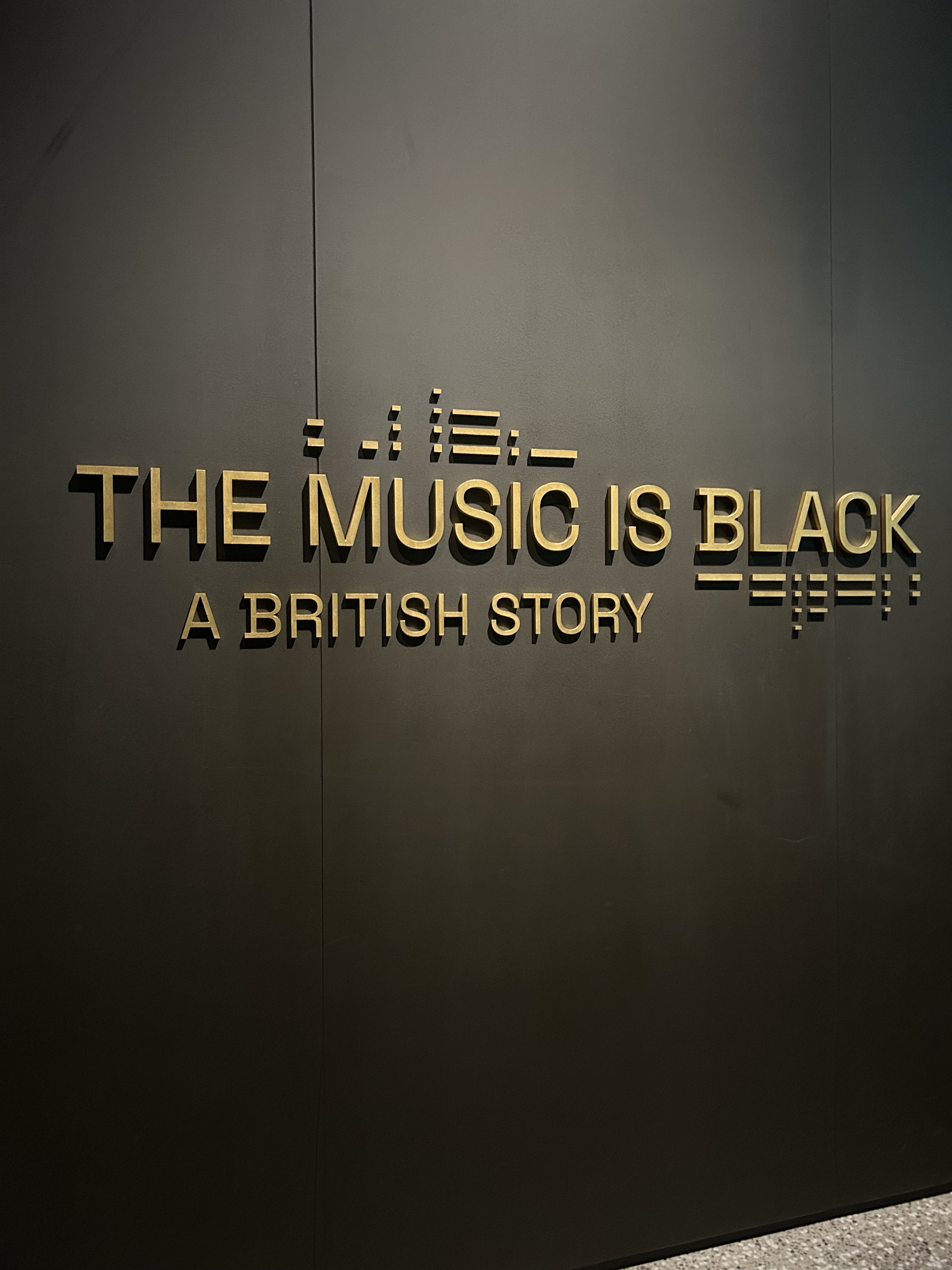
Much of the music the exhibition celebrates is what I grew up listening to, so it felt really special to be there. I’d been looking forward to it for ages. The sounds of soul, acid jazz, jungle, drum and bass, trip hop, UK Garage and more besides, blasted from the small stereo in my bedroom, the headphones of my walkman, and later my mini-disc player. They carried me through school, university and beyond; in the background as I did my homework or studies and providing a soundtrack to so many significant moments and experiences. Perhaps because the music, with cultural roots disparate to mine, articulated something that felt vital and important, which I connected with – it confronted me and inspired me. Not only that it taught me about numerous lived experiences in Britain which were different to my own – and challenged notions of what might be ‘typically British’ including the formality and ‘stiff upper lip’ of so much of the British Establishment. It was an education, musically and otherwise.

Music in general was beginning to capture my imagination. On a Sunday night I would sit recording my favourite songs off the Top 40 (primed to press stop and record just in time to cut out the DJ), I was going to dance classes every evening after school, learning instruments, playing in groups or orchestras, and singing in choirs. Music was becoming a big part of my life and I was always listening out for those tracks and artists that I really enjoyed – I still am.

At primary school, we would spend break times making up dances in the playground to our favourite tunes which included pop, hip hop, rap, and inevitably, Michael Jackson – a genre all his own. He was a musical superhero to us, even if his fame-fuelled antics were becoming ever-stranger by the day. And while American culture had a huge influence on all of us growing up during the 80s (music, TV, fashion, footwear…), the London I was growing up in thrummed with sounds that had been inspiring and shaping Black British music for years. This was especially true each year at the Notting Hill Carnival, when generators and sets of speakers were loaded onto the backs of lorries and stacked up to make sound systems, sending their bass-heavy beats, with reggae and dub and more – reverberating through the local neighbourhoods. Caribbean culture was celebrated – especially at Carnival time – and I couldn’t wait to join the party.

While in my own family and culture there was little self-expression, in what felt like a truly organic put-the-music-on-and-just-start-dancing sense, elsewhere all I seemed to do was put on music and dance. The more rhythm and bass and groove it had the better and I sought it out. One of my first-ever albums was a gift from my older cousin: Soul II Soul’s Club Classic Volume 1 which she copied onto a blank cassette tape for me one summer afternoon. Holding it in my hands felt like I’d won the lottery. I listened to songs like Keep on Moving so much the cassette almost wore out. As I discovered more music I collected it wherever I could; copied, bought or borrowed – always asking for a new album for Christmas or birthdays. Among my growing stack of tapes and CDs was Aswad, Neneh Cherry, the Young Disciples, Incognito and then later came Goldie, Massive Attack, Smith and Mighty and Roni Size. I was so taken with the Bristol Sound that I moved to Bristol. And after graduating from the university I soon grew to properly appreciate the history and sounds of reggae, ska and two-tone thanks to one of my first jobs. One of the managers at the deli I worked in would play anything and everything from Trojan Records on the shop stereo whenever I was on shift with him – taking it upon himself to explain the music and its musical lore to me. And while working there one day I found myself making a deli sandwich for Mushroom from Massive Attack, and being so awestruck – even when he asked if we had any Marmite (sorry no) – that my knife sliced through the ciabatta I was cutting together with my hand – ouch.

And so it was that I arrived at the gallery entrance at V&A East to don my Sennheiser headphones, (which would sense my location in the space and trigger different tracks), and headed in through the doors to learn, reminisce and rediscover so much of the music I still love.

The Music is Black is on at V&A East until 10 January 2027.

© Alexandra Noel. All rights reserved.

Olivia Rodrigo is listening to her gut

Olivia Rodrigo lying in a field of flowers in an image from her album you seem pretty sad for a girl so in love.

“Olivia Rodrigo’s third album, released on 12 June, is the unexpected outcome of listening to her gut. Now 23, she already had two critically acclaimed albums, Sour (2021) and Guts(2023), under her belt as she set about writing her new album. She was also in a brand-new relationship, and not just any relationship. She was happily in her first proper ‘adult’ relationship, and it promised to deliver all the inspiration and stimulus for an album dedicated to the heights and depths of being in love. Or so she thought.” Read more at Woman Alive…

The Flimsy of “Wuthering Heights”

Jacob Elordi and Margot Robbie in Wuthering Heights wearing black in Yorkshire.

All that wind might blow Wuthering Heights away

On a very wet and blustery Sunday afternoon I went to see Emerald Fennell’s “Wuthering Heights”, which opened in UK cinemas on Valentine’s Day. And let me tell you; those quotation marks, insinuating its loose affiliation to the original book, are absolutely necessary. In this article I’m sharing my immediate impressions of the film. There’s at least one more article coming which looks at other aspects in greater depth.

Interpreting the text

Firstly, if you have never read the book, it doesn’t matter – because this film bears little resemblance to it. I had this fact quickly corroborated by the two young women sitting in the audience next to me when I asked them for their opinion. And then later when I reviewed and checked the plot when nothing seemed to… check out. But “Wuthering Heights” is not designed to be an accurate adaptation. It is entirely Fennell’s own interpretation of Emily Brontë’s book. And based – as I can well imagine – on a particular way it made her feel as a young person. So in that respect at least, it is entirely faithful to her experience. She has said in interview that this is the film her 14-year-old self would have made. And honestly, it shows. It is full of nostalgia for the crushes and dreams and whimsy that play like a collection of posters on a teenage girl’s bedroom wall; the excitedness of sleepovers, coming-of-age films and emotive chart songs… and boys.

It is also perhaps the story a 14-year-old would have wanted to read. Instead of its bleak reality which never satisfies Catherine and Heathcliff’s obsessive longing for each other, meaning their love is never consummated – not even close. Fennell’s decision to gratify many-a-reader’s own longing and deliver up the passionate love affair that never actually happened, changes things entirely. In that sense, this film is a total revision of Wuthering Heights, imagining a parallel world for these two unrequited lovers. It’s very Sliding Doors. To help achieve this she has removed certain characters, changed timelines and focused only on Volume 1 of the book. In Fennell’s version, the romance-that-never-happened is now vital and centred, and propelling the characters towards the same star-crossed doom as Romeo and Juliet. And altogether avoiding the novel’s deeper message and significance.

Music montages and big feelings

One of many things I wasn’t expecting was that a large portion of the film would dispense with any meaningful plot development. And be given over to a series of montages – styled in a way that can only be described as ‘1980s music-video’. It’s probably no accident that Charli xcx’s album which accompanies the film is full of synths and breathy, choral sounds – think Enya or T’Pau. Montages aim to cover a lot of storytelling in a short time – but the film relies heavily on these to convey the pair’s desperate desire for each other, as well as its consummation. The music videos of those aforementioned artists, plus the Bangles, Madonna and others (Billy Idol even), offer up the right type of romance thanks to their billowing curtains, countless candles, and studio backlighting – as well as overacting those Big Feelings. In the end, it was beginning to feel a bit like a parody, and the much-lauded eroticism of the sex scenes seemed to fall flat. Frankly it left me cold.

Then there are other moments which, for me, evoke 80s films like The Never Ending Story, itself traumatising a whole generation of children just as much as the Brontë sisters’ work – Jane Eyre anyone? And also The Princess Bride. And of course, Kate Bush is in the mix too. Her own avant garde interpretation of the book gave us her song by the same name. But she too – according to the women I spoke to after watching the film – had mis-sold them on the romance of the book. 

Aesthetics and religious overtones

The 1980s seem a good lens to unite the aesthetics, including bright colours, big hair and bigger jewellery, harnessing all the opulence of the era to supercharge the Georgian-Victorian-Edwardian looks worn, especially by Margot Robbie’s Cathy. It’s a hodge-podge of influences but it works. Emblematic of this – and used to great effect – are the crucifixes; a nod perhaps to the book’s religious overtones and Victorian morality which produce the context for some of its bleakest moments, and its most repressed emotions. Her bejewelled cross resembles those worn by Madonna, in white wedding dress, during her Like a Virgin performance at the MTV Video Music Awards in 1984. This use of religious icons rankled the Catholic church, but inspired swathes of adoring teenage fans to adopt her look. It filtered out across the high fashion and music of the decade. Utilised in collections by Christian Lacroix, Chanel and Karl Lagerfeld, its design drew from the Baroque era to make it become synonymous with 80s fashion. Madonna wore Christian Lacroix for Like a Prayer‘s album artwork, shot by Herb Ritts, albeit more muted than his catwalk couture. Nonetheless, it echoes Margot Robbie’s historically-inspired outfits – bodices and all. In terms of costume, it’s to designers like these, and others like Mugler, Alexander McQueen and Vivienne Westwood that Fennell has looked for inspiration, and for many of the high fashion moments she orchestrates, artfully staged in their own right (but jarring with the film overall). Meanwhile, Heathcliff’s outfits simply observe the tradition of Brontë’s time. But the gold-tooth and earring are enough to give him the air of a pirate plundering his treasure.

[Scroll down to keeping reading…]

Madonna in her Like a Prayer era wearing Christian Lacroix for a Herb Ritts photoshoot - for an article by Alex Noel, writer and digital marketer.
A 1980s female model on the catwalk wears an outfit by Christian Lacroix - for an article by Alex Noel, writer and digital marketer.
Margot Robbie wears a white dress against a blue background in a still from the film "Wuthering Heights" - for an article by Alex Noel, writer and digital marketer.

Providing further crossover with Robbie’s costumes and appearing at least, to inspire much of life in the Linton household, is the saccharine Victoriana of Tim Burton’s Alice in Wonderland. Even down to several outfits worn by Robbie which remind me of the Queen of Hearts. Cathy more than evokes Helena Bonham-Carter’s spoiled sense of entitlement in the way she treats ‘her’ Heathcliff, whom she proudly named as if he were her pet. And in much the same way that the queen treats her grovelling subjects; Cathy is screaming and petulant when she doesn’t get her way. Meanwhile, the tables at Thrushcross Grange groan under a spread of food in keeping with the boastful excesses of the Victorian era. This is told by one particular shot which slowly zooms in towards Margot Robbie seated at one end, over a banquet of confectionary including towers of sweetmeats, macarons and aspic jellies. It doesn’t miss a beat in calling to mind the Mad Hatters tea party with its exuberant colours, outlandish creations and well, madness.

Cinematic references

In amongst all this is Fennell’s obvious affection for golden-era technicolour romances, even if it does mildly poke fun at them too. Much like the Coen brothers did in their film Hail, Caesar! it sends up the style of the time – overacting and all. In that film a subplot features a group of Marxist writers who kidnap the star of the film whose screenplay they’ve written, in a conspiracy which aims to exploit the studio system. As a result, the Coen brothers critique both capitalism and communism with equal irony. In light of this, it is interesting that there have been several Marxist readings of Wuthering Heights, a candidate for this by being written just as the industrial revolution was firmly taking hold, and noticeably in West Yorkshire where the book is set. Its capitalist goals soon to change forever the agrarian community Emily Brontë writes about. 

Aside from this there are lighter moments of slapstick comedy, in the spirit of Singing in the Rain. Speaking of rain: there is an awful lot of it. As one internet commentator put it: “‘Yorkshire’ in the film looks as though it suffers from permanent monsoon. The Yorkshire tourist board must be thrilled.’’ The production designer, Suzie Davies speaking to Architectural Digest (ArchDigest) on Instagram explains how they built a composite set as “a throwback to those 40s and 50s-type films” where the whole environment was built within a studio. The ‘wet look’ they give much of the set is about more than just the weather (though wind and rain effects were going in nearly every scene, she says). The tiles on the buildings were finished in high gloss: “we wanted the whole environment to feel really wet and sweaty and moist” as if “even the walls were sweating, crying or extruding some kind of bodily fluid.” Which neatly circles back to that bathroom scene in Emerald Fennell’s previous film – Saltburn

This film does seem made more for stage than screen; so much so that I wonder if I can see the sets wobbling, especially at wind-battered Wuthering Heights, which sits in a dramatic high-sided ravine perpetually assaulted by the elements. But I also wonder if Emily Brontë herself saw her characters acting this story out, the book is a little too hyperbolic to only live on the page. But perhaps it was inspired by hyperbolic characters – I’ve heard Lord Byron’s poetry mentioned more than once as a major inspiration for her writing. And whose heroes (‘Byronic’ as they were) would likely have been on her own bedroom wall, had she lived in the 1980s. Nonetheless, under all that gloss, Emerald Fennell’s film still lacks cohesion but it is “Wuthering Heights” after all. And though it is flimsy, it does have its own sense of robustness.

© Alexandra Noel – all rights reserved 2026

The eternal light of LUX

Rosalìa’s new album, LUX, is one to inspire devotion

Rosalìa's album cover for LUX, featuring her in a while top and nun's habit - for an article by Alex Noel, writer and digital marketer.

“If there was ever an album to inspire devotion, it would be LUX by Rosalía. Since its release on November 7th, it has been received to rapturous applause. And not for the reasons you might expect. LUX (which means ‘light’ in Latin) doesn’t tick a set of boxes guaranteed to win over audiences or aim to please an algorithm…” Read more at Woman Alive magazine.