
Music that moves you: from determined resistance to inspiring change
When Massive Attack played their first Bristol show in 5 years – on August 2024 – it provided the perfect excuse to look back. At how the Bristol Sound has evolved from the Trip-hop that first defined it, to encompass Idles’ post-punk and everything in between. And to consider afresh what it all really stands for.
A lot has happened in Bristol, and elsewhere – since Idles released their 4th album, Crawler in November 2021. And I certainly wasn’t the first person to notice that it opened with an obvious nod to mainstays, Massive Attack: “You might initially think you’ve accidentally put on Massive Attack’s Mezzanine with opener ‘MTT 420 RR’ heavily referencing ‘Angel’ by their fellow Bristolians”, wrote The List’s review in 2022.
And that’s not where the similarities end.
The ‘Bristol Sound’ has always been more than the trip-hop that came to define it in the 90s. And equally it’s more than its evolution over the last few years to include Idles’ post-punk prominence.
Idles and the changing Bristol Sound
Releasing their 5th album, TANGK, in February, there’s no question that Idles have established themselves as a force to be reckoned with. Are they mainstream now? No, not yet. Still, they’re probably the first name that springs to mind for many when it comes to the Bristol music scene.
But as Idles continue their meteoric rise, Massive Attack remain steadfast – they’re not backing down. They play their first UK show in five years on August bank holiday weekend. From Bristol’s Clifton Downs they will look out over a musical landscape much altered since their last outing. And yet entirely congruent with Bristol’s unique musical history. What could Idles possibly have in common with them – apart from that creeping intro section?
While Idles’ music is nowhere near the ‘Bristol Sound’ popularised over 25 years ago, it still sounds like Bristol all right. It draws from the same well of resistance and independence that has fuelled the Bristolian attitude for years, and has been variously expressed by bands like Smith & Mighty, Tricky and Massive Attack, not to mention drum and bass outfits like Roni Size’s Reprazent, and many more.
The wider scene, while less well-known, has always included metal, folk, rock, punk, indie and country too. And arguably there’s been more of a shift towards these in recent years. Those watching Bristol’s music will be all too aware of Americana star Yola, who sang with Massive Attack (under name Yolanda Quartey) in her early career, and arrives at her current success by way of the hugely underrated Bristol country band, Phantom Limb.
Living and playing music in Bristol
The richness of the music scene had me happily living in that great city for 12 years, even dabbling in it as a musician myself; and never short of new music to discover. Bristol’s music has always been a blend of rich cultural influences. The city’s post-punk evolution is intriguing, especially if you were immersed in the music scene of the late 90s and noughties. But punk sensibilities are deeply rooted in Bristol. Not least in the fact that Bristolians are fiercely protective of their city – successfully resisting the attempts of insistent corporates to infiltrate it over the years.
One such attempt on Gloucester Road – gracefully winding its way north from the city centre and full of independent shops and businesses – was met in 2011 with local residents firebombing a new Tescos. Renowned Bristol artist Banksy paid homage to the city’s energy in one of his street murals: the words ‘The Mild Mild West’ set above a cuddly teddy bear readying itself to chuck a Molotov cocktail at police carrying riot shields. You get the idea.
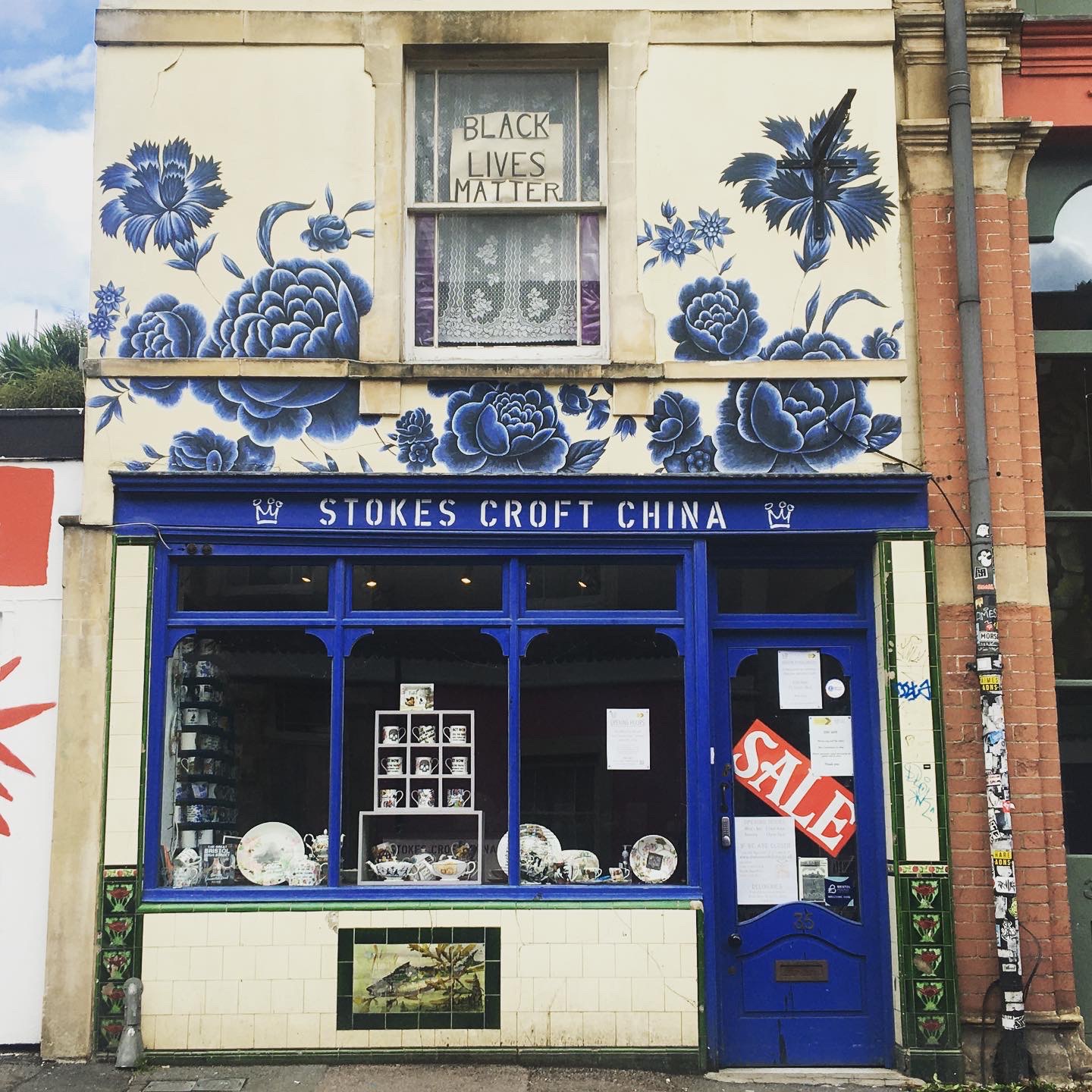
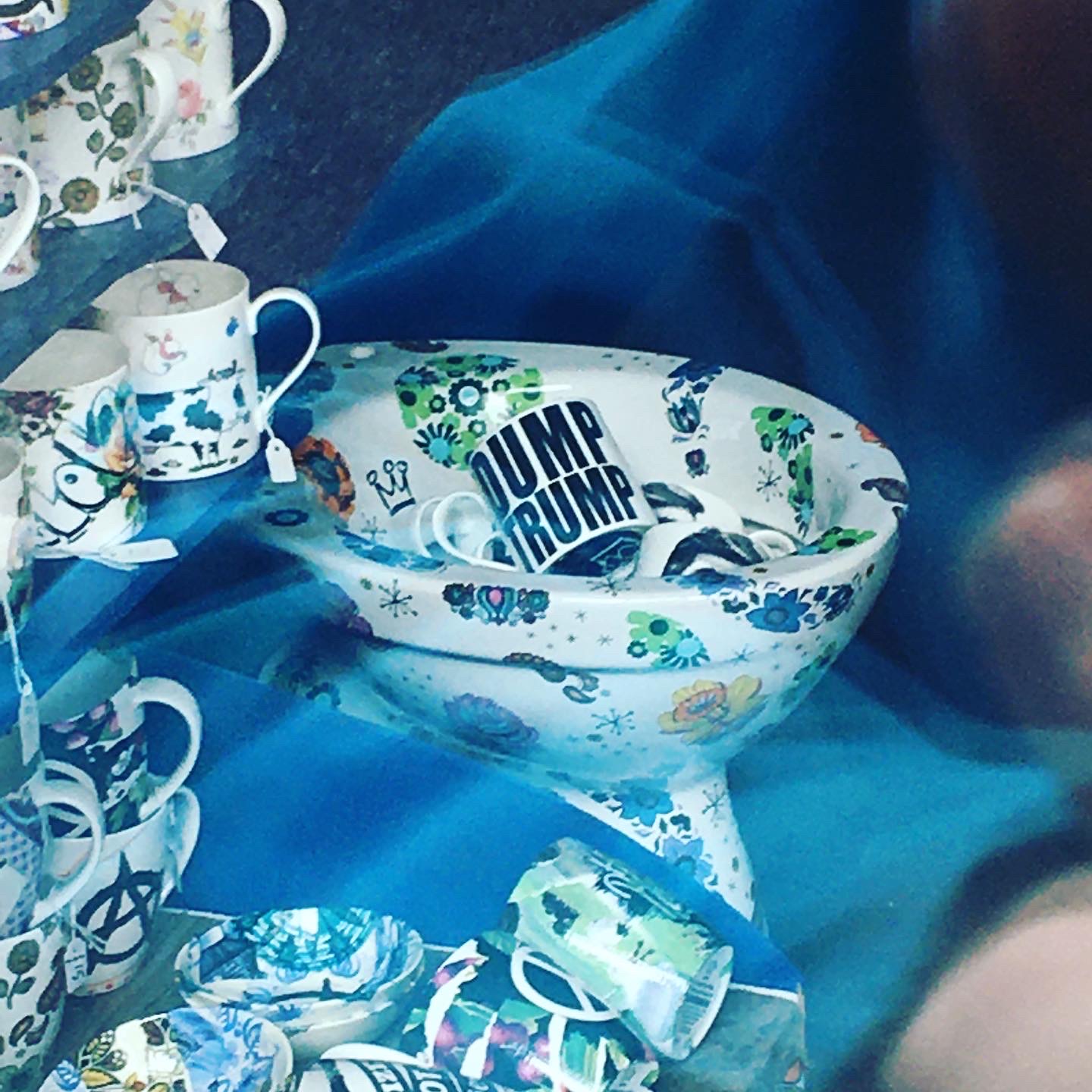
As if to drive the point home, the china shop across the street makes a colourful selection of porcelain mugs and homeware – decorated with socialist slogans. Perfect for that delicious cuppa – served up with a slice of anarchy perhaps. For me the piéce de ‘resistance’ was a mug I saw there in 2020 emblazoned with the slogan ‘Dump Trump’ – neatly positioned for display in a porcelain toilet bowl.
Doubling down on resistance
During the Covid years, Bristol doubled-down on this resistance. It has continued to fight off commercialisation, and has thrown itself against one big issue after the other; protesting against Brexit, the Climate Crisis, the city’s legacy of Colonialism and Slavery, with thousands coming out in support of Black Lives Matter and later Ukraine.
A seminal moment happened in 2020 when the statue of slave-trader, Edward Colston, who had financed and lent his name to numerous landmarks in the city – was toppled from its position in the city centre and thrown into the river. Suddenly, former-Mayor, Marvin Rees, was all over the national news. He stated that despite the criminal damage, it was important to have empathy and listen to such protestors. And ordered the disgraced statue be retrieved and stored as a lesson for posterity.
A subsequent sculpture by eminent artist – Mark Quinn (of BLM protestor, Jen Reid) put in place of it without permission – was removed by Bristol City Council within 24 hours. Rees announced that whatever replaced the original statue would be decided pending a public consultation. (Banksy, who by nature has never asked permission, remains).
Many of these same issues have been addressed in Idles’ rage-filled song lyrics too, many of which strongly critique class struggle, capitalism, toxic masculinity, mental health and the idea of protest itself. And so it would seem that the anger and dis-establishmentarianism of the punk era has found a vital new resonance. A sure reason for the band’s success. It is music with an energy and metre that cries out for change.
Even in the 90s and noughties, trip-hop’s fusion of influences was credited as being “music for our globally aware and culturally fragmented times”. While it may have captured the times it didn’t challenge them in the way Idles have over the last few years.
Breaking the mould
But Idles are adamant that they are not activists, though their lyrics would say otherwise. Through Covid and BLM they were thoughtful, and gave voice to the angst shared by countless fans. And when the Israel-Palestine conflict erupted more recently, they were co-opted into this cause. Fans assumed their music would automatically translate into an active political stance on the issue. But they resisted – if their music is about activism, it’s very much on their terms. They will be the ones to define it, and to decide how and when (at Glastonbury this year as it turns out).
Lead singer, Joe Talbot stated in a Rolling Stone interview in January that: “We are not activists. I am concerned with the human condition and how that affects each other, and I use music to connect it to the world”.
Idles have resisted the post-punk label too. In 2017 off the back of their breakout album, Brutalism, Talbot said: “We’re not a post punk band. I guess we have that motorik, engine-like drive in the rhythm section that some post punk bands have, but we have plenty of songs that aren’t like that at all.”
Massive Attack have also resisted their trip-hop label, finding it limiting to the point of saying, “It doesn’t describe our music at all”. Neither band wants to be defined. Their rejection of these monikers gives them more in common than music ever could, both unconsciously shaped by the city’s values.
Despite shunning the punk label to evolve their sound (as their new album shows), Idles still sits firmly within the post-punk milieu. Like the post-modernism of the late 20th century, they have broken punk down further and further which each successive album – they query its tenets, asking how it could be reimagined.
On TANGK they continue to use the distortion and synths first introduced on Crawler, but they also hark back to punk’s foundations on this album with songs referencing 50s rock and roll.
Confronting the issues
With the issues, political or otherwise, that Talbot has addressed; perhaps they have gone further than punk ever could in confronting them. Exasperation with the Tory government, wrestling with questions of what it means to be a man, Talbot’s own, at times overwhelming, sense of grief and personal loss, and his journey with mental health issues, have all ultimately become a means of self-reflection. Talbot now holds up a mirror both to himself and society.
The political energy in their music isn’t so much that of the Clash and the Sex Pistols – though they’ve been compared to them often enough. Yes the repetition in their lyrics stands like protest chants – but they’re not those of anti-government rallies. It’s the angry objections spoken by frustrated families in tidy living rooms that we hear.
They’ve been called out for being middle class – the Sleaford Mods have criticised them openly for appropriating punk from the working classes. But even the middle classes can become disenfranchised. And Talbot rightly gives voice to that.
Idles have captured that angry impotence and powerlessness that convinces you that all you can do is rage and vent. That’s what happens when no-one is listening any more. Talbot has become more and more reflective over these five albums, admitting that he’s less about changing things ‘out there’ and increasingly focuses on changing himself. This has come by way of his mother’s death, and his first daughter being stillborn, all prompting his own torturous self-examination.
This album is geared even more decidedly towards self-reflection and personal healing. Perhaps that’s the way real change happens anyway. On TANGK Talbot is empowered and clear – no longer shouting but with a gravitas that makes you lean in and listen to what he’s saying.
Musical heritage rooted in Bristol and beyond
Both bands can trace their musical heritage to a fusion of influences rooted in the 60s and 70s that have created the diversity of today’s ‘Bristol Sound’. Emerging in the late 70s in rejection of mainstream rock and roll music, punk was already politically charged. By then in Bristol, sound system culture had taken off thanks to the arrival of migrants from the Caribbean who have continued to have a huge influence on the city’s (and UK’s) music. Bringing with them reggae, dancehall, rocksteady; and dub – its progeny the trip-hop of the 90s. In turn punk absorbed reggae – the sound has both recombined with other influences and also remained distinct.
On TANGK Idles call back to the rock and roll which inspired punk in the first place as well as imbibing the distortion, synths and electronic sounds more often associated with Massive Attack and their counterparts. And vice versa, Massive Attack’s Robert del Naja (aka 3-D) noted in an interview that their album Mezzanine: ““really did bring in all the elements that made us,” he said. ”Funk, soul, reggae, hip-hop and punk thing – it was all there.””
These Bristol cousins undoubtedly share common DNA. The ‘Bristol Sound’ has been described as “possessing a darkness that is uplifting, a joyful melancholy”. Though different, both Idles’ and Massive Attack’s music is certainly that.
TANGK continues to capture this juxtaposition, still it is a different beast from Idles’ early days, taking ground towards a sense of reconciliation, self-empowerment, joy and love – a long way from their first album, which was angrier, darker and more frustrated.
Evolving the Bristol Sound to take action
This marks the evolution of their message and sound, and of themselves – especially that of Joe Talbot. I can’t help but think that we’ve gone on this journey with them. That we’re getting better at processing our anger and at finding ways to communicate our frustrations: at looking at ourselves first before attacking others.
It remains to be seen what ‘Act 1.5‘ will bring as Massive Attack re-enter the musical fray. But it seems they’ve been taking notes – the ‘Climate Action Accelerator’ will address the climate crisis and sets out to be the lowest carbon show of its size. Maybe actions will speak louder than words in their case.
As the ‘Bristol Sound’ continues to evolve, it is not only becoming older and wiser, but an increasingly compelling voice for change, embodying its possibilities and rewards. And perhaps what unites Idles and Massive Attack more than anything is a shared belief that it’s invariably better to ‘be the change you want to see’.
© Alexandra Noel – All Rights Reserved – May 2024
 Alex Noel