Interview with London-based florist, Jessie Watson
“When Jessie Watson launched her eponymous flower business, ‘Jessie Watson Flowers’ in early 2023, it was the culmination of a passion that couldn’t help but grow even though she had a fulfilling life in London. “I’ve always loved the idea of doing something creative with my hands as a job”, she says, “[and] working with something beautiful.”” Read more at Woman Alive Magazine…
New Year, new you! Or perhaps we need a whole new identity?
Listen to the talk here – recorded 19th January (NB moderate audio quality), or read below:
New Beginnings
‘New Year, new you!’ We’re really familiar with this now. And it’s everywhere at the moment.
It is true that the beginning of a new year offers us a new start. We can finally turn the page on last year, including any of its failures, embarrassments and disappointments. ‘This year is going to be different’, we tell ourselves.
We feel hopeful for our newly adopted exercise regimes, diets, healthy eating plans, or January fasts, plus any newly discovered productivity hacks etc. So many things right now are being recommended, promoted or sold on the promise of becoming a ‘new you’. Although I think people are getting wise to these advertising strategies, we’re all yearning for a bit of self-improvement and who doesn’t want to become their ‘best self’?
A new version of ourselves
Then there are new beginnings that require a whole new version of us. Or that a new part of ourselves emerges, or an existing part gets dialled up. New jobs will require new skills, as do new contexts – we will all at times need new ways of understanding, and new ways to communicate with people. Not to mention learning new technologies and new ways of operating – it’s something I had to do when I changed my career a few years ago.
These life-moments which produce a new version of us might include, moving house, moving to a new city, getting engaged, getting married, or having children. Those of you who are parents will probably remember how you felt when you first held your son or daughter, and in what ways being a mother or father has changed you. Similarly how marrying someone and setting up home starts to require new things of you – which can be exciting and challenging all at the same time. No matter your relationship status – single, married, divorced or widowed there are always new callings and new phases of life we have to embrace – all of which present some kind of new beginning. Asking that we become a new version of ourselves in some way.
For all of us, living through a pandemic has changed us. As has our journey together as a church community over the last few years. As well as completing a season of life, saying farewell to friends, facing illness, caring for loved ones – these are all experiences that require us to become a new or different version of ourselves. Usually for the better, but sometimes it can feel for worse – at least for a while.
But these experiences don’t fundamentally change who we are – we might learn new habits, or ways of doing things; we may grow or expand around our circumstances but our essential personhood remains unchanged. We are still ‘us’. With our various quirks and foibles. And unfortunately our sinful natures. We’re shaped by a whole range of factors which affect the way we respond to things, our thought patterns and the conclusions we draw about ourselves and others, as we navigate life. And we get comfortable. That’s our identity – ‘it’s just who I am’, we tell ourselves. And that can be depressing. Especially when we strive to change ourselves and it doesn’t pay off. What we need is more than just a new version of ourselves – we need a new identity.
A new identity brings resistance
As we heard last week, the Exodus saw the Israelites leave Egypt where they had been enslaved for generations. They witnessed an increasingly severe set of plagues as God turned the screws on Pharaoh to let his people go. When they left Egypt they fled across the parted waters of the Red Sea, and then moved through the desert from camp to camp as they followed a pillar of cloud by day and the pillar of fire by night, for 40 years. Apparently this journey would only take 11 days if they’d walked in a straight line. But this journey was about more than covering distance, they needed to become a new people with a new identity. And they just couldn’t seem to let go of their old identity as slaves in Egypt. So much so, that when the Promised Land was so close they could touch it (literally they’d brought back samples of the produce) they couldn’t enter into it.
When the twelve spies had gone into the land to suss it out. Ten of them spread a bad report. The people grumbled, freaked out and then even started to organise! They were not going to the Promised Land. In Numbers 14v2 they said: “If only we had died in Egypt! Or in this wilderness! Why is the Lord bringing us to this land only to let us fall by the sword!” They thought it was better to go back to Egypt, v4: “And they said to each other, “We should choose a leader and go back to Egypt”.
As they stood on the cusp of a new beginning, most were too intimidated by what stood before them and believed the negative reports of ten of the spies, spread amongst them. They looked with fear, rather than faith – at the land before them – the land that God was promising them.
A new identity produces new ways of seeing
But two of the spies saw with eyes of faith – Caleb and Joshua. Though they saw the same things there; they had an entirely different interpretation of what they saw. They urged the Israelites to have faith – they were so close! Later in Numbers 14 they said: “The land we passed through and explored is exceedingly good. If the Lord is pleased with us, he will lead us into that land, a land flowing with milk and honey, and will give it to us. Only do not rebel against the Lord. And do not be afraid of the people of the land, because we will devour them. Their protection is gone, but the Lord is with us. Do not be afraid of them.”
But it was to no avail. They refused to listen. God was exasperated at the contempt they showed for him. This was more important than his own glory. And I just want to underline the meaning of contempt because its something that God takes seriously (and so should we): the feeling that a person or a thing is worthless or beneath consideration – disregard and disobedience. These are rooted in contempt.
God had forgiven them but there still had to be consequences. This is another example of where God has boundaries. He is a Person. “No one who has treated me with contempt will ever see [the Promised Land].” The eldest generation that left Egypt would die in the wilderness and only their children would see it. He then told them that they would spend 40 years in the wilderness, one year for every day that the spies were in the land.
And then God said – and I think this is really critical: “But because my servant Caleb has a different spirit and follows me wholeheartedly, I will bring him into the land he went to, and his descendants will inherit it.” Numbers 14:24 NIV And then again: ““Not one of you will enter the land I swore with uplifted hand to make your home, except Caleb son of Jephunneh and Joshua son of Nun.” Numbers 14:30 NIV
The ten spies died by plague and when the Israelites tried to enter the promised land in their own strength the Amalekites and Canaanites who lived in the hill country beat them back. They didn’t succeed. And so they wandered for 40 years, that whole first generation dying in the wilderness except for Caleb and Joshua.
A different spirit means a brand new identity
Joshua and Caleb had a different spirit and wholehearted followed the Lord. They had shed their pasts and their old identities, they were no longer slaves. They had a brand new identity.
Identity was always a struggle for ancient Israel. And it can be a struggle for us to. One of the fathers of ancient Israel was Jacob. And Jacob was a man struggling for identity. As a young man he impersonated his older brother Esau, stealing his identity – this was the original identity theft; in order to obtain his elder brother’s birthright. Then a whole set of trials and circumstances humbled him – until he could articulate his core complaint to God – the heart of the issue. It led him to a confrontation with God – wrestling him (or an angel or Jesus?) in frustration and desperation. His deepest desire/complaint was that wanted God to bless him: “I will not let go until you bless me!” Then Jacob was renamed Israel – and it’s from him whom the people of Israel took their name.
So here they were, standing on the cusp of this realised blessing, the Promised Land. But there were still fundamental issues of identity holding many back from entering into the very blessing their forefather Jacob wrestled with God for all those years before. And I think it can be the same for us.
My own wrestle has been with being creative. And allowing myself to embrace who God has made me to be. It wasn’t particularly validated in my family despite there being plenty of creative and its been an existential journey to step into it. I had to embrace a new identity to be who God created me to be.
The ‘new beginning’ of our promised land demands more of us, it demands not just a new version of us but that we have a new identity. And even that we are renamed. Our identity is under constant threat, and it can cost us like it did the Israelites who rebelled, so wedded were they to their old, wrong identities as slaves from Egypt.
Foreshadowing things to come
The different spirit found in Caleb and Joshua, foreshadows what the prophet Ezekiel would say many years later: “I will give you a new heart and put a new spirit in you; I will remove from you your heart of stone and give you a heart of flesh. And I will put my Spirit in you and move you to follow my decrees and be careful to keep my laws. Then you will live in the land I gave your ancestors; you will be my people, and I will be your God.” Ezekiel 36:26-29 NIV
In turn this foreshadowed the outpouring of the Holy Spirit in Acts, as foretold by the prophet Joel: “And afterward, I will pour out my Spirit on all people. Your sons and daughters will prophesy, your old men will dream dreams, your young men will see visions. Even on my servants, both men and women, I will pour out my Spirit in those days. I will show wonders in the heavens and on the earth, blood and fire and billows of smoke. The sun will be turned to darkness and the moon to blood before the coming of the great and dreadful day of the Lord. And everyone who calls on the name of the Lord will be saved; for on Mount Zion and in Jerusalem there will be deliverance, as the Lord has said, even among the survivors whom the Lord calls.” Joel 2:28-32 NIV
What does it mean for us?
For us this means becoming as a child of God. And having our identity in Christ.
There can be many things that cause us to question our identity – rejection, struggle, our personal deserts, suffering, unemployment, heartbreak… Experiences and circumstances can force us to question ourselves – including upheavals, loss, relational issues, change – anything that destabilises us. But God’s unchanging invitation to us is to place our identity in Christ. And he will unsettle those things which we begin to form our identity around – be it a job, a person, a church, our hobbies and interests even which define us. Any answer we might provide to the question ‘Who am I?
The incredible thing about placing our identity in Christ – is that this identity supersedes every other identity we could possibly have. Be it gender, sexuality, relationship status, work, our national identity, racial identity, cultural identity, educational, denominational… who you know. It’s the most freeing thing ever to take on this brand new identity. Identities become labels, they can be reductive, they can be excuses we make: ‘that’s not me’, they can be limitations, they can be exclusionary… I’m a mum now I can’t let loose on the dance floor for fear of my ‘mum dancing’. I’m single and don’t have children – I can’t contribute to the kids ministry. I’m old, that counts me out of contributing, I’m young – what do I possibly have to say?? There is one identity that matters and that is our identity in Christ and it supersedes all others and sets the precedent; once and for all answering the question – Who am I?
The Work under the work
It’s something that Tim Keller mentions. He talks about: “the work under the work”. That in all our striving and attempts to change and improve ourselves, achieve and drive ourselves forward – become our ‘best selves’ we are trying to answer the question, Who Am I. But placing our identity in Christ takes care of our fundamental identity so that we don’t have to strive to define ourselves.
In his letter to the Galatians, Paul explain this: “So in Christ Jesus you are all children of God through faith, for all of you who were baptised into Christ have clothed yourselves with Christ. There is neither Jew nor Gentile, neither slave nor free, nor is there male and female, for you are all one in Christ Jesus. If you belong to Christ, then you are Abraham’s seed, and heirs according to the promise.” Galatians 3:26-29 NIV
New beginnings invite us into a new identity. And the ultimate new beginning is our new identity in Christ. In so many ways that is our Promised Land.
And so rather than going back to what we knew, we move forwards, into the new things God is doing. In many ways we’re still travelling, but it’s alway from glory to glory. And so we press on because God has a higher calling for us beyond our ‘new year, new you’ goals and beyond becoming our ‘best self’. We are to become children of God through faith with a new identity in Christ.
Isaiah 43:19 sums this up, calling back to Joshua, Caleb and the wilderness years of Israel. Our new identity is forward facing and our old identity is firmly behind us. So many times we’re told not to look back – to forget what’s behind us: “This is what the Lord says— he who made a way through the sea, a path through the mighty waters, who drew out the chariots and horses, the army and reinforcements together, and they lay there, never to rise again, extinguished, snuffed out like a wick: “Forget the former things; do not dwell on the past. See, I am doing a new thing! Now it springs up; do you not perceive it? I am making a way in the wilderness and streams in the wasteland.” Isaiah 43:16-19 NIV
And so we press on. In more words of Paul’s from his letter to the Philippians: “Brothers and sisters, I do not consider myself yet to have taken hold of it. But one thing I do: Forgetting what is behind and straining toward what is ahead, I press on toward the goal to win the prize for which God has called me heavenward in Christ Jesus.” Philippians 3:14 NIV
And that’s a new year goal worth having
The singer Bob Dylan is getting a lot of airtime at the moment because of the new biopic featuring Timothée Chalamet. He wrote an amazing set of gospel songs as well as his other music, and I want to play one of them to you. The version we’ll hear is sung by the Chicago Mass Choir but do listen to the original one sung by Bob Dylan too. Listen below.
Listen to the talk here – recorded 23rd June 2024 (NB moderate audio quality), or read below:
A number of biblical characters blazed a trail ahead of Christ – somehow pointing to or depicting key aspects of Jesus’ character, purpose or ministry. Other words and phrases to describe this are ‘prefiguration’ or ‘type of Christ’ or ‘forerunner’. These are like echoes that go across the Bible showing us something about Jesus, and acting as signposts towards him. See also Things Can Only Get Better which looks at Noah’s story.
Now, things are about to get really interesting because we’re going to look at Ruth, and how she blazed a trail for Christ. It might sound unusual to think of Ruth as a ‘type of Christ’. Because we often think of Boaz as the Christ-figure in this story – don’t we? But it’s Ruth we’re considering here, which is really exciting.
How I’ve come to view Ruth
In my particular echo chamber and my algorithm of life – which, I’ll say is somewhat (and inevitably) informed by being a single/unmarried woman in church, though what I experience is felt more widely too. The story of Ruth holds a particular – slightly uncomfortable – meaning for me. And this isn’t based on the Bible, this is more informed by church culture and wider culture too, and is something I’ve imbibed.
Ruth is a story about: a poor, sorry, single woman whose only hope is to marry a man. And who, after much misfortune is finally seen and noticed and taken pity on by Boaz. Who is a Good Man and agrees to rescue her because she cannot do that for herself. And after making a rather unorthodox approach at the Threshing Floor (more on that later) he agrees to marry her, and they live happily ever after. The End. Isn’t that the story?!
Romantic tropes and fairytales
It’s very much a damsel-in-distress/ knight-in-shining-armour trope – it’s still a very present idea in western culture. And it’s a cultural blueprint for relationships. But we all know that relationships aren’t like that in reality in the day to day grind of doing life with someone. But we still have this Disney idea and idealism about relationships.
But, the Bible offers us a higher ideal. And this story if we look closely will show us what that ideal is.
And Ruth is a beautifully constructed piece of literature – it has a fairytale format but it subverts this and shows us something else entirely.
Setting the scene
Ruth 1v1: ‘In the days when the Judges ruled, there was a famine in the land. So a man from Bethlehem in Judah, together with his wife and two sons, went to live for a while in the country of Moab.’
This sets our scene. The very last verse of the book of Judges – Judges 21v25 – explains: ‘In those days Israel had no king; everyone did as they saw fit.’ So it was pretty lawless, and it wasn’t a Godly time. The man was called Elimelek. The fact his family was from Bethlehem immediately connects this story to Jesus. They were a family displaced by famine.
Elimelek dies in Moab, leaving his wife Naomi widowed, with her two sons in a foreign land. They marry Moabite women – somewhat naturalising. And then both of her sons die after about 10 years of living there, we don’t know why but their names suggest it was from illness; Mahlon means ‘sick or sickly’ and Kilion means ‘failing’.
Naomi is utterly bereft, she doesn’t ‘belong’ there and she has been thrown together with her two daughters-in-law – two Moabite women.
In Ruth 1v6 Naomi hears that: ‘the Lord has come to the aid of his people by providing food for them’. The famine is over and she can finally go home. All three widowed women return to Judah. After accompanying her, she encourages her daughters-in-law to return to Moab to their own mothers’ homes. It’s a bit like she’s shooing them off. And while Orpah obeys and returns home, Ruth doesn’t obey, and insists that she stay with Naomi, asserting herself in v16: ‘”Don’t urge me to leave you or to turn back from you.”‘
Very early in this story Ruth shows a strength and determination which is noteworthy, and unusual.
She makes a covenant with Naomi, and with her people saying; ‘”Where you go I will go, and where you stay I will stay. Your people will be my people and your God will be my God. Where you die I will die, and there I will be buried.”‘ Again, we don’t know why but she has settled it within her heart, and won’t be dissuaded. This points us to how Jesus covenants himself with his Church. And how God covenanted himself with Israel. The unusual thing here is that Ruth is a Gentile, she is not an Israelite.
What’s in a name?
The name Ruth means ‘Friend or Companion’. We see how she stands with Naomi – providing that support and being her ally in difficult circumstances. And Jesus too is our friend who sticks closer than a brother, our companion. He says in John 15:13: ‘Greater love has no-one than this: to lay down one’s life for one’s friends’.
They didn’t have male any protectors or providers and Ruth shoulders this for her mother in law. I would say in the absence of a husband but I’m reluctant to – this ability and quality is always present in women— married or single, and it’s in Ruth.
Ruth acts in a Christ-like covenant friendship towards Naomi, laying down her life for her.
Bitterness versus hope
Ruth 1v19 says; ‘When they arrived in Bethlehem, the whole town was stirred because of them, and the women exclaimed, “Can this be Naomi?”.’
‘”Don’t call me Naomi [which means Pleasant]”‘ she told them. ‘”Call me Mara because the Almighty has made my life very bitter. I went away full, but the Lord has brought me back empty.”‘
Naomi is bitter, and blames God for all her misfortune. Have you ever spent time with a bitter person? It is hard work! Which makes Ruth’s decision even more interesting.
Notice the stark contrast being Naomi and Ruth. Ruth has had similar misfortunes – she’s lost her own husband too, plus her brother-in-law and they would have likely been a close family unit. But she shows no signs of bitterness. Even in this first chapter Ruth is a hopeful figure. She appears to place her hope in the God of Israel – deciding that her future lies with Naomi, and with God’s people. That God will protect her and provide for her. Unlike Naomi who has become a bitter victim of her circumstances.
We too can place our hope in Jesus, who always writes a better story for us through his death and resurrection.
As the Barley Harvest Begins
They arrive in Bethlehem, v22: ‘just as the barley harvest was beginning…’
Ruth 2v1 tells us; ‘Now Naomi had a relative on her husband’s side, a man of standing from the clan of Elimelek, whose name was Boaz. And Ruth the Moabite said to Naomi, “Let me go to the fields and pick up the leftover grain [let me go and glean] behind anyone in whose eyes I find favour”. Naomi said to her, “Go ahead, my daughter”.’
Ruth is polite and deferential towards Naomi, but she doesn’t need permission to do this. Ruth is the initiator here, not Naomi.
Gleaning is mega-resourceful. In rural cultures, it’s a great way to earn extra cash. And this is something Jesus and his disciples would do as well many years later.
Dignifying the Poor
Ruth sought resources and work to provide for herself and Naomi, before she ever gave thought to seek romance. She needed work. She needed a job! She had a legal right to be in that field – Boaz didn’t ‘allow’ her to work there – she was positioning herself under God’s command to ancient Israel which allowed the poor to glean. A law which acknowledged the poor as valuable, contributing members of society. It was dignifying. And this points us to Jesus – how he fulfilled the law and always dignified the poor.
As she looks to God and finds a way to provide for herself, she has both faith and initiative – and these things make way for her. Ruth had already set her intentions. Ruth 2v3, ‘as it turned out, she was working in a field belonging to Boaz, who was from the clan of Elimelek’. Was just happenstance, seeing her intentionality and resourcefulness already God makes a way.
Ruth 2v4 says, ‘Just then Boaz arrived from Bethlehem and greeted the harvesters, “The Lord be with you!”, “The Lord bless you!” They answered’. What happy workers they are.
This is the first harvest in years. And Ruth worksfrom morning til night, and then threshes the barley herself to gather as much as she can. Boaz, removes the obstacles for her, he also invites her to eat and creates a good environment for her to work in. Fundamentally he welcomes her in and meets her needs. He reinforces that ancient law – he’s a Godly man. But he also takes responsibility upon himself to go further in making a way for Ruth to glean, he goes above and beyond the law. Still without doing anything for her, which underlines this sense of dignity – respecting her God-given sense of autonomy, agency and ability.
And you have these two God-fearing, righteous, faith filled people – unusual in their generation.
Ruth finds favour with him. In Ruth 2v10 she asks him: ‘”Why have I found such favour in your eyes that you would notice me – a foreigner?” Boaz replied, “I’ve been told all about what you have done for your mother-in-law since the death of your husband – how you left your father and mother and your homeland and came to live with a people you did not know before. May the Lord repay you for what you have done. May you be richly rewarded by the Lord, the God of Israel, under whose wings you have come to take refuge.”‘ Now Boaz needs to be careful, because he just might be the answer to his own prayer!
Jesus often portrayed himself as an outsider and identified himself with the poor and marginalised. This reminds me of the story Jesus tells in Matthew 25v34: ‘Then the King will say, “come…take your inheritance, the kingdom prepared for you since the creation of the world. For I was hungry and you gave me something to eat…I was a stranger and you invited me in…”‘
Boaz hears Jesus across the generations as he welcomes and makes a way for Ruth. He acknowledges her inherent God-given value – not only as a woman but as someone who might typically be marginalised from society.
In this field as they speak, and contained within this interaction it’s as if the treasure of Kingdom of heaven (which Jesus speaks about in Matthew 13) is already being gently disturbed and unearthed. Here we see two individuals, from different places entirely, who are living out of the obedience, integrity and dignity of the Kingdom of God, that Jesus would later come to fully establish through his life and ministry.
So Ruth returns home with her grain after a hard day’s work. And Naomi asks her where she’s been working, and Ruth replies that she was in Boaz’s field. I think Ruth ended up there through her instincts and intuition, and by God’s direction.
Making a plan
Naomi starts planning. Ruth 3v1 says, ‘One day Ruth’s mother-in-law said to her, “My daughter, I must find a home for you, where you will be provided for”.’ She wants to see Ruth married and settled. It’s interesting that Naomi suggests this, not Ruth. Ruth never raises it.
But Naomi suddenly wants to do Ruth this ‘kindness’. And with that perhaps she is also thinking of herself, and her own future. It is she who really wants to be properly settled. Encouraged by the favour Boaz has shown to Ruth, she sets her sights on him and looks to exploit this opportunity. He is their kinsman redeemer – the closest relative she knows of, who has the right to buy back the family’s property so it would stay in the family name. I think also meaning that her and Ruth would be taken in and looked after.
Naomi’s cunning plan
She shares her cunning plan with Ruth: ‘”Tonight [Boaz] will be winnowing barley on the threshing floor. Wash, put on perfume, and get dressed in your best clothes. Then go down to the threshing floor, but don’t let him know you are there until he has finished eating and drinking. When he lies down, note the place where he is lying. Then go and uncover his feet and lie down. He will tell you what to do.”‘
Surely Ruth would have known where Boaz would have been, she had been working in his field for the entire harvest. I think Ruth also sees an opportunity which is why she is so willing and says; ‘”I will do whatever you say”.’ Verse 6 says: ‘so she went down to the threshing floor and did everything her mother-in-law told her to do.’
Now, I’m not entirely sure what went down at the Threshing Floor, but in the middle of the night, asleep by the grain pile we know that Boaz is startled by something (her perfume) and wakes up to find a woman (Ruth) lying at his [uncovered, bare] feet asking: ‘”Who are you?”‘
Prostitutes at the Threshing Floor
This is quite random for her to dress up and go to the Threshing Floor. Apparently it was quite common for there to be prostitutes at Threshing Floors after hours . But Boaz runs his threshing floor differently. Not only is he surprised to find a woman at his feet in the middle of the night, but he’s also very clear with Ruth later on that no one must know that a woman had been there, before sending her on her way.
It does make me wonder about Naomi – what was she thinking?
Perhaps in devising her cunning plan she was mindful to the origins of the Moabite people. I wonder too whether there was some prejudice against them in Naomi’s heart. Not only were they Gentiles, so they weren’t considered ‘clean’, but they came into existence through the incest of Lot and his daughters – which if you want to look it up is in Genesis 19v31.
I can imagine Naomi’s reaction when her husband suggested they move to Moab. She might have been appalled; “we’re not moving there!! Not to Moab…! Not those people!” And becoming ever more distressed when her own two sons married Moabite women.
And in some ways she reduces Ruth even further, here to the status a prostitute.
And so how much more impressive it is that Ruth had pledged herself to Naomi, and continues to honour her. She had come to love her deceased husband’s God, his people and Naomi too.
But with that she has to traverse not only Naomi’s bitterness and victimhood, but her prejudice too.
So, in response to Boaz, Ruth is very quick to identify herself. In fact she doesn’t follow Naomi’s advice here; she doesn’t wait for him to ‘tell her what to do’. She immediately tells him who she is and why she’s there. She has to. In v9 she says: ‘”I am your servant Ruth… Spread the corner of your garment over me, since you are a kinsman-redeemer of our family.”‘
Judgement at the Threshing Floor
Threshing floors held a lot of meaning and symbolism in the Bible. Their symbolic of provision and plenty, a place of worship, of sacrifice and offerings, of the coming Messiah, and his judgement. John the Baptist says of Jesus: ‘His winnowing fork is in his hand, and he will clear his threshing floor, gathering his wheat into the barn and burning up the chaff with unquenchable fire.’
The wheat is being separated from the chaff on this Threshing Floor tonight! Ruth’s intentions, her motives, are laid bare. She could have accepted Naomi’s plan, and been reduced by it. But Ruth instead chooses transparency and stays in her integrity. She’s not about prostitute herself, or seduce Boaz to sleep with her, and though he is older and could be her father she won’t do what Lot’s daughters did to continue their family line.
Faith is spelt R-I-S-K
In doing that she takes a huge risk, it’s a vulnerable move from her because Boaz could have suspected her of any of those things. Ruth puts herself in God’s hands, acts with righteousness, and puts her faith in Boaz’s character. Trusting that as a righteous man too, he will hear her, read her true intentions and comprehend her correctly.
And thankfully Boaz does. How does he react? Far from being shocked or horrified, he is honoured: ‘”The Lord bless you my daughter,” he replied. “This kindness is greater than that which you showed me earlier: You have not run after the younger men, whether rich or poor. And now, my daughter, don’t be afraid. I will do for you all you ask. All the people of my town know you to be a woman of noble character”.’
Woman of Valour
And the Hebrew word used here for noble character actually means Valour – he calls her a woman of Valour. And it’s the same word used for the woman in Proverbs 31. Again Boaz recognises her God-given qualities. Calling her a woman of Valour isn’t so far from the meaning of the Hebrew word Ezer – Warrior. Which is what God calls himself when he comes Israel’s aid time and again. And it’s how Eve is identified when God creates her in Genesis – to be Adam’s Ezer Kenegdo – shoulder to shoulder, a sister in arms. Ruth is offering these qualities to Boaz and he is delighted and honoured by what she is proposing. He knows that she is an incredible asset. He sees that she is bold, knows her worth, has integrity and has taken a mega risk here. It’s becoming clearer and clearer that she has set out to redeem Naomi’s family.
She operating in this God-given identity and ability regardless of her marital status, or the times she lived in. And she offers this to Boaz just has she offered it to Naomi. She obeys a higher law.
Set your face
Her determination reminds me so much of Jesus. Early on we are told she is determined. She has set her face towards this, perhaps even from the point she left Moab. And she hasn’t deviated, no matter what unknowns and risks it would bring. She has such a sense of purpose, even though she didn’t know quite where it would all lead her. And Jesus too ‘set his face’ towards Jerusalem with his own unwavering determination as he approached the cross. Luke 9v51 says ‘as the time approached for him to be taken up to heaven, Jesus resolutely set out for Jerusalem.’ He was determined to redeem us.
Ruth’s kindness
Why is Ruth kind? With Ruth would come the land which belongs to Naomi’s family. In essence I think Ruth is making a deal, an offer to Boaz saying I’m giving you first refusal, marry me and you can redeem the land by rights. So in this she is thinking of Naomi’s family first, and of redeeming Naomi’s family. Which makes Ruth a Redeemer, like Christ.
If the other Kinsman-Redeemer had agreed he’d get the land first and the widow as an after thought, potentially seen as a burden. Boaz says to the other Kinsman-Redeemer in Ruth 4v5: ‘”On the day you buy the land from Naomi, you also acquire Ruth the Moabite, the dead man’s widow in order to maintain the name of the dead with his property”.’ But Ruth offers herself to Boaz first – as a prize, with the land a bonus.
And with Jesus it’s the same – his kingdom first, benefits second. In the Sermon on the Mount, Jesus said, ‘”But seek first his kingdom and his righteousness, and all these things will be given to you as well.”‘
Jesus’ transparency
Like Ruth was with Boaz, Jesus is transparent with us. About the cost of following him, about who he is, and what he came to do. And he makes his proposal to us, his church, saying: ‘”Come follow me”‘.
The Final Chapter
So Boaz announces that he’s acquired Ruth and the property. And the townspeople bless him and Ruth. And she is adopted fully into Israel – compared to Rachel and Leah. And Perez… And becomes Jesus ancestor, he carries Ruth DNA, a Gentile, she actually was woven into the very fabric of Israel and into Jesus himself. Because of her faithfulness, righteousness and integrity. And she points to the Kingdom of God which was extended to the Gentiles too
And that’s not where the redemption stops. It’s plentiful like the harvest after the famine. Ruth and Boaz have a son, who redeems Naomi’s losses too. Ruth 4v14 says: ‘”For your daughter-in-law, who loves you and who is better than seven sons [more complete – acknowledging her significance] has given birth. Then Naomi took the child in her arms and cared for him. The women living there said, “Naomi has a son!”. And they named him Obed. He was the father of Jesse, the Father of David.”‘ And the forebear of Jesus himself.
On the 80th Anniversary of D-Day, I look back at the part my grandfather – Derek Prentice, played in D-Day, by announcing it to the world.
British troops landing on the beaches in Normandy on D-Day– Reuters
On 6th June 1944, as people in the UK were getting up and going about their morning routines; on the radio they would have heard news of the D-Day landings, broadcast to them by the ‘BBC Home Service’. It informed them of the extraordinary events that had taken place during the night, while they were still soundly asleep. However, this wasn’t the first announcement of D-Day.
Hours before, as 6th June 1944 was just beginning, and as the armada of ships and planes were making their way across the Channel, BBC newsreader Derek Prentice announced the first news of D-Day. It was broadcast to vast numbers of dedicated listeners on the ‘BBC Overseas Service’. As the broad term denoted, it reached audiences beyond Britain’s shores – all around the world. Derek Prentice was my grandfather.
Afterwards, he was told that his D-Day broadcast must have had 100 million listeners, reportedly the biggest radio audience in history at the time.
My grandmother shared this story with the BBC’s WW2 People’s War project in 2014. Throughout the war, Derek’s BBC news bulletins were broadcast across Europe and the world, to countries including India, Mauritius, Canada, the USA, Australia and New Zealand. Always beginning with the words: “This is London calling”.
To his global audience he was a well known and familiar voice during the war, synonymous with the BBC. In Europe his name was so recognisable that it was used to send messages amongst the resistance. In the book ‘Facing Fearful Odds’, journalist John Jay (writing about his father’s experience of captivity, escape and resistance during WW2) tells of a prisoner of war camp in Setzdorf where one prisoner had acquired a radio receiver. Possession of such devices was punishable by execution.
Jay describes how the POWs there had “managed to tune in to the BBC European Service, with its announcement: ‘Here is the news read by Derek Prentice’.” He continues: “Prentice had gained legendary status in occupied Europe, where people used his name as code. Whispered questions such as ‘Have you heard from Derek today?’ would be an invitation to disclose the contents of BBC broadcasts. At Setzdorf, the main points of each transmission would be scribbled down and distributed”, as look-outs kept careful watch for the guards.
In other parts of the ‘British Empire’ including Canada and Australasia, people listened anxiously for news of the allies’ position and progress in the war. For them Derek was the voice of Britain. With a reassuring and authoritative quality, his voice signalled to listeners around the world that victory would come sooner or later. As the war raged on, claiming millions of lives – people needed hope. He read the BBC news throughout, right up until the end of the war.
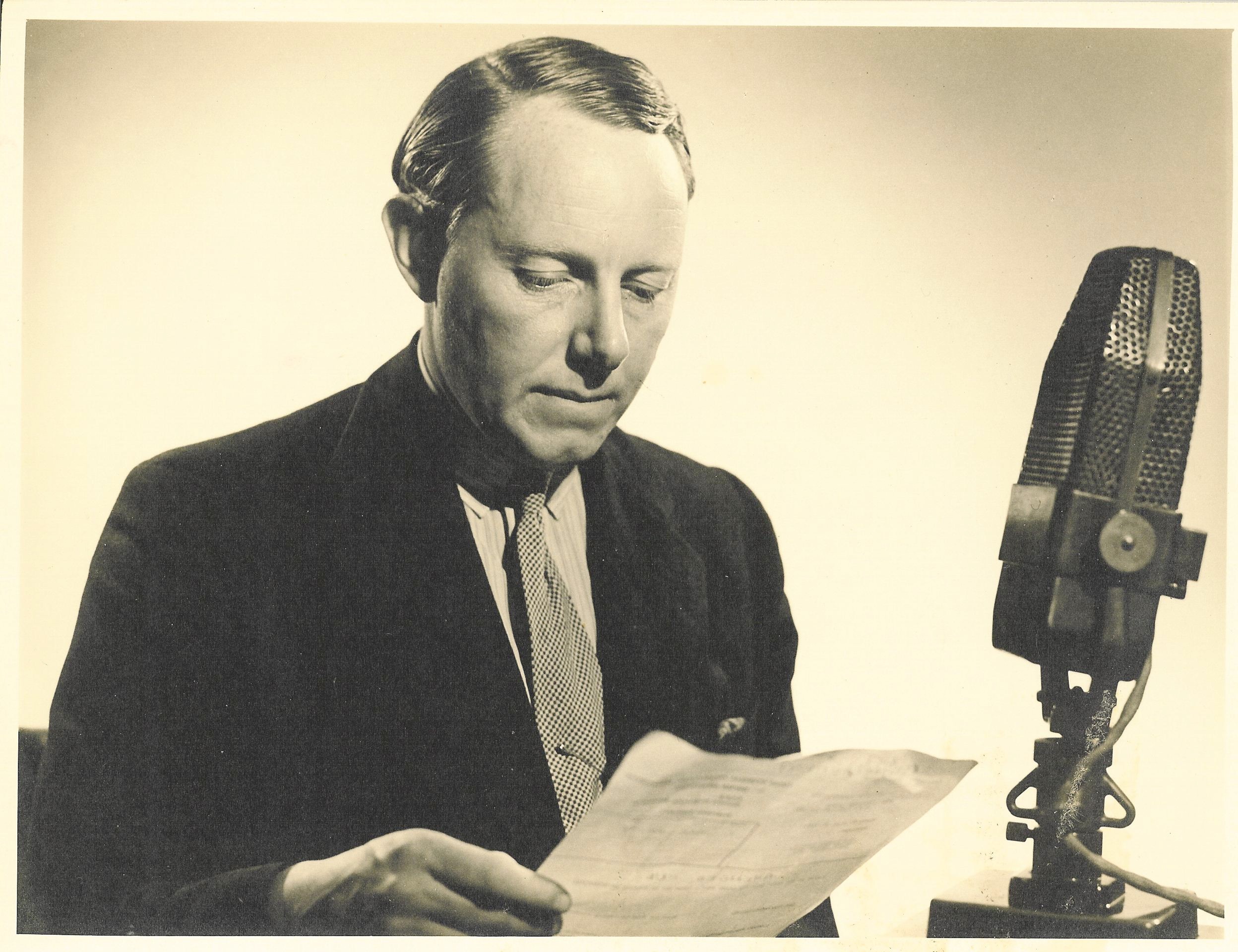
Derek Prentice at the BBC microphone – a treasured family photograph.
Prior to working at the BBC, my grandfather had been an actor. His interest in theatre had begun during his time studying French and German at New College, Oxford (which followed his schooling at Winchester College). He initially became an engineer upon graduating, but he was so passionate about acting that he was able to persuade his parents to support this true vocation. Years later, working in London – including the West End – he was put out of work by the outbreak of war in 1939, when the theatres closed. As a linguist, he first went into censorship; then turned his acting training, and vocal talent to radio. He got a job with the BBC where he frequently worked the nightshift as a news reader. One particularly treasured family photograph shows him at the BBC microphone. After the war, he returned to acting, working across theatre, radio, film and television.
He was a hugely popular newsreader and his many fans across the world would send letters and gifts to him and his young family (his wife, Katherine and their two daughters) in beleaguered Britain . He would share these gifts with his colleagues – there was more than enough to go around. Other published reminiscences we have found echo that he was a recognised and much-loved radio voice of the time.
My mother and I have been trying hard to track down the original recording of that D-Day broadcast. Our many attempts to obtain a copy included approaching the BBC, who were very helpful but unable to locate the original recording. However, recently in April this year, we reached out again to the Australian Broadcasting Commission, who had featured the broadcast in a programme marking the 70th anniversary of D-Day in 2014. We were delighted to be told this time that they could make their recording of that original shortwave radio broadcast available to us. And with the BBC’s permission they have just released a copy of it for our personal use.
It’s wonderful to hear my grandfather, who I never met (he died before I was born), announcing such a pivotal moment in history; one we now know would lead to the end of WW2.
Listen to the talk here – recorded 2nd June 2024 (NB moderate audio quality), or read below:
A number of biblical characters – including Noah – blazed a trail ahead of Christ – somehow pointing to or depicting key aspects of Jesus’s character, purpose or ministry. Other words and phrases to describe this are ‘prefiguration’ or ‘type of Christ’ or ‘forerunner’. These are like echoes that go across the Bible showing us something about Jesus, and acting as signposts towards him. See also Not So Sorry and Single which looks at Ruth’s story.
Meaning-making creatures
We are meaning-making creatures. We look for meaning, and God appeals to this part of our design by hiding ‘Easter Eggs’ or symbols – for those who are looking; like an artist, filmmaker or writer might hide them in their work. Throughout the Bible these hint and speak of the conclusion of the story; and of our ultimate hero and protagonist, Jesus.
God is happy for these mere humans; imperfect, created beings to be the first to demonstrate what his son came to fulfil. They go ahead of him. God didn’t need his own son to be there, right from the outset – first in line, dominating or pushing to the front…Jesus came after them all. They showed us first, what Jesus would be like – which he later fulfilled.
Adam was the first ever human, and Noah came 9 generations after him. Adam’s family line went: Adam – Seth – Enoch – Keenan – Mahalelel – Jared – Enoch – Methuselah – Lamech – NOAH.
Genesis 5v29 says that Lamech, Noah’s father: “‘named him Noah and said, “He will comfort us in the labour and painful toil of our hands caused by the ground the Lord has cursed.’”.
So here’s one of our first clues. Because what does this tell us? In part; Noah, like Jesus, would provide comfort and relief from the consequences of the fall and the problem of sin.
The Human Condition
Things had got really bad in the 9 generations since Adam. Genesis 6v5 says, “The Lord saw how great the wickedness of the human race had become on earth, and that every inclination of the thoughts of the human heart were only evil all the time”.
Here the human condition is laid out for us. If you read this verse slowly – it is exhaustive in explaining just how bad things were, it leaves no stone unturned in underlining how consumed humans were by wickedness and evil.
‘Everyinclination of the thoughts of the human heart were only evil all the time.’
What did God say when he created Adam? That it was ‘very good’. But the goodness of the first human had been utterly consumed by evil. There was no good left in him whatsoever.
Genesis goes on to say; “The Lord regretted that he had made human beings on the earth, and his heart was deeply troubled.”
I find this extraordinary because to me it reveals the transparency and vulnerability of God. These are recognisably human responses and emotions. It’s easy to overlook how human God is – obviously he’s not human, but we are made in his likeness. We can forget that he experiences feelings like joy, disappointment, anger. Here he feels REGRET, and his heart was DEEPLY TROUBLED. These are big emotions. Let’s imagine what that’s actually like – for God to regret something he’s done and to be deeply troubled. Think back to those times of regret in your life, or when you have been deeply troubled. It’s not nice.
Regret means feeling sad, repentant, disappointed about what you did or weren’t unable to do. But is also rings of despair: the complete loss or absence of hope.
God was facing the mega failure of Project Earth – it was created to be this incredible expression of the love experienced within the Godhead. He was about to lose everything he’d created. There was a spiralling moral cost to his project, humanity was haemorrhaging morality.
Catastrophic failure
God was facing a catastrophic failure. What is that?
When we talk of catastrophic failure we often think of things like machines, rockets, aeroplanes, buildings and structures, pipelines, technology… or submersibles. The definition of a catastrophic failure is – ‘a sudden and total failure which cannot be put right, and from which recovery is impossible’. And a catastrophic failure often leads to something called a ‘cascading systems failure’ – where all interconnected systems fail too. A computer would completely crash, a building would collapse, a pipeline would rupture, a submersible would implode with no survivors.
God’s creation had developed a deep flaw, it was the problem of evil and sin that had taken root and it was causing this catastrophic failure – it could not be put right and was beyond recovery. The free will God had given Adam and Eve meant that humankind could choose whether to obey or disobey God. And the result of the Fall – their disobedience, had compounded; wickedness upon wickedness upon wickedness – to become a screaming feedback loop.
Genesis 6v7 says “So the Lord said, “I will wipe from the face of the earth the human race I have created—and with them the animals, the birds and the creatures that move along the ground—for I REGRET that I have made them.”” (Interestingly the whole of creation is implicated here.)
Genesis 6v11-12 explains further. It says “Now the earth was corrupt in God’s sight and was full of violence. God saw how corrupt the earth had become, for all the people on earth had corrupted their ways.” So God said, “I am going to put an end to all people, for the earth is filled with violence because of them. I am surely going to destroy both them and the earth.””
The word that stands out here to me is VIOLENCE. What is violence? Violence is intentional destruction. The World Health Organisation offers an insightful definition of violence which is: “the intentional use of physical force or power, threatened or actual, against oneself, another person, or against a group or community, that either results in or has a high likelihood of resulting in injury, death, psychological harm, maldevelopment, or deprivation.” So if the earth was full of violence according to that definition, it was absolutely dreadful. People were doing violence to themselves, to each other and to their communities.
God had give humankind dominion over the earth, they were to steward it but they had misused this power, turning it over to violence. Like I said earlier, all the good there had been was now consumed by wickedness. The inevitable trajectory of everything on earth was already destruction – before it was ever flooded it. So at this point there was no option other than to pull the plug. And the sooner the better.
But Noah…
Then we hear these words: ‘But Noah’. This is the game changer. Genesis 6v8 says: “But Noah found favour in the eyes of the Lord”.
One man, among the entire human race had found favour in God’s eyes. Along with his family. Noah used his free will to choose to live righteously and to follow God.
Genesis 6v9 tells us more. It says: “Noah was a righteous man, blameless among the people of his time, and he walked faithfully with God.” To remain blameless in those days was quite a feat, with everything that was going on. And because of that choice, Noah became God’s lifeline. He restored God’s hope in humanity.
This points to Jesus. Jesus went voluntarily to the cross. he presented himself to God, surrendering himself saying: “Here I am, I have come to do your will”. Yes he was the son of God, but he too had free will. Noah had chosen the same.
So our righteousness and obedience create possibilities for God. Our faith and faithfulness enable God to move.
The earth and the human race was already burned up and destroyed by wickedness. But Noah was a single glowing ember, one righteous man. He was the smouldering wick, and the bruised reed. And here we glimpse one of God’s ‘WHYs’ – In Isaiah and several of the gospels it says “A bruised reed he will not break, a smouldering wick he will not snuff out…” until he has brought about justice and victory – ultimately in Jesus. But he wasn’t going to snuff out even the vaguest hope that things could continue.
Righteousness and Relationship
Like Christ – Noah is a singular saving figure in his generation. Noah’s righteousness restored him to relationship with God. Jesus did this ultimately but Noah points to the restored relationship that comes through Christ’s righteousness. God talks with him. They are friends. ‘He walked faithfully with God.’ Here God is talking with Noah, sharing himself, his disappointments and then also his plans. Noah gives God hope, and from that glowing ember, new possibilities are born.
This story shows too how we’re partners with God in his plans and purposes. God prepared a life raft for Noah and his family. Yes he saved them but at the same time Noah’s righteousness offered God the potential to redeem humanity. He saved God right back. That feels a bit sacrilegious to say that, but this mutuality is really evident. Jesus does this too. This mutuality is a principle that runs through scripture, it’s integral to God’s values and to his design-rules. It’s at the heart of marriage and relationships: mutuality, mutual submission, mutual saving. God wants participants, collaborators, and volitional followers, friends, lovers. It was a huge risk encoding free will into the core of creation, it can and did go so very wrong but when people choose God, the outcome is awe-inspiring and wonderful. And as Noah signals, it was worth the risk.
Instructions for an Ark
So God gives Noah instructions to build an Ark. The Ark itself points us to Christ as well. He is our Ark. He saves us as we place our faith and obedience in him. While Noah built a physical ark, Jesus through his death and resurrection was building a spiritual ark with eternal significance. It would mark an end to the problem of sin forever, ending the wickedness in the hearts of humanity. It was complete Salvation.
This also sets a precedent; that God is an Ark Builder. His inclination, his leaning, and his nature is always towards providing rescue. He will delay judgement as long as possible – he is merciful. We need to participate, but he will always provide the means of rescue. Jesus is our Ark – our rescue.
Warren Buffett; a businessman, investor and philanthropist, who is known for his business know-how and wisdom (he’s also incidentally the 9th-richest person in the world and 93 years old). He cam up with something called ‘The Noah Rule’, which is that ‘predicting rain doesn’t count; building arks does’. And this rule is seen as key to surviving adversity. He described how his company, Berkshire Capital had a terrible year after 9/11 happened. He’d actually predicted many of the market events that happened before that terrible event in September 2001 (and as a result). But he acknowledged that he “didn’t convert thought to action”, and he violated what he termed ‘the Noah Rule’.
For him the rain came, but he hadn’t built an Ark.
Bias to action
Genesis 6 v 22 says “Noah did everything just as God commanded him”. Noah built an ark. This took trust, faith and obedience – born out of his righteous and relationship with God. This was the same for Jesus as he approached the cross.
Faith has a bias to action. It’s called obedience. As it says in James, ‘faith without action is dead’. Faith is action. Why was Noah featured in the Hebrews ‘faith hall of fame’? Because he built an ark… Hebrews 11v7 says “By faith Noah, when warned about things not yet seen, in holy fear built an ark to save his family. By his faith he condemned the world and became heir of the righteousness that is in keeping with faith.”
He was the forerunner of faith – he demonstrated what faith in action can accomplish. Jesus later would do this again and again (and other figures too). Jesus demonstrated this in miracles but also through his whole life. He was characterised by faith in action and his life on earth culminated with the miracle of resurrection. Death could not hold him. Acts 2:24 says “But God raised him from the dead, freeing him from the agony of death, because it was impossible for death to keep its hold on him”.
And as the waters rose, with Noah and his family and all the animals inside the ark – did this not also foreshadow and point to Jesus’s death and resurrection? These echoes across the Bible.
Standing alone
So, the rains came down and flood came up. And in Genesis 7v23 it says, “Only Noah was left and those with him in the ark”. And there’s something here in there being a certain ‘aloneness’ in following God, and his righteousness. Earlier, Genesis describes how Noah was alone in his generation, in this moment he stands alone too.
And I’m also conscious of the silence there must have been. Water is quiet. The silence would have been deafening, you would feel so alone. Jesus too stood alone on the cross, raised up in death.
And I think that this silence points to Easter Saturday. That bleakest of days – forever marked by Jesus’s death. The disciples thought it was all over. Perhaps floating on that silent sea, Noah did too.
And for me, I imagine zooming out and looking at the earth as if from a satellite or space station. Not that they would have existed then! And seeing the entire earth submerged; no land, no nothing, just water covering the earth. And perhaps even indistinguishable from the vastness of space around it. The earth had all but ceased to exist. And then seeing this tiny pinprick, barely visible. The Ark. A seed of hope – all but dead – floating on that vast sea, but full of possibility nonetheless. It carried all the potential for new life.
Seeds of Faith
The ark was like a single seed, with all the DNA locked inside for life, packed with potential. A tiny mustard seed.
God is both at the vast macro level – the Universal. But he is also in the minute – in the micro level. He came to earth as a tiny foetus after all. And from the vantage point of space in the moment, the ark is a literal but microscopic seed of hope in the midst of despair and destruction. One seed of faith, one person, one possibility.
Where does God see possibility? Wherever there is faith, there’s potential for God to move. Even in death and destruction, God will find potential. In a seed, in an ark floating with no obvious hope of making landfall, in a tomb even. God’s potential has no limits; no ceiling. No devastation is too great. All that is needed for God to move is faith, even faith the size of a mustard seed.
A New Beginning
What does this mean for us? When you think it’s all over: you’ve exhausted all your options or things have gone beyond the realms of what’s humanly possible, remember that faith makes it possible for God to move.
And that changes everything: it changes illness, infertility, loss, trauma, grief, hopelessness, death, failure, unemployment, homelessness, broken relationships, desperation and despair. Because Noah shows us that wherever there is faith, there is the potential for God to move. And to create a new beginning.
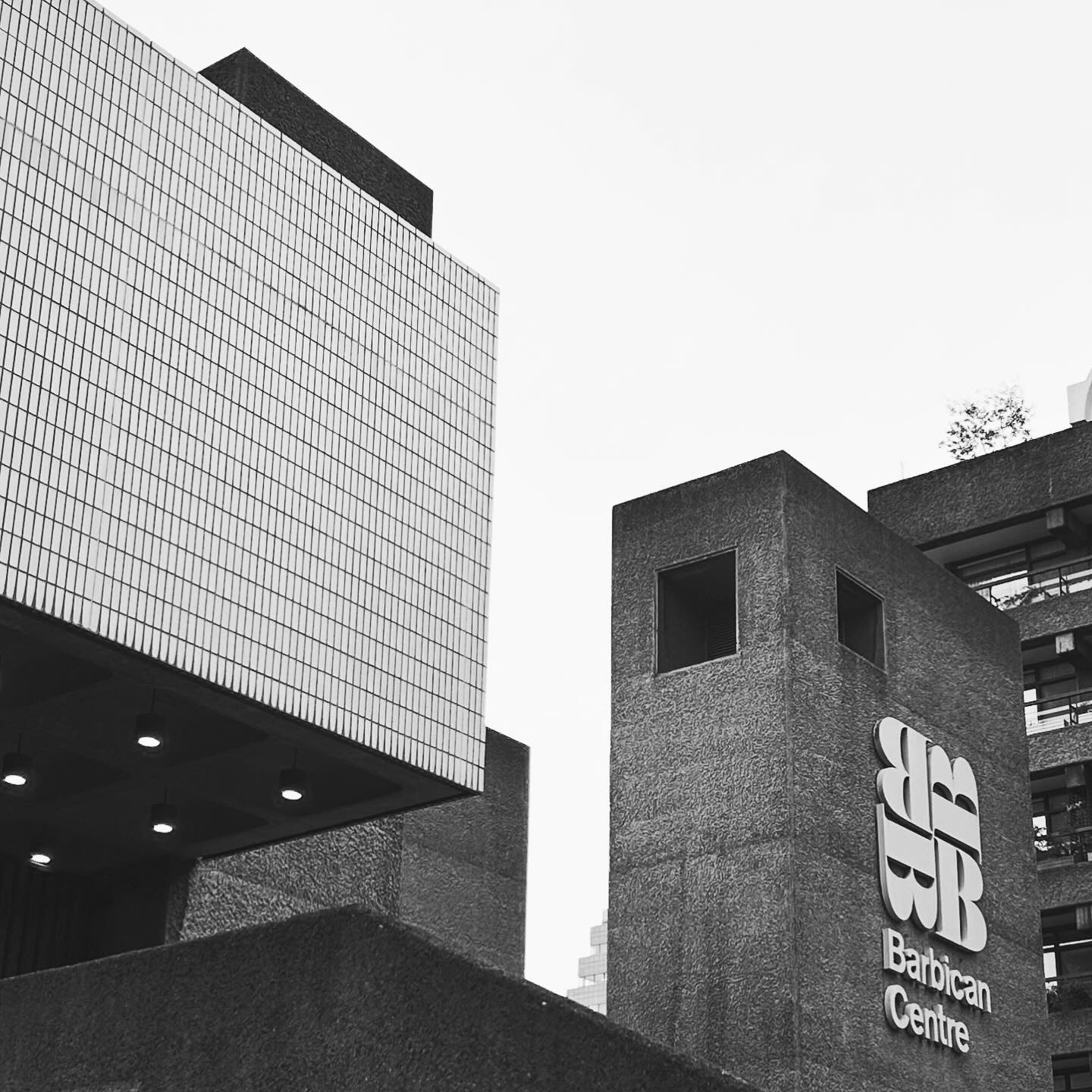
Walking through the City on a cold February day, with Liverpool Street station behind me; I look for glimpses of the Barbican’s unmistakeable brutalism peering out between the surrounding glass and steel. Its architecture a monument to post-war rebuilding and a vision of 1980s aspirational living (it opened in 1982), it serves as a counterpoint to the austerity that revealed itself in the ‘winter of discontent’ of 1978-9. The late 70s were largely characterised by an influx of migrants, trade union strikes, brewing racial tensions and anti-government protests; creating an atmosphere not dissimilar to that of the last few years, and paved the way for the nascent Thatcherism that soon followed.
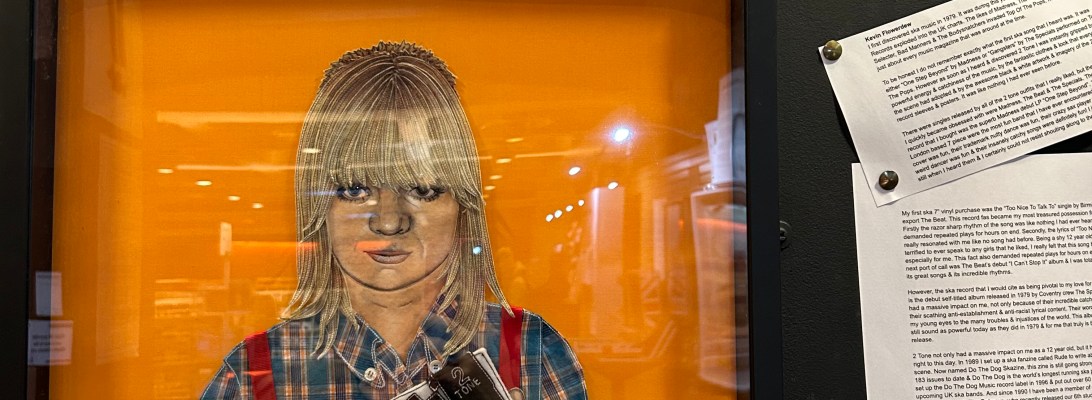
On an otherwise-average weekday, the Barbican is buzzing when I arrive. Navigating the Escher-like maze of walkways, hallways and stairways is easier than it seems. Soon I find the Barbican Music Library – a quiet haven sequestered within the main library. Here is the reason for my visit: a lovingly curated exhibition charting the rise and influence of Two-tone; the multicultural music genre which signalled that racial integration was not only possible – it was serious fun.
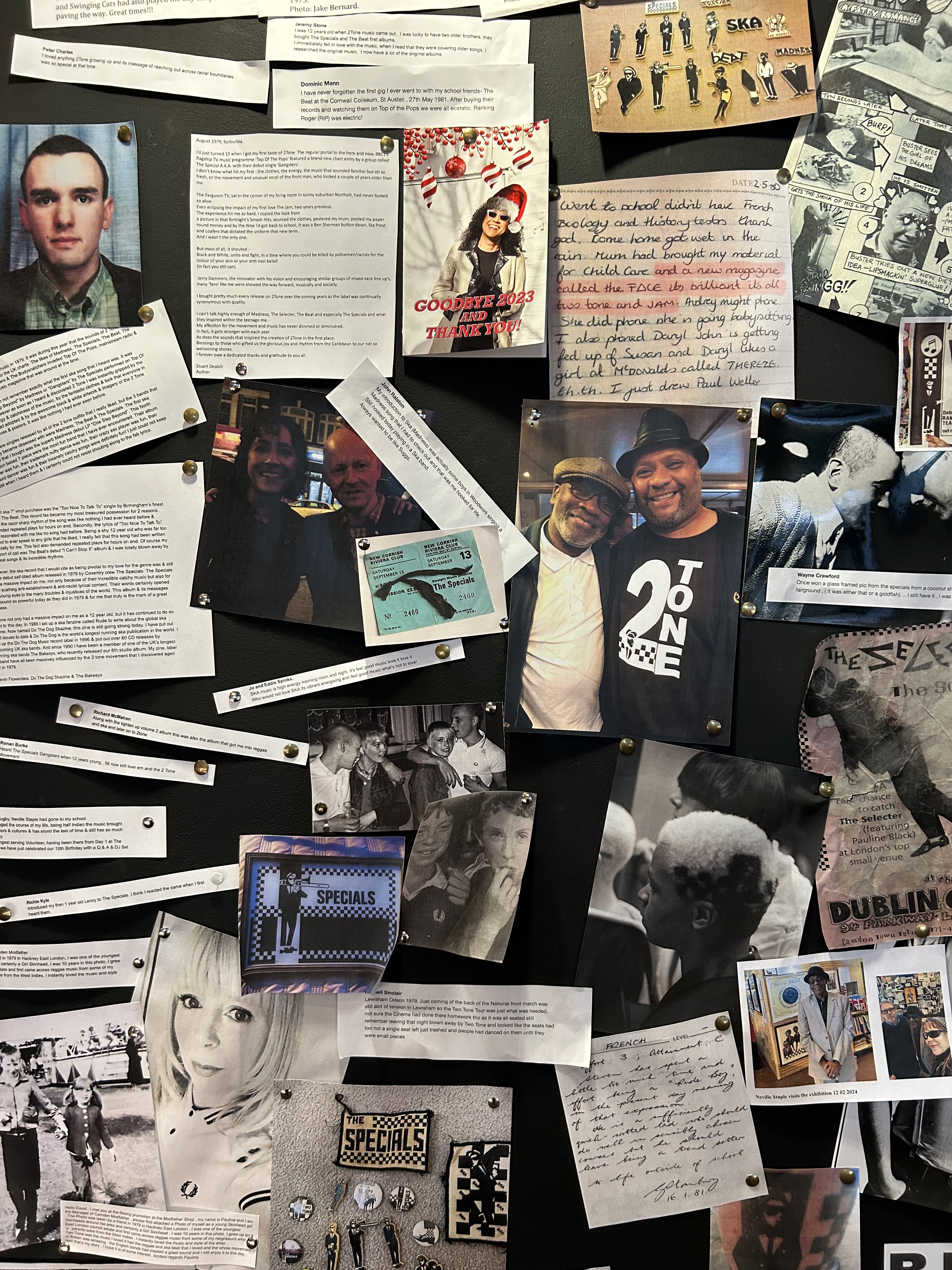
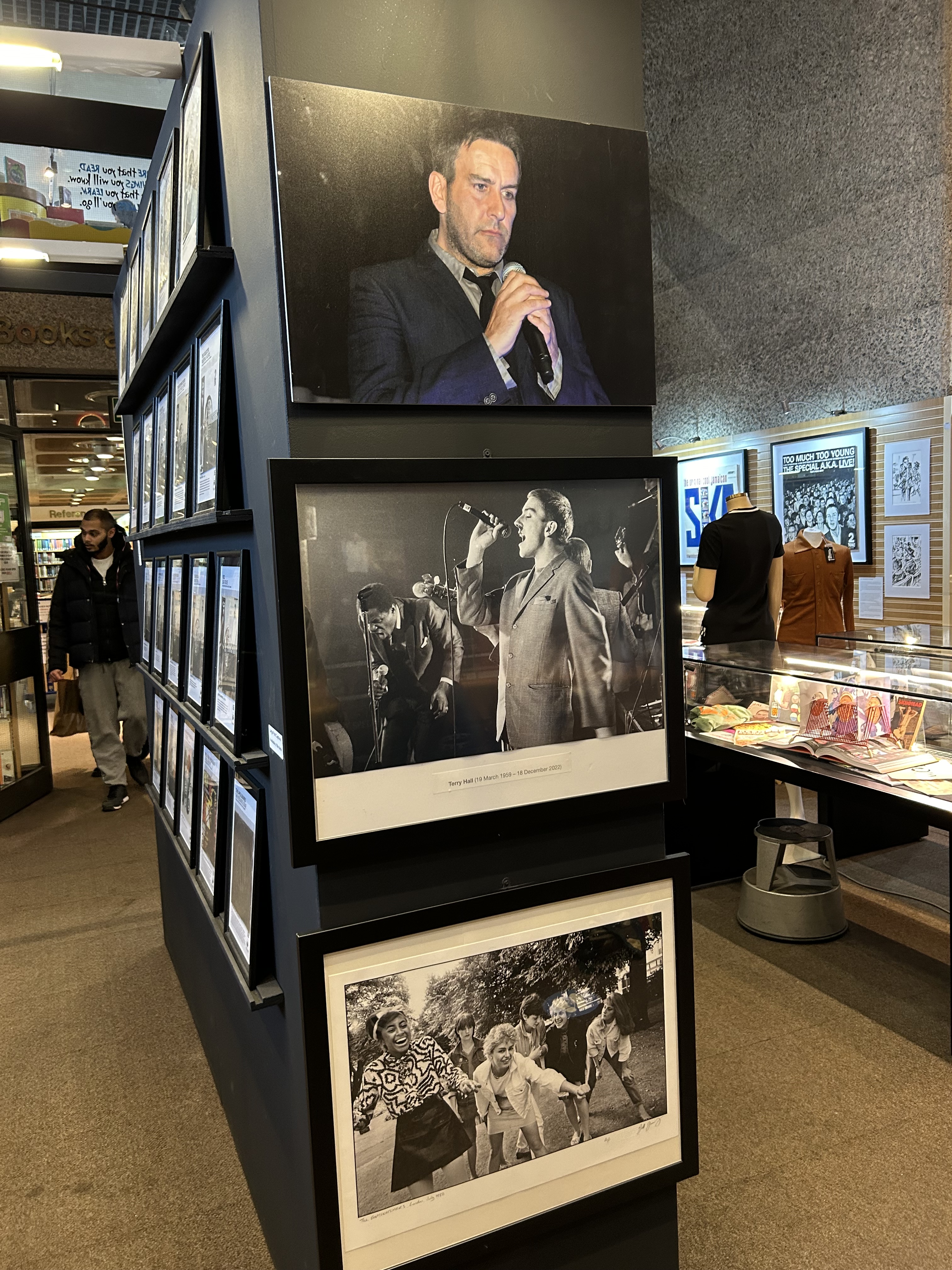
The exhibition celebrates Two-tone music and the whole cultural scene that surrounded it; featuring an impressive array of memorabilia, stories and reminiscences from musicians, writers and plenty of fans. These are not only to be found in the displays – where individual stories tell of unforgettable experiences, but also in the pages of the visitors’ book packed with more memories of those times. The evident gratitude people feel for the exhibition and the opportunity to collectively remember, makes it clear that this is something special.
It also serves up a rich slice of recent British history and pays tribute to those who travelled to the UK from the Caribbean to support the war efforts of the first and second world wars, and to rebuild war-torn Britain afterwards. Amongst this contribution to British society, was the music which laid the foundations for Two-tone and more besides.
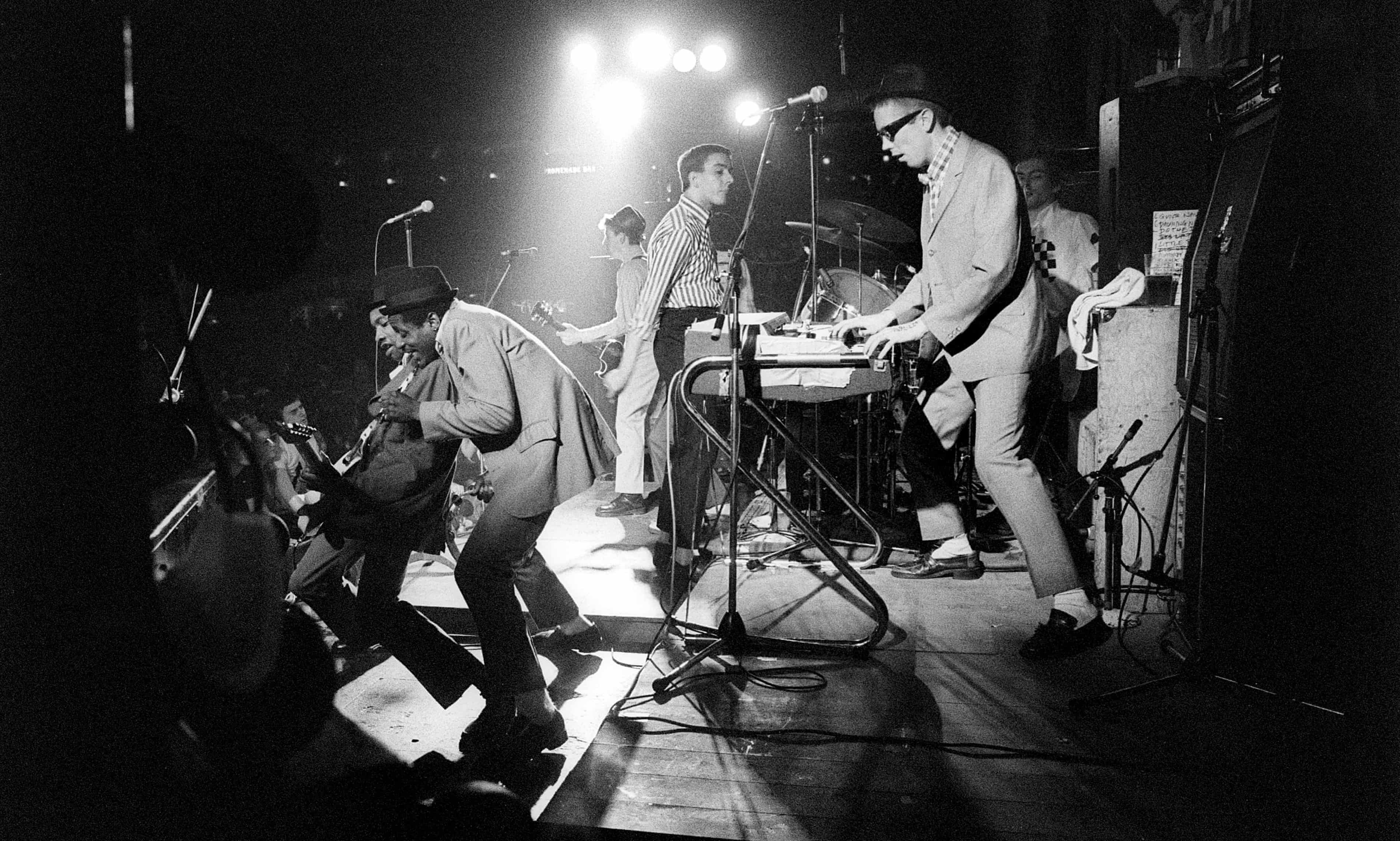
2 Tone Records – the eponymous music label, was launched by Jerry Dammers of The Specials in 1979. Based in Coventry it attracted groups and performers who had embraced Jamaican ska, rocksteady, reggae and dub – brought to the UK from the Caribbean, and combined it with Punk, and New Wave, music synonymous with the UK . This fusion came to define the two-tone sound. Though the label itself was short-lived (closing in 1981 after only two years); it left an indelible mark on the UK’s musical, and socio-political landscape.
Delving into the wider context: war-time evoked strong feelings of patriotism across the British empire of the time. And thousands of men from the West Indies volunteered to fight against Britain’s enemies, eager to contribute to the war effort. Expecting to join established British regiments, they were kept back from active combat in WW1, and instead assigned to labouring and logistical roles until King George V intervened. As a result the British West Indies Regiment was formed as a distinct unit. Remarkably 15,600 men enlisted from across the Caribbean forming 11 battalions; with Jamaica contributing the majority. Three battalions were deployed to Egypt. While playing a ‘supporting role’ in the theatre of war, they fought the Ottoman Turks in Palestine and Jordan, distinguishing themselves by their courage and skilfulness in the particularly challenging desert conditions. This marked a turning point in British military history, including and recognising the essential contribution of non-white troops to the overall war effort.
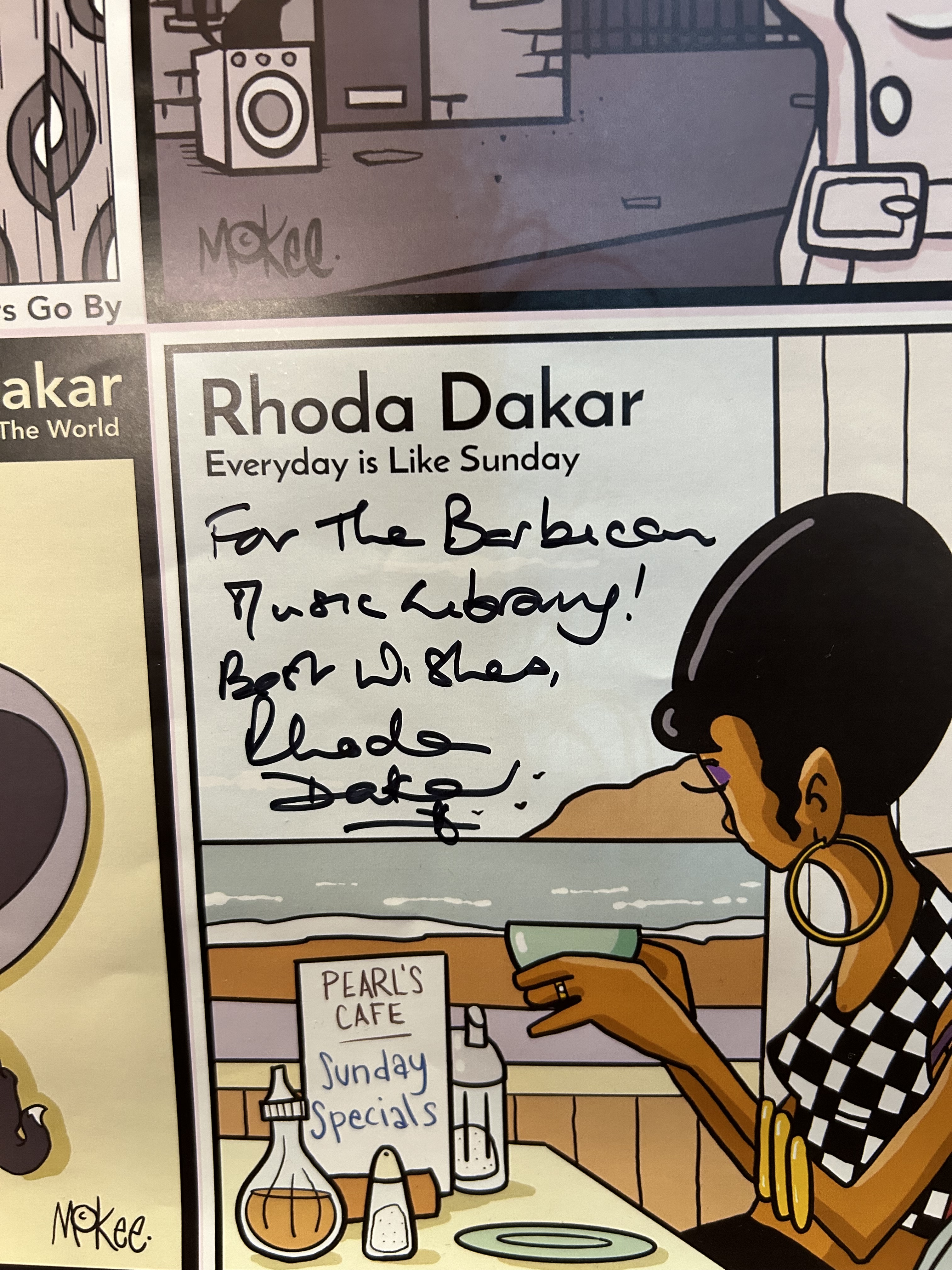
Lead singer of the Bodysnatchers, Rhoda Dakar – a major contributor to the exhibition, shares her family’s story – especially that of her father Rudolph Dakar, known as André. It is intrinsically woven through the events of wartime Europe: “My father, having joined the British West Indian Regiment and gone off to Europe to fight in WW1, returned to Jamaica with his Military Medal but never settled. He arrived in London but left to travel around Europe; France, Belgium, Italy and all the way to Hungary.”
In the 1920s André and his french-speaking Belgian wife – a pianist, settled in Paris where he built his music career, penning lyrics and writing songs. In the Paris of the 20s and 30s he was celebrated alongside other artists and luminaries of the time such as Louis Armstrong and Josephine Baker – his contemporaries in the Paris jazz scene. However, the outbreak of WWII forced him and his wife to the UK (he held a British passport). However, they weren’t received or celebrated in the same way they were in France. Rhoda describes his comparison of Paris and London: ‘He always said “in France if you speak French, you’re a Frenchman. In England you’re just another black man”’.
Nonetheless, André Dakar made his way in London, and became a well-known figure emceeing a music night called The Antilles, and subsequently hosting a jazz club in Piccadilly. Rhoda remembers that he was always impeccably turned out. He was also fully furnished with stories of the politicians, actors, journalists, artists and musicians he encountered, including the occasional clandestine visit from a royal. During the 50s and 60s he turned to film and television which included appearing in The Avengers and Danger Man.
Another featured story is told by the broadcaster, writer and DJ, Tony Minvielle. His dad arrived in 1960 from St Lucia, securing a job as a printer – unusual for a person of colour – and was working his way up to becoming a Master Printer, attending the London College of Printing. His mum arrived in 1961 (also from St Lucia) and became a seamstress. But in 1966 his father was hit by a car, and tragically died of his injuries. This left his mum (then only 23) to raise Tony on her own, who managed with the help of several ‘aunties’ and working multiple jobs, but it wasn’t easy. When she faced racism she face it head-on, with an approach of “no messin’”. Soul and reggae music was always playing on their ‘radiogram’ at home; and Tony recalls how joyful and soothing he found it.
In their reminiscences, fans of Two-tone recall the influx of Jamaican culture into the UK, and how it made an indelible mark on life in London, and other cities – like Bristol – with significant Caribbean communities. Memories include hearing Ska and Bluebeat blaring from windows in London’s east end, seeing “snappily dressed [Jamaican] rude boys hanging out on street corners” speaking in Jamaican patois – and being irrepressibly drawn to the culture, readily adopting its style and music.
Photo by AuthorPhoto by AuthorPhoto by AuthorPhotos, recollections and memorabilia at the Barbican Two-tone exhibition
Many recollections focus on 1979, when Two-tone music burst onto the UK scene. Highlights were of seeing The Specials – either live, or on Top of the Pops, and how they embodied this new youth movement combining British and Jamaican heritage; the music, the clothes and the sensibilities – bringing the two cultures together (which the documentary ‘Dance Craze’ details). And this in stark opposition to the extreme nationalism and racism promoted by the National Front and similar organisations.
It can’t be emphasised enough how important Two-tone was to society at the time – both politically and socially. Britain in the late 70s was a burgeoning multicultural nation. But for the most part young people weren’t overthinking things; they were just mixing and absorbing each others’ cultures. Many of those who got into Two-tone, already had their musical roots in Punk – and were open to exploring new sounds. In fact, embracing a changing UK was to increase the energy, vitality and political relevance of Punk. David Burke who curates the exhibition with Mark Baxter shares that: “If punk was my first crush, then ska and soul would be my life partner, my religion and my guide, to hopefully living a life that embraced all cultures and influences.”
The name ‘Two-tone’ was derived from the racial mix of the groups, as well as the black and white outfits they wore; emblematic of their mission and values. It offered a beacon of hope amidst the racial tensions. But the vision of multiracial harmony epitomised by the bands just couldn’t be matched by their audiences. Fights would regularly break out in venues, often sparked by interlopers who fundamentally disagreed with what they were witnessing on stage – and who resisted it as a genuine vision for life in the UK. Rhoda Dakar tells of a gig she performed with the BodySnatchers which had to end abruptly because of fighting in the audience. Events like this would eventually signal the end of Two-tone, because they couldn’t continue on.
In the end several bands, including the BodySnatchers, broke up in despair of the situation. And 2 Tone Records shut down in 1981. But as this exhibition shows, its legacy remains; not only in the music and memories, but in a set of values which welcomes immigrants to the UK, embraces their multicultural influences, dares to create something new, and in so doing adds a greater richness to society.
A SHORT STORY INSPIRED BY A CIGARETTE BUTT ON THE STREET
Peter was frustrated. He looked up towards the ceiling, leaning back in his chair; its cheap plastic lattice squeaked as it flexed and strained under his weight. Feeling the stretch, he sat quickly forward, plonking his elbows back on the table. He looked down at the packet of cigarettes in front of him. Smoking kills. Oh eventually it probably will. He looked closely at the gruesome photos of a tumoured tongue. Could do without that though. He sneaked open the packet and ruefully stroked the cigarettes. A few moments went by. He reached for his coffee, taking a strong gulp, and cast his mind back to sitting in a pub as a student, so young, what problems did he have then? He remembered the pleasure of smoking inside. Preferably over a nice cold pint, with friends. He shook his head quietly and set his cup down. “Just popping out” he called to the woman behind the counter. She nodded.
Outside it was damp and dark after the recent rain. He pulled up his collar against the autumn chill and fished around in his jacket pocket for his lighter. He lit a cigarette. The first deep breath is always the best, it tasted of sweet satisfaction, and relief. It’s all downhill after that. The self-loathing and feeling of disgust increased with each drag. He perched on the window ledge of the cafe, making sure to sit far enough under the awning to miss the drips of rain still falling down from its edge. He took one long last drag, feeling the burning heat closing in on his lip. Inhaling, he peered back through the window at his table – his coffee would be getting cold. He exhaled slowly. He was aware that his frustration had gone, and instead, a queasy peace had replaced it – he knew it was only down to the cigarette. He really needed to sort out his life. Better go. He flicked the remains of the cigarette away and went back inside.
This is one of several articles/mini-essays I wrote when I was in my very early 20s. I recently found them, filed away in a folder of keepsakes. I was just out of university at the time and beginning to experience and process the complexities of being a grown-up. I was also dreaming of becoming a writer of some sort – maybe a food or travel writer. Anyway, these are like letters from my 20-year-old self and give some insight into one person’s thoughts in the year 2000. Instead of keeping them on file I thought it was time they finally saw the light of day – so here they are.
Life as a graduate is an interesting mix of being glad to have shed the student skin, with all its connotations of loafing and drinking, and desperately wanting to return to something that you know and feel comfortable with. And of course navigating the shocking reality of having to get up at the same time each morning (early), with the disciplined regime of working nine-to-five.
It’s also difficult suddenly not being surrounded by people who are the same age as you, and who are all in the same time of life and dealing with the same set of challenges. There’s the possibility of being lonely; friendships become distant, people who you were friendly with at university now seem like mere acquaintances or even strangers. What drew you together in the first place – the fact that you were sharing a common experience – now seems to be one of the only reasons that you were ever friends.
It is an exciting time though, and also a daunting time. Exciting in that you finally get to do what you’ve been preparing for all these years. Education partially serves the purpose of turning out a work force that will be productive and good for the economy. Our whole lives have been geared towards reaching this point, this moment. But strangely, and somewhat tragically, many of us emerge from the other side of our education with little idea of what we want to do.
It may be a sign of the times, or a consequence of our consumerist culture. There are so many possibilities and almost every action we make is determined by a decision where multiple options have to be weighed up against each other. As humans in the face of such overwhelming choice it can seem preferable not to make any choice at all – what author Douglas Coupland aptly describes as ‘option paralysis’. We get stuck.
If we’re not alert to this, many of us will end up just drifting along, too overwhelmed to make the choices that matter for our lives, and instead existing in a haze where nothing is defined, nothing is certain, and life has happened ‘to’ us rather than us choosing it. However, the best path is there and can be chosen, and I hope that all other options will pale in comparison. Then it becomes not a just choice but a glorious inevitability.
This is one of several articles/mini-essays I wrote when I was in my very early 20s. I recently found them, filed away in a folder of keepsakes. I was just out of university at the time and beginning to experience and process the complexities of being a grown-up. I was also dreaming of becoming a writer of some sort – maybe a food or travel writer. Anyway, these are like letters from my 20-year-old self and give some insight into one person’s thoughts in the year 2000. Instead of keeping them on file I thought it was time they finally saw the light of day – so here they are.
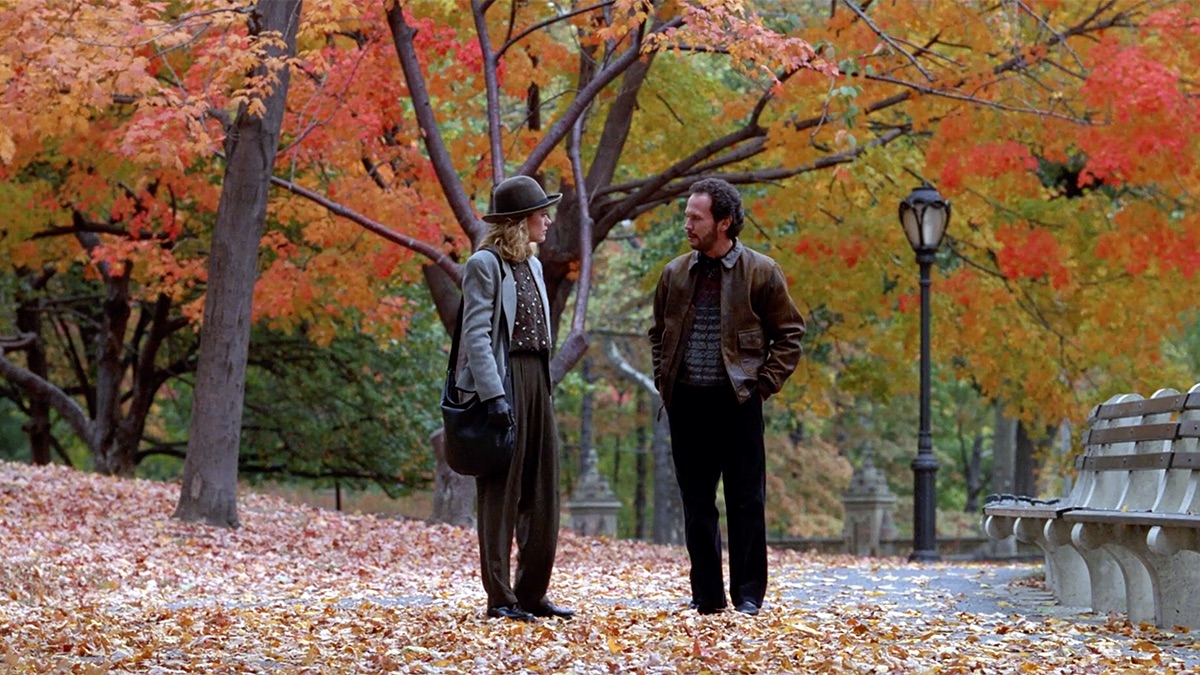
Image from When Harry met Sally featuring Billy Crystal and Meg Ryan.
Friendship is a difficult thing, especially between a boy and girl. The eternal question is; can two people of opposite sexes be friends without love (or sex) interfering? Wasn’t that the whole premise of ‘When Harry met Sally’? I do have some friendships that are totally platonic but these aren’t the friendships that mean the most to me. I can take them or leave them. I don’t miss the other person when I haven’t seen them for ages; it’s nice to hear from them after a while but these are not the friendships that I pursue. There’s somehow not enough passion to fuel my pursuit at any cost of that individual. Even if it’s quite clear that nothing will ever happen between us, either by mutual admission, mutual knowledge or painful experience. Perhaps it’s up to me to work out why I have such a passion about someone, is there still the faint hope that one day this all might lead somewhere? If I demonstrate my stoic friendship now, proving to my friend what a steadfast and consistent individual I am then maybe, somewhere down the line (sooner rather than later would be preferable) he will realise how much he values me, and loves me and we’ll fall desperately in love and live happily ever after. And the girlfriend will disappear into the distance never to be seen or heard from again. And all our friends will agree that he chose the right girl in the end and be overwhelmingly happy for us.
But sadly this romantic notion of love-finally-requited is just that, a romantic notion. And romance whilst representing some high ideal is not the stuff of life. I can vainly hold onto the hope that my friend will one day come to love me but it doesn’t enable me to face reality. The fact is that I am not the girl for him, nor is he the boy for me. But I will not accept that. I won’t let him go. I’ve cried enough over him, talked enough about him, thought enough about him and convinced myself on an intellectual level that it would never work. But for reasons that are inexplicable, I love him. I can acknowledge that his girlfriend is much better for him than I ever would be. I concede that, grudgingly. I know that there is none of the spark necessary for a relationship to develop; I can’t laugh with him, our chats always take on a very serious tone, there doesn’t seem to be an easiness and calm between us. It’s all a bit of an effort really. But still in the pit of my heart there is the hope that all this could change and we could suddenly fall for each other. However, if we did, I would have to become a totally different person and probably so would he and that’s not going to happen. And I certainly haven’t come this far in becoming more myself to throw it all away and become someone else.
But this brings up the question of how much do I really value my friendships? Why do I place such a high value on a relationship with that person, believing that I’ve only got second best as a friend? Platonic love is love nonetheless and only one person will ultimately fulfil the role of girlfriend, wife, lover. So why do I think that I’ve lost out? I still crave that special place and even as a friend I want to be the best-loved friend. But if I was that I’d soon become the girlfriend and that’s not going to happen. So friends it must be, in whatever shape or form it comes. Not craving more, being satisfied with what I’ve got and realising that that is the best.













 Alex Noel