“Louis Theroux’s documentary Inside the Manosphere sheds an uncomfortable light on the male influencers known for disseminating misogynistic content across social media channels, podcasts and websites. Its main proponents include figures like Andrew Tate, as well as a whole host of others who are just as notorious, at least within the Manosphere itself. Drawing heavily on the film The Matrix for its central idea, this inspires the term ‘red-pilled’, which means to wake up to the realities of the world as the Manosphere sees them. Namely, that men are oppressed by women and therefore unable to succeed within this paradigm.” Read more at Woman Alive magazine…
If you read my previous post you will already know that I’ve been reading a lot of James Baldwin lately. And that one of the reasons his writing resonates with me is because it feels like music; specifically like jazz – which he said intentionally shaped his style. You can feel it in his cadence and phrasing; the sense of improvisation giving it an energy and freshness that continues to play across the decades and inform our present moment.
It was therefore, serendipitous (or maybe just algorithmic) when – shortly after I wrote it – I came across an article from the Institute of Art and Ideas (the people behind HowTheLightGetsIn Festival), on how music and creativity are in our very DNA. The article by molecular biologist Ewa Grzybowska, sets out how the existing paradigm for how DNA works (established by Crick and Watson), has been largely superseded in recent years.
Composite image by author.
The Science Bit
She explains that the established understanding – that DNA codes only for well-ordered, well-structured proteins is now basically redundant. And rather than a machine-like, linear, ‘1+1=2’ process (where one gene produces one structure which has one function), it is in fact something more akin to improvisation. While DNA sequences code for proteins, there are also non-coding sequences. This ‘superfluous’ genetic material was initially thought to be ‘junk DNA’ (even though this would have been jarringly inefficient for any cell to have), until its vital function was unearthed. It gets transcribed into non-coding RNA molecules which have separate functions from the RNAs involved in making the proteins themselves. And which operate as a “vast pool [of RNA]…involved in the regulation of gene expression” both before and after the DNA itself is transcribed. This, Grzybowska says, opens up the “vast new planes” of regulation and is responsible for this paradigm shift in how DNA is now understood. Meanwhile, they also found that some proteins can change their function, effectively moonlighting in other tasks; while others can change their structure, folding differently despite retaining the same genetic sequence. And then there are proteins with no stable structure at all – completely disordered, able to shape-shift according to their functionality. DNA is therefore less a blueprint and more a text to be interpreted.
What it all means
In other words, genetic material and proteins in a cell are agile; able to adapt and respond to changes in the wider environment. And rather than a production line, cell activity is “fluid, improvisational, and brimming with creative possibility”. Our DNA operates more like a live group of jazz musicians riffing and responding to each other and to what’s happening in the room.
It feels helpful to consider this when our present moment is forcing us more and more, to define what it is to be human, especially as we reckon with AI. But being human, may well come down to some very basic biological facts – the fundamentals, rather than anything high-minded or philosophical. If music and creativity are in fact coded into our very cells, what does that mean for our overall operating system as human beings? And therefore, how we can operate it well? Encoded in our DNA is this essence of creativity, immutably printed into our cells. More than that, it forms a responsive, collaborative and improvisational operating system which makes creativity central to our very lives and existence.
Creativity and being our most human
Recent studies, and books such as Art Cure by Daisy Fancourt, lend weight to the fact that we can only hack the human operating system so far. One thing we can’t get around is our need to create – to make things. Art, and creativity, in all its forms – is good for us. It is good for our basic humanity – our minds, bodies and spirits. A particularly powerful dynamic happens when we fulfil a creative idea and make it real ourselves, it might be taking a simple action, or making a drawing, painting, a piece of writing or sculpture, or anything else we might call “something we created”. When we create something with our own hands, whether it’s a paper aeroplane or an oil painting – there is an unmistakeable sense of exhilaration that accompanies that hand-eye-brain connection. And when we’re totally absorbed by it, giving it our full attention. But if we outsource our creativity entirely – both in terms of our thinking and our creative execution, to something that does it ‘for’ us, where does that leave us? We also risk missing out on the process of collaboration: the satisfaction of co-creating with others, and the joyful connection that can bring.
We need to ask ourselves what exactly are we gaining? And more critically, what are we losing? We may gain in productivity and output, but this can soon become a tyranny in itself. Sales pitches I’ve seen from AI companies are often based on a promise that their products will win us back valuable time, but this is a fallacy. Instead they drive more and more productivity. At a recent event I attended, several entrepreneurs declaimed the power of using AI agents to run parts of their businesses. Only to also confess that they were now working double their original hours, rather than using the time they’d won back for their own leisure or to be with their families. In one case, a founder said with a hollow laugh, that as a result of using AI, his 80 hour work week was now more like 160 hours.
There are already strong suggestions that AI can limit creativity and homogenise thought, if you’re in the habit of outsourcing those things to it. Though it may be wildly convenient to have the work done for you, without any of the struggle inherent in doing the work ourselves, we might be losing something more essential to our humanity in the process, injuring our capacities for genuine originality and human ingenuity. For something to feel worthwhile it often needs to cost us something – that it took some effort on our part. It’s that effort which intrinsically connects us to it. And it’s in our essential nature to create, we’re wired to make things, whether we think of ourselves as creative or not. It’s right there in our biology – in our very cells and DNA: that being human is having the ability to say: “I made that” with 100% conviction.
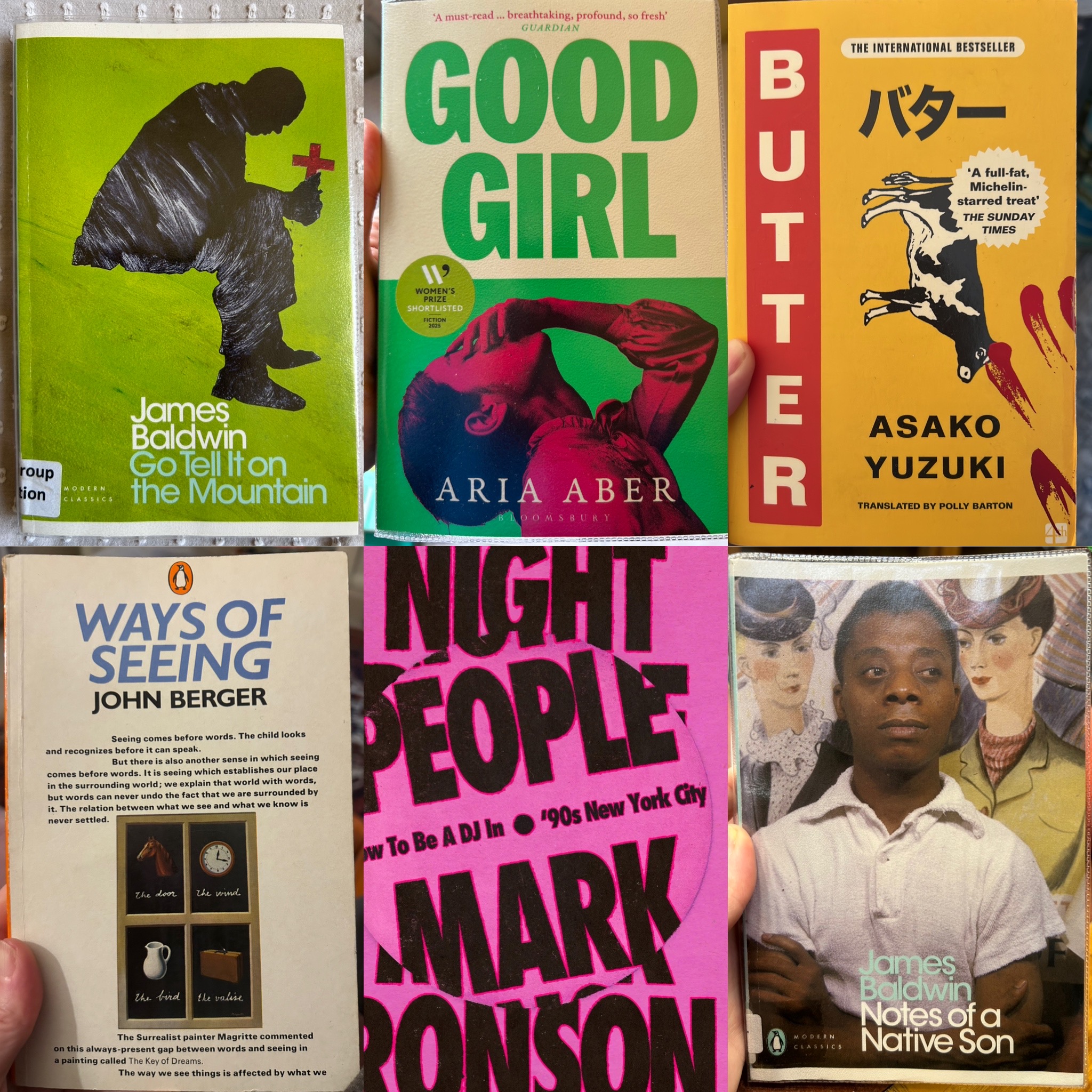
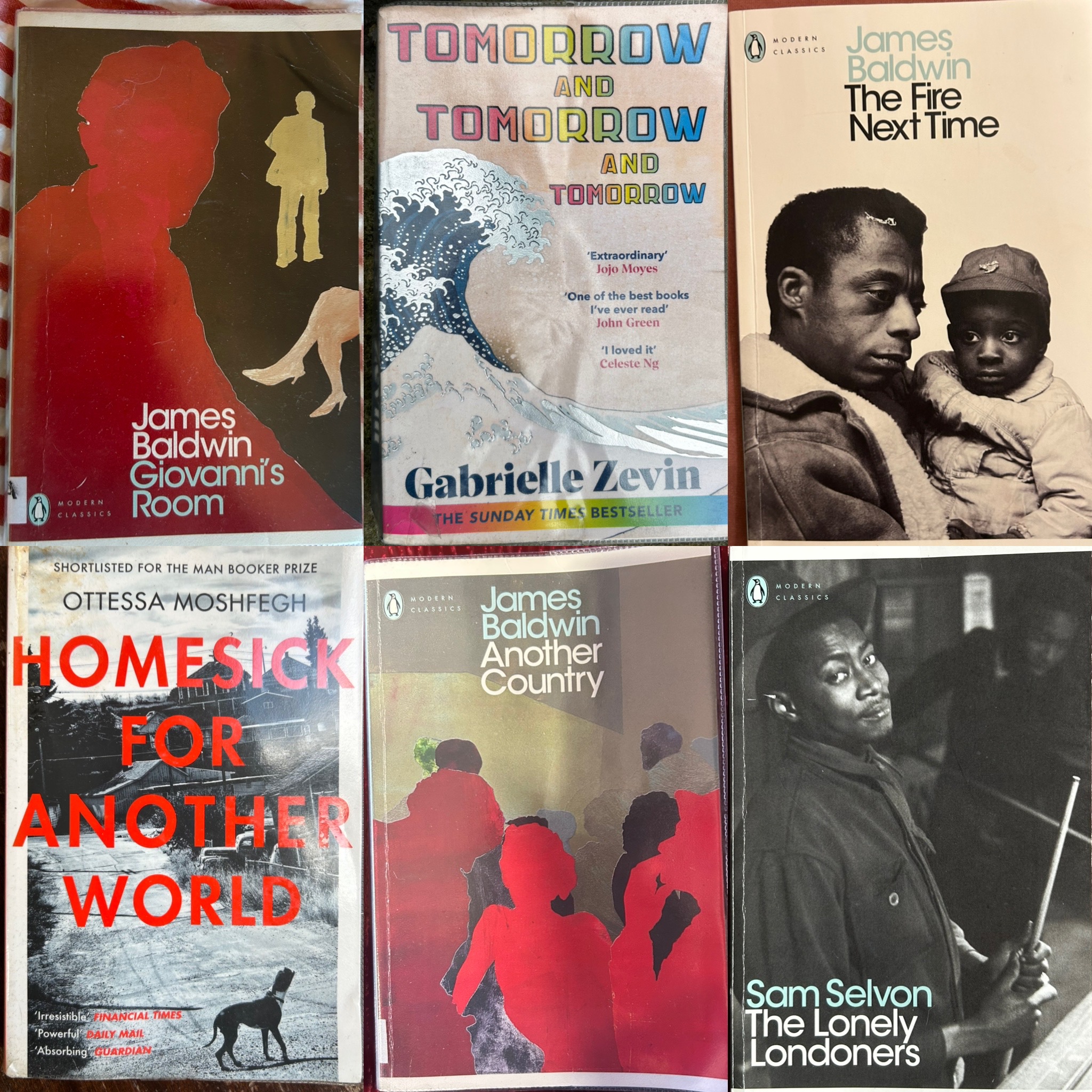
Below you’ll find some of the books I’ve read and enjoyed over the last few months… plus a few ‘next ups’ (Good Girl and Butter) and one currently in progress. Those I’ve read already come highly recommended. As for the others, I’ll just have to let you know about those. In any case, this is a shameless article about books, and for yesterday’s World Book Day no less, but it is also about literacy and something I’m really excited to be part of this year. Read on to find out more.
Book list
Go Tell it on the Mountain – James Baldwin
Good Girl – Aria Aber
Butter – Asako Yusuki
Ways of Seeing – John Berger
Night People – Mark Ronson
Notes of a Native Son – James Baldwin
Giovanni’s Room – James Baldwin
Tomorrow and Tomorrow and Tomorrow – Gabrielle Zevin
The Fire Next Time – James Baldwin
Homesick for Another World – Ottessa Moshfegh
Another Country – James Baldwin
The Lonely Londoners – Sam Selvon
When I posted this list on Instagram one friend responded wryly (and accurately): “Have you considered reading any James Baldwin :)” And yes, there is A LOT of James Baldwin, I’m definitely going through a phase. Let me explain.
Escaping the algorithm
A few months ago I decided to escape the algorithm that would invariably send me adverts for all the latest book releases, and instead let ‘IRL’ guide my reading choices. So rather than being influenced by digital marketing (which in theory I’m all for especially if you’re the one trying to market a great idea or a product you really believe in) I decided to let myself be directed by my immediate surroundings. And it has been so refreshing.
Alongside being a writer and digital marketer, I do quite a bit of cat sitting. Often I will be staying in other people’s homes and looking after their cats. Last summer, rather than buying the latest book on Amazon, I decided to limit my reading choices to either the bookshelf in the living room, or the books in the bedroom I was sleeping in. This approach has introduced me to a panoply of new authors and books I’ve only ever glanced at before. I also joined my local library, which happens to be quite large with lots of choice. So that too, has been a brilliant non-digital / real-world / analogue (*delete as appropriate) way to find new books to read which doesn’t depend on endlessly scrolling my social feeds.
And so, when it came to choosing my next great read, I would take my time, and stand quietly in front of the bookshelves. Just letting my attention rest on books I’d not seen before, or those I had heard of and always wanted to read. No hurry, or compulsion. I then might take a book off the shelves, hold it for a moment, turn it over in my hands and read the back, before skimming a few pages and deciding whether to read this one or not. And then I’d either set it down on the coffee table or at my bedside ready to read later, or put it carefully back on the shelf. This approach has been leading me to lots of great books that I don’t think I would have read otherwise. Perhaps I thought they were too old-school, or they just didn’t come into focus long enough for me to notice.
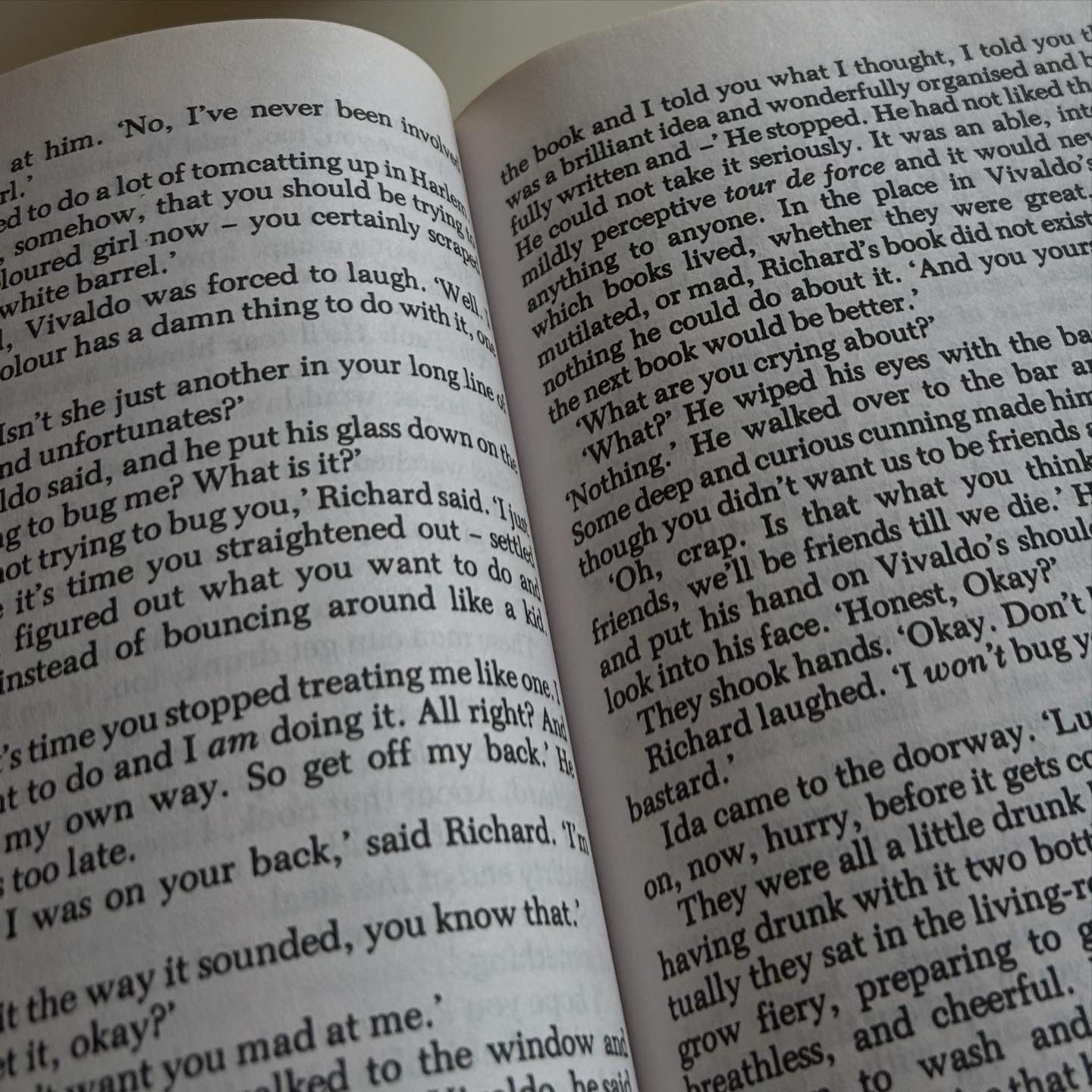
This is how I finally read a book by the great James Baldwin. And I can tell you now, his writing has impacted me more than I could ever imagine since I read him for the first time last Autumn. Better late, than never. And this feels like just the right time in so many ways. I started off with reading Another Country which I found on a library shelf, and was a very good place to start. I have since read four more books by him; The Fire Next Time, Giovanni’s Room, Notes of a Native Son. And I’m currently reading Go Tell it on the Mountain. The way he conveyed and expressed meaning; his craft, blows me away. I’m basically in love with his writing; it is tender, heart-breaking, incisive, inspiring, angering, confronting. It is very very good.
Music and social commentary
There are two things I especially love about his writing:
Firstly, it feels like music to me: the phrasing, the cadence, the rhythm and the way the words sound together. Most of all it feels like jazz, there’s that sense of push and pull, and a freshness that reminds me of improvisation. As someone who’s really ‘into’ music, the experience of reading words that feel musical really resonated with me. One thing I take a lot of pleasure in when I write, is channelling my musicality into it. When I wanted to understand more of this I discovered that James Baldwin’s writing style was strongly influenced by music, he said this: “I think I really helplessly model myself on jazz musicians and try to write the way they sound”. And boy, did he…
Secondly, what I’ve read so far (and there’s a lot more to read), whether fiction, essays or memoir – contains a searing social commentary on the world he moved through. His insights into what it means to be American and a person of colour are totally confronting, accompanied by a clear-eyed perspective on white sensibilities and how they have shaped the dominant culture in the West. It has shed a lot of light on our present moment and the way in which American culture imagines itself. He was an observer, a true artist, and someone who didn’t conform. He could put himself into the shoes of people very different to him to connect with them – writing with an empathy and tenderness which drew out their essential humanity. This approach is so inspiring, as is the way he used his creativity to hold up a mirror to society, where would we be without it? His work stands the test of time and still feels so relevant, and I’m learning so much from it.
There’s a lot more to say about James Baldwin and each of these books I list above, but that’s for another time. And now for what I mentioned at the beginning:
Writing and reading are totally intertwined, you can’t do one well without the other, (whichever tools you’re using). That’s why, this year I’ve become a National Year of Reading champion with the National Literacy Trust. If you’re looking for someone to talk enthusiastically about books, reading… (and writing), and literacy in general – do get in touch. I’d love to help!
Why gathering in-person fights against the fragmentation
“In my favourite local cafe, I pause mid-step to take a sip of the coffee I’ve just ordered. Setting it down on a table, I slide into my seat and turn my attention to the music playing over the speakers. It’s always good in here. It’s one of the reasons I like this place…” Read more at Seen&Unseen.
Music that moves you: from determined resistance to inspiring change
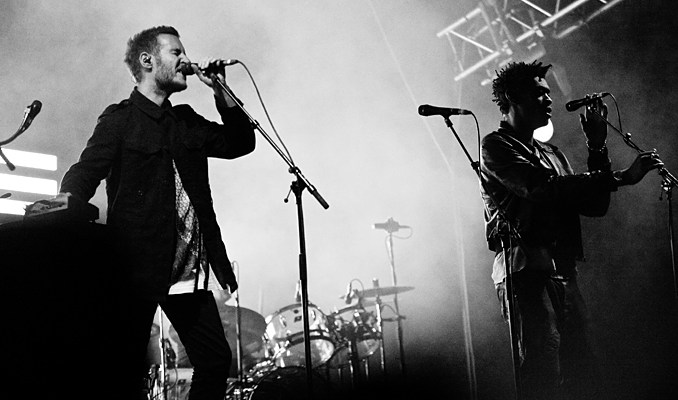
When Massive Attack played their first Bristol show in 5 years – on August 2024 – it provided the perfect excuse to look back. At how the Bristol Sound has evolved from the Trip-hop that first defined it, to encompass Idles’ post-punk and everything in between. And to consider afresh what it all really stands for.
A lot has happened in Bristol, and elsewhere – since Idles released their 4th album, Crawler in November 2021. And I certainly wasn’t the first person to notice that it opened with an obvious nod to mainstays, Massive Attack: “You might initially think you’ve accidentally put on Massive Attack’s Mezzanine with opener ‘MTT 420 RR’ heavily referencing ‘Angel’ by their fellow Bristolians”, wrote The List’s review in 2022.
‘MTT 420 RR’ by Idles bears more than a passing resemblance to Massive Attack’s ‘Angel’.
And that’s not where the similarities end.
The ‘Bristol Sound’ has always been more than the trip-hop that came to define it in the 90s. And equally it’s more than its evolution over the last few years to include Idles’ post-punk prominence.
Idles and the changing Bristol Sound
Releasing their 5th album, TANGK, in February, there’s no question that Idles have established themselves as a force to be reckoned with. Are they mainstream now? No, not yet. Still, they’re probably the first name that springs to mind for many when it comes to the Bristol music scene.
But as Idles continue their meteoric rise, Massive Attack remain steadfast – they’re not backing down. They play their first UK show in five years on August bank holiday weekend. From Bristol’s Clifton Downs they will look out over a musical landscape much altered since their last outing. And yet entirely congruent with Bristol’s unique musical history. What could Idles possibly have in common with them – apart from that creeping intro section?
While Idles’ music is nowhere near the ‘Bristol Sound’ popularised over 25 years ago, it still sounds like Bristol all right. It draws from the same well of resistance and independence that has fuelled the Bristolian attitude for years, and has been variously expressed by bands like Smith & Mighty, Tricky and Massive Attack, not to mention drum and bass outfits like Roni Size’s Reprazent, and many more.
The wider scene, while less well-known, has always included metal, folk, rock, punk, indie and country too. And arguably there’s been more of a shift towards these in recent years. Those watching Bristol’s music will be all too aware of Americana star Yola, who sang with Massive Attack (under name Yolanda Quartey) in her early career, and arrives at her current success by way of the hugely underrated Bristol country band, Phantom Limb.
Living and playing music in Bristol
The richness of the music scene had me happily living in that great city for 12 years, even dabbling in it as a musician myself; and never short of new music to discover. Bristol’s music has always been a blend of rich cultural influences. The city’s post-punk evolution is intriguing, especially if you were immersed in the music scene of the late 90s and noughties. But punk sensibilities are deeply rooted in Bristol. Not least in the fact that Bristolians are fiercely protective of their city – successfully resisting the attempts of insistent corporates to infiltrate it over the years.
One such attempt on Gloucester Road – gracefully winding its way north from the city centre and full of independent shops and businesses – was met in 2011 with local residents firebombing a new Tescos. Renowned Bristol artist Banksy paid homage to the city’s energy in one of his street murals: the words ‘The Mild Mild West’ set above a cuddly teddy bear readying itself to chuck a Molotov cocktail at police carrying riot shields. You get the idea.
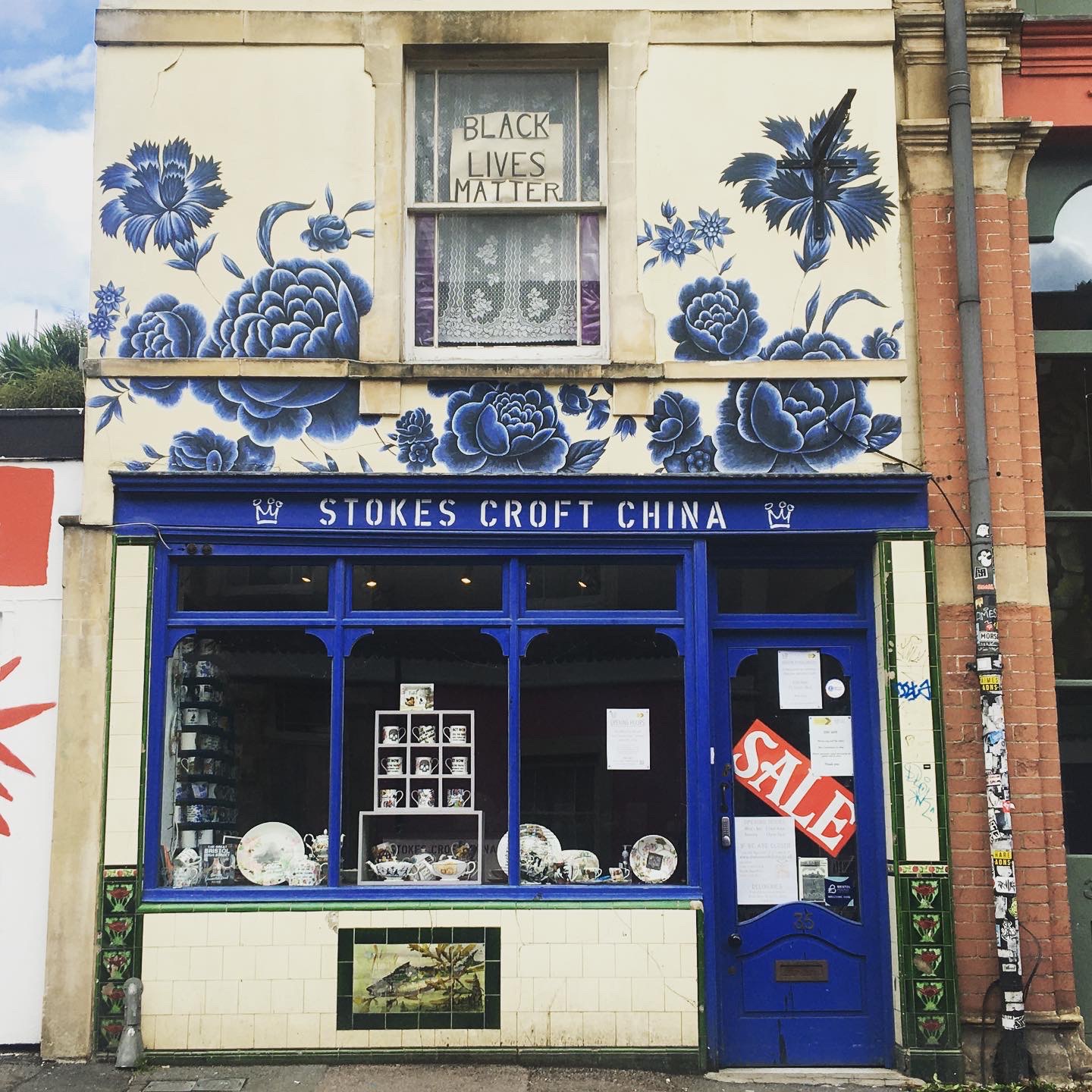
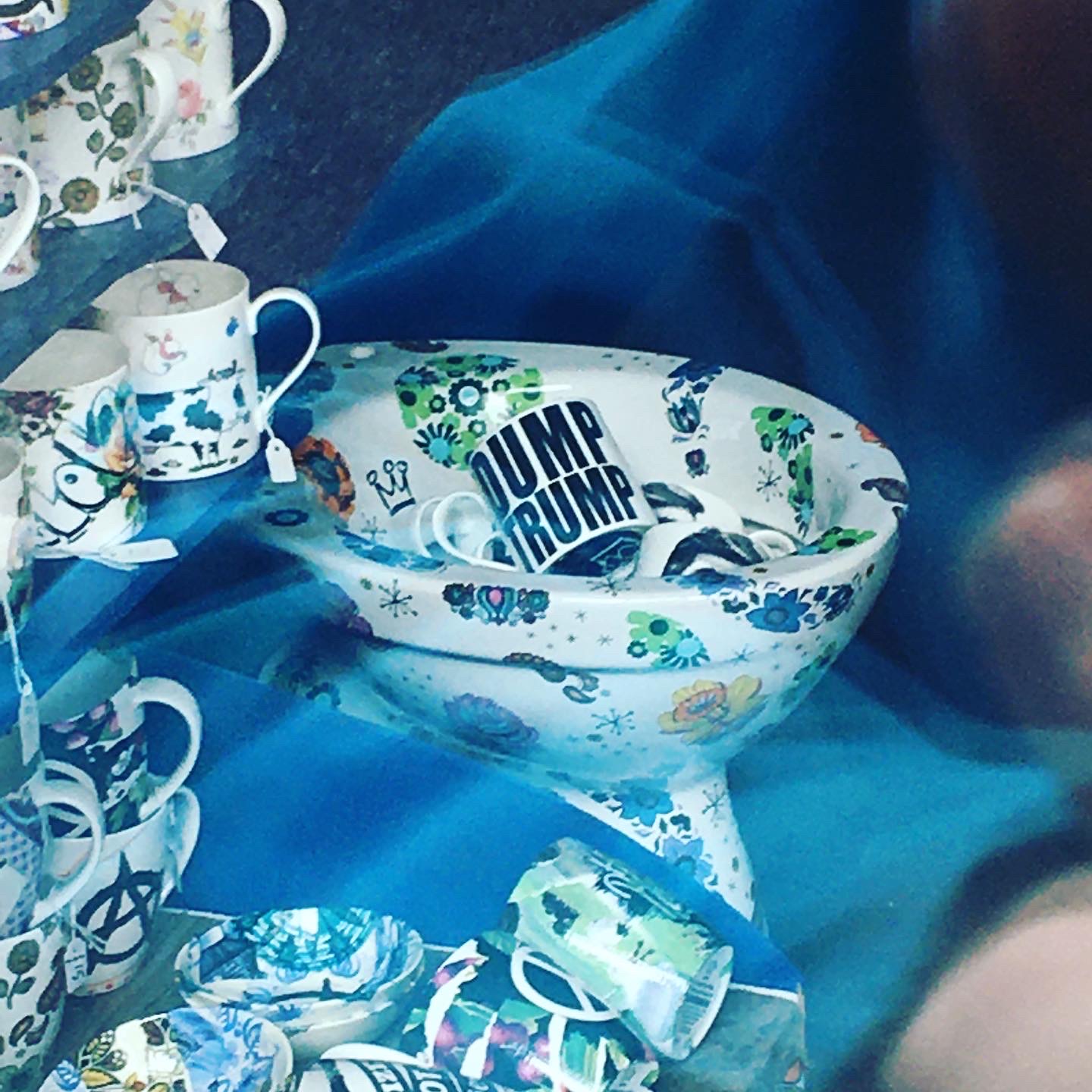
As if to drive the point home, the china shop across the street makes a colourful selection of porcelain mugs and homeware – decorated with socialist slogans. Perfect for that delicious cuppa – served up with a slice of anarchy perhaps. For me the piéce de ‘resistance’ was a mug I saw there in 2020 emblazoned with the slogan ‘Dump Trump’ – neatly positioned for display in a porcelain toilet bowl.
Stokes Croft China shop – photo by author (2020)Dump Trump porcelain mug – photo by author (2020)
Doubling down on resistance
During the Covid years, Bristol doubled-down on this resistance. It has continued to fight off commercialisation, and has thrown itself against one big issue after the other; protesting against Brexit, the Climate Crisis, the city’s legacy of Colonialism and Slavery, with thousands coming out in support of Black Lives Matter and later Ukraine.
A seminal moment happened in 2020 when the statue of slave-trader, Edward Colston, who had financed and lent his name to numerous landmarks in the city – was toppled from its position in the city centre and thrown into the river. Suddenly, former-Mayor, Marvin Rees, was all over the national news. He stated that despite the criminal damage, it was important to have empathy and listen to such protestors. And ordered the disgraced statue be retrieved and stored as a lesson for posterity.
A subsequent sculpture by eminent artist – Mark Quinn (of BLM protestor, Jen Reid) put in place of it without permission – was removed by Bristol City Council within 24 hours. Rees announced that whatever replaced the original statue would be decided pending a public consultation. (Banksy, who by nature has never asked permission, remains).
Many of these same issues have been addressed in Idles’ rage-filled song lyrics too, many of which strongly critique class struggle, capitalism, toxic masculinity, mental health and the idea of protest itself. And so it would seem that the anger and dis-establishmentarianism of the punk era has found a vital new resonance. A sure reason for the band’s success. It is music with an energy and metre that cries out for change.
Even in the 90s and noughties, trip-hop’s fusion of influences was credited as being “music for our globally aware and culturally fragmented times”. While it may have captured the times it didn’t challenge them in the way Idles have over the last few years.
Breaking the mould
But Idles are adamant that they are not activists, though their lyrics would say otherwise. Through Covid and BLM they were thoughtful, and gave voice to the angst shared by countless fans. And when the Israel-Palestine conflict erupted more recently, they were co-opted into this cause. Fans assumed their music would automatically translate into an active political stance on the issue. But they resisted – if their music is about activism, it’s very much on their terms. They will be the ones to define it, and to decide how and when (at Glastonbury this year as it turns out).
Lead singer, Joe Talbot stated in a Rolling Stone interview in January that: “We are not activists. I am concerned with the human condition and how that affects each other, and I use music to connect it to the world”.
Idles have resisted the post-punk label too. In 2017 off the back of their breakout album, Brutalism, Talbot said: “We’re not a post punk band. I guess we have that motorik, engine-like drive in the rhythm section that some post punk bands have, but we have plenty of songs that aren’t like that at all.”
Massive Attack have also resisted their trip-hop label, finding it limiting to the point of saying, “It doesn’t describe our music at all”. Neither band wants to be defined. Their rejection of these monikers gives them more in common than music ever could, both unconsciously shaped by the city’s values.
Despite shunning the punk label to evolve their sound (as their new album shows), Idles still sits firmly within the post-punk milieu. Like the post-modernism of the late 20th century, they have broken punk down further and further which each successive album – they query its tenets, asking how it could be reimagined.
On TANGK they continue to use the distortion and synths first introduced on Crawler, but they also hark back to punk’s foundations on this album with songs referencing 50s rock and roll.
Confronting the issues
With the issues, political or otherwise, that Talbot has addressed; perhaps they have gone further than punk ever could in confronting them. Exasperation with the Tory government, wrestling with questions of what it means to be a man, Talbot’s own, at times overwhelming, sense of grief and personal loss, and his journey with mental health issues, have all ultimately become a means of self-reflection. Talbot now holds up a mirror both to himself and society.
The political energy in their music isn’t so much that of the Clash and the Sex Pistols – though they’ve been compared to them often enough. Yes the repetition in their lyrics stands like protest chants – but they’re not those of anti-government rallies. It’s the angry objections spoken by frustrated families in tidy living rooms that we hear.
They’ve been called out for being middle class – the Sleaford Mods have criticised them openly for appropriating punk from the working classes. But even the middle classes can become disenfranchised. And Talbot rightly gives voice to that.
Idles have captured that angry impotence and powerlessness that convinces you that all you can do is rage and vent. That’s what happens when no-one is listening any more. Talbot has become more and more reflective over these five albums, admitting that he’s less about changing things ‘out there’ and increasingly focuses on changing himself. This has come by way of his mother’s death, and his first daughter being stillborn, all prompting his own torturous self-examination.
This album is geared even more decidedly towards self-reflection and personal healing. Perhaps that’s the way real change happens anyway. On TANGK Talbot is empowered and clear – no longer shouting but with a gravitas that makes you lean in and listen to what he’s saying.
Musical heritage rooted in Bristol and beyond
Both bands can trace their musical heritage to a fusion of influences rooted in the 60s and 70s that have created the diversity of today’s ‘Bristol Sound’. Emerging in the late 70s in rejection of mainstream rock and roll music, punk was already politically charged. By then in Bristol, sound system culture had taken off thanks to the arrival of migrants from the Caribbean who have continued to have a huge influence on the city’s (and UK’s) music. Bringing with them reggae, dancehall, rocksteady; and dub – its progeny the trip-hop of the 90s. In turn punk absorbed reggae – the sound has both recombined with other influences and also remained distinct.
On TANGK Idles call back to the rock and roll which inspired punk in the first place as well as imbibing the distortion, synths and electronic sounds more often associated with Massive Attack and their counterparts. And vice versa, Massive Attack’s Robert del Naja (aka 3-D) noted in an interview that their album Mezzanine: ““really did bring in all the elements that made us,” he said. ”Funk, soul, reggae, hip-hop and punk thing – it was all there.””
These Bristol cousins undoubtedly share common DNA. The ‘Bristol Sound’ has been described as “possessing a darkness that is uplifting, a joyful melancholy”. Though different, both Idles’ and Massive Attack’s music is certainly that.
TANGK continues to capture this juxtaposition, still it is a different beast from Idles’ early days, taking ground towards a sense of reconciliation, self-empowerment, joy and love – a long way from their first album, which was angrier, darker and more frustrated.
Evolving the Bristol Sound to take action
This marks the evolution of their message and sound, and of themselves – especially that of Joe Talbot. I can’t help but think that we’ve gone on this journey with them. That we’re getting better at processing our anger and at finding ways to communicate our frustrations: at looking at ourselves first before attacking others.
It remains to be seen what ‘Act 1.5‘ will bring as Massive Attack re-enter the musical fray. But it seems they’ve been taking notes – the ‘Climate Action Accelerator’ will address the climate crisis and sets out to be the lowest carbon show of its size. Maybe actions will speak louder than words in their case.
As the ‘Bristol Sound’ continues to evolve, it is not only becoming older and wiser, but an increasingly compelling voice for change, embodying its possibilities and rewards. And perhaps what unites Idles and Massive Attack more than anything is a shared belief that it’s invariably better to ‘be the change you want to see’.
On the 80th Anniversary of D-Day, I look back at the part my grandfather – Derek Prentice, played in D-Day, by announcing it to the world.
British troops landing on the beaches in Normandy on D-Day– Reuters
On 6th June 1944, as people in the UK were getting up and going about their morning routines; on the radio they would have heard news of the D-Day landings, broadcast to them by the ‘BBC Home Service’. It informed them of the extraordinary events that had taken place during the night, while they were still soundly asleep. However, this wasn’t the first announcement of D-Day.
Hours before, as 6th June 1944 was just beginning, and as the armada of ships and planes were making their way across the Channel, BBC newsreader Derek Prentice announced the first news of D-Day. It was broadcast to vast numbers of dedicated listeners on the ‘BBC Overseas Service’. As the broad term denoted, it reached audiences beyond Britain’s shores – all around the world. Derek Prentice was my grandfather.
Afterwards, he was told that his D-Day broadcast must have had 100 million listeners, reportedly the biggest radio audience in history at the time.
My grandmother shared this story with the BBC’s WW2 People’s War project in 2014. Throughout the war, Derek’s BBC news bulletins were broadcast across Europe and the world, to countries including India, Mauritius, Canada, the USA, Australia and New Zealand. Always beginning with the words: “This is London calling”.
To his global audience he was a well known and familiar voice during the war, synonymous with the BBC. In Europe his name was so recognisable that it was used to send messages amongst the resistance. In the book ‘Facing Fearful Odds’, journalist John Jay (writing about his father’s experience of captivity, escape and resistance during WW2) tells of a prisoner of war camp in Setzdorf where one prisoner had acquired a radio receiver. Possession of such devices was punishable by execution.
Jay describes how the POWs there had “managed to tune in to the BBC European Service, with its announcement: ‘Here is the news read by Derek Prentice’.” He continues: “Prentice had gained legendary status in occupied Europe, where people used his name as code. Whispered questions such as ‘Have you heard from Derek today?’ would be an invitation to disclose the contents of BBC broadcasts. At Setzdorf, the main points of each transmission would be scribbled down and distributed”, as look-outs kept careful watch for the guards.
In other parts of the ‘British Empire’ including Canada and Australasia, people listened anxiously for news of the allies’ position and progress in the war. For them Derek was the voice of Britain. With a reassuring and authoritative quality, his voice signalled to listeners around the world that victory would come sooner or later. As the war raged on, claiming millions of lives – people needed hope. He read the BBC news throughout, right up until the end of the war.
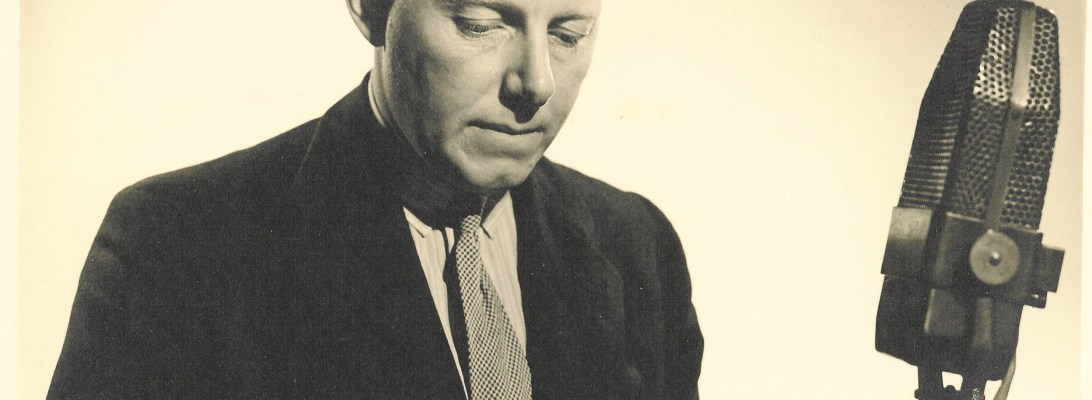
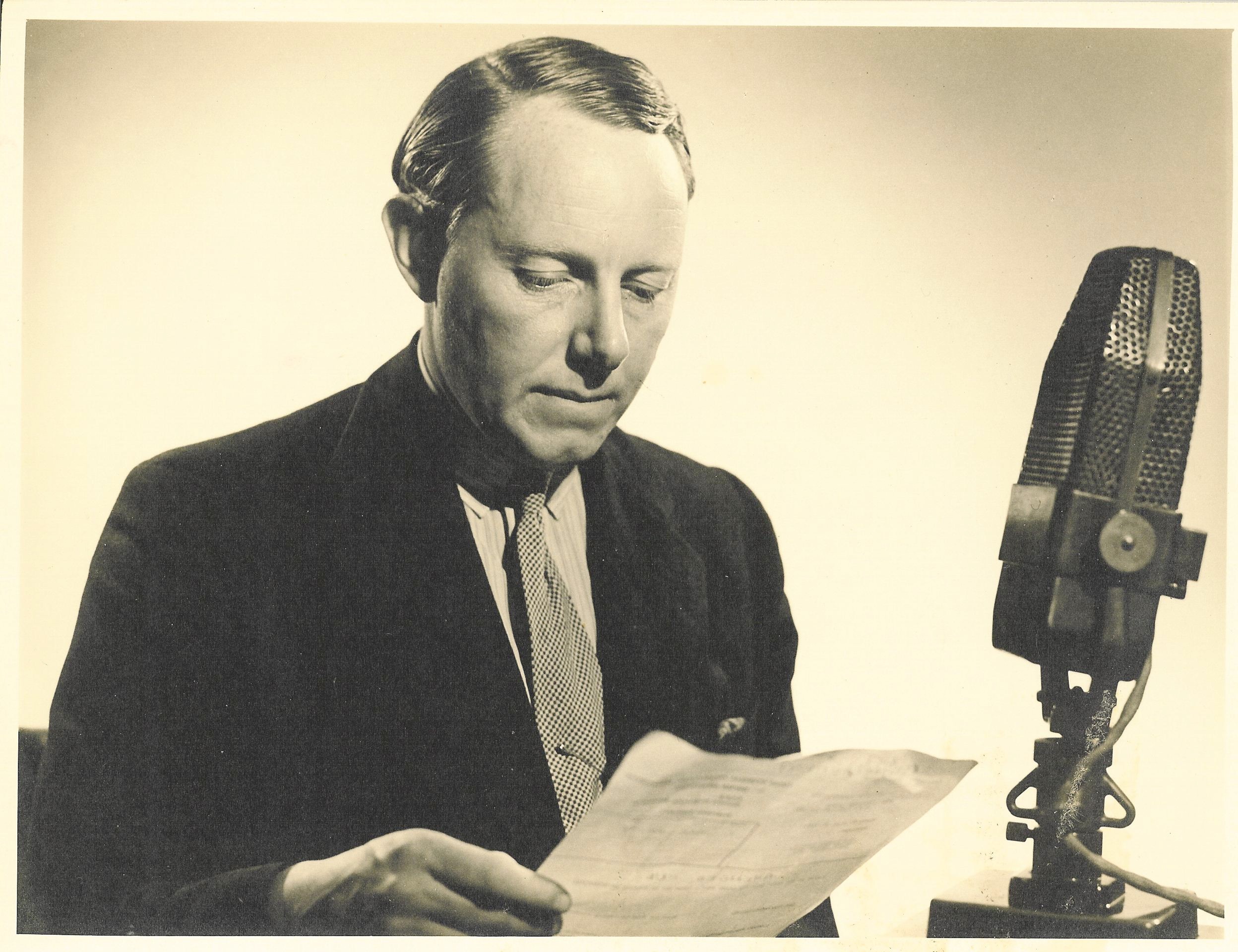
Derek Prentice at the BBC microphone – a treasured family photograph.
Prior to working at the BBC, my grandfather had been an actor. His interest in theatre had begun during his time studying French and German at New College, Oxford (which followed his schooling at Winchester College). He initially became an engineer upon graduating, but he was so passionate about acting that he was able to persuade his parents to support this true vocation. Years later, working in London – including the West End – he was put out of work by the outbreak of war in 1939, when the theatres closed. As a linguist, he first went into censorship; then turned his acting training, and vocal talent to radio. He got a job with the BBC where he frequently worked the nightshift as a news reader. One particularly treasured family photograph shows him at the BBC microphone. After the war, he returned to acting, working across theatre, radio, film and television.
He was a hugely popular newsreader and his many fans across the world would send letters and gifts to him and his young family (his wife, Katherine and their two daughters) in beleaguered Britain . He would share these gifts with his colleagues – there was more than enough to go around. Other published reminiscences we have found echo that he was a recognised and much-loved radio voice of the time.
My mother and I have been trying hard to track down the original recording of that D-Day broadcast. Our many attempts to obtain a copy included approaching the BBC, who were very helpful but unable to locate the original recording. However, recently in April this year, we reached out again to the Australian Broadcasting Commission, who had featured the broadcast in a programme marking the 70th anniversary of D-Day in 2014. We were delighted to be told this time that they could make their recording of that original shortwave radio broadcast available to us. And with the BBC’s permission they have just released a copy of it for our personal use.
It’s wonderful to hear my grandfather, who I never met (he died before I was born), announcing such a pivotal moment in history; one we now know would lead to the end of WW2.
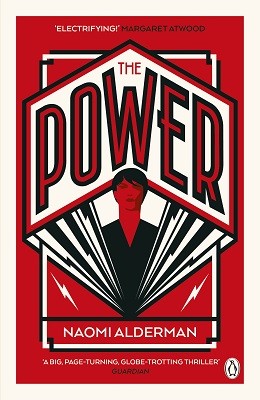
It’s no small coincidence that having devoured every episode so far of Succession’s final season, with its jostling for position and power-games, that I would be in mind for a bit more. As I was scrolling through a myriad of options for Something Great to Watch, I came across The Power. Released on Prime at the end of March, it’s the TV adaptation of Naomi Alderman’s brilliant book of the same name, which I read a few years ago.
Where Succession deals with posturing for control of the Roy family’s patriarchal media empire, The Power charts the complete undoing of patriarchal society as we know it. Set in a dystopian future, this piece of speculative fiction follows the unfolding events of a global crisis, happening in the wake of an unconventional women’s uprising.
The Power on Amazon Prime trailer, starring Toni Collette and John Leguizamo among others
To say that I am excited to watch the TV adaptation is an understatement, and judging from the trailer (above) it looks like pretty compelling viewing. But however faithful it is to the book, by all accounts, The Power really benefits from being read. Not only to experience its characters in more depth, but to properly digest its details and themes. And so as not to miss the challenges and implications of what it explores, despite its unmistakeable entertainment value. Read my thoughts on the book below – warning: some spoilers ahead.
The Story of The Power
I initially dismissed The Power by Naomi Alderman as popular fiction. I thought it was a sort of feminist chick-lit, which I wasn’t particularly interested in (the chick-lit that is, not the feminism). Thankfully, a friend strongly recommended I read it, lending me her book, so I had no excuse.
It turned out to be a great recommendation. As I often gravitate towards books about politics and society, philosophy and spirituality, whether fact or fiction, this was right up my street. Incidentally I also enjoy crime novels and thrillers, sci-fi (within reason) and the classics. (And a good autobiography never goes amiss). I really like dystopian fiction – probably because it draws on so many of these elements, arranging them in such a way that it brings a new perspective on current circumstances.
And I’m a firm believer that any creative work, whether it’s a book, film, art, spoken word or music has the potential to speak into the issues of life and society. In a way that often cuts through the noise and rhetoric, getting straight to the heart of the issue. In this, The Power has already made a significant impact. It was described by one critic as “one of those essential feminist works that terrifies and illuminates, enrages and encourages.”
The story is set in a near future. In the best tradition of dystopian fiction it is a world that is at once foreign and familiar, new and relatable. This, along with Alderman’s writing, helps to make the circumstances and premise of the book oddly plausible. Within the first chapter I’d already accepted its dystopian ‘reality’ without much argument. Women discovering that they have the capacity to generate electricity thanks to a vestigial muscle, an electrical ’skein’ on their collar bones, seemed reasonable enough.
This new ‘power’ is awakened in a sort of adolescent coming-of-age which gives women and girls a new and shocking ability (literally). Once they come to terms with this electrical upgrade in their bodies, they discover its potential as an in-built self-defence mechanism and even a weapon, putting them on a physical par with their male counterparts.
It empowers many to address ingrained fears and imbalances. Suddenly aware of a subtle, second-nature timidity in themselves they have never questioned until now. By learning to harness this new ability they realise they can combat their intimidation and address the oppression they experience from the men and society around them.
The Power interweaves the stories of several female characters in whom this new ability has suddenly awakened. In the book, Alison escapes an abusive home by electrocuting her uncle while he assaults her. She befriends Roxy, the tough-as-nails daughter of a London crime family. Who, in spite of her inner strength and resolve, becomes one of the most vulnerable in this new reality. Margot is a government official who is grasping to maintain her position and tow the party line (while struggling to keep her emergent power under wraps). And her daughter, Jocelyn, is right in the midst of her teenage angst, never mind everything else that’s going on.
There’s also Tunde, a male journalist who follows the ensuing uprising across the globe in the wake of what is coined ‘The Day of the Girls’.
The book isn’t just about how this new-found power impacts relationships with men though. It explores this, but in addition it looks at how this power changes women themselves and how they relate to each other. There’s a religious angle too. One character believes she can channel a deity figure called Mother Eve, inspiring devotion from thousands of women as the antithesis of a patriarchal god. It gives them a new found sense of purpose and calling. Despite this hopeful transcendence, there is a dangerous and sinister side to the origin of this figure. You wonder at its true agenda and how trustworthy it is as it marshals women to become increasingly militant. The transformation of society is near total but unsettlingly it mirrors the characteristics of patriarchy, now in female form.
The Power (And Power Itself)
The Power goes beyond simplistically confirming the potential seen as inherent in women’s feminism. And does more than explore its imagined capacity to overthrow established male power structures. It actually asks some really difficult questions about the nature of power itself.
The chaos that ensues after the ‘Day of the Girls’ is also the book’s challenge. The issue isn’t just about who holds power. It’s not simply about men abusing positions of authority or the patriarchy being at fault. That’s not to say that these systems (and the individuals within them) aren’t capable of doing egregious harm. But the books posits that a total transfer of power from men to women wouldn’t create the easy utopia one might imagine either. It is about the nature of power itself and its ability to corrupt whomever holds it. Along with the systems established to operate it.
For me, the book is a brilliant exercise in challenging perception. It does this by totally upending what we experience in society, and know to be the status quo. The Day of the Girls is no gradual or incremental change towards equality. It is a sudden and overwhelming shift to an opposite, providing the starkest of contrasts. To imagine a world where women hold the utmost power and what kind of society it would create for us is extraordinary to consider. Not least because it highlights how much we continue to accept as normal. And quite how much remains unchallenged in what is essentially still a patriarchy. As a woman, to imagine myself in a situation where I have complete societal superiority and advantage is mind-blowing. Yet also extremely discomforting as I consider all the pitfalls that holding power has. Those which society bears witness to on an almost daily basis.
I found myself asking, ‘What would I do if patriarchy was completely overturned?’ If women were suddenly, by default superior and in charge, by some unearned biological advantage, as the book explores. Could we be just as susceptible to the misuse of power? Just as likely to subjugate and do harm to those who have less or no power at all? It’s a sobering thought. Our human commonality making us all vulnerable to this regardless of gender.
It underlines that any kind of ‘-archy’ (that is, ‘system of governing rule’), regardless of how it is organised and who’s in charge, is open to corruption and abuse of power. The historian and moralist, known as Lord Acton, expressed this opinion in a letter to Bishop Mandell Creighton in 1887. It forms the basis of the well-known proverb:
“Power tends to corrupt, and absolute power corrupts absolutely.
Lord Acton
With this in mind it can seem that creating a genuinely fair and equal society for all is an unachievable utopia. Despite the checks and balances that exist in the constitution and through the law, in parliamentary processes and in democratic procedures, power is always prone to corrupt those who hold it. At large and small scales, and in every sphere.
But there is an alternative to the idea of overturning established power structures, and the corrupting nature of power itself. One which doesn’t end in one group or gender gaining superiority over another. It would take the mechanism designed to overthrow established power and turns it upside down and inside out…
Putting Power Aside
During the recent crowning of King Charles III, (go with me on this) there was a part which seemed like something of an irony. Whatever you may think about the monarchy; at his coronation, the new king made a disarmingly profound statement. He pledged that “I don’t come to be served but to serve”. In doing this, he committed himself to an important principle; that his rule and reign would be underpinned by service to others. This intention means that he doesn’t assume power because of his privilege and position as king. Instead he is responsible to lay these things aside and prioritise serving others. He doesn’t expect people to serve him. The idea is that it’s volitional and reciprocal.
This is inspired by Jesus, and taken from his words in the Bible, something which infused much of the coronation service. Mark 10:41-45 says, “Even the Son of Man [how Jesus often referred to himself] did not come to be served, but to serve, and to give his life as a ransom for many”. By way of explanation: Philippians 2:6-11 says, “Who, being in very nature God, [he] did not consider equality with God something to be used to his own advantage; rather, he made himself nothing by taking the very nature of a servant, being made in human likeness. And being found in appearance as a man, he humbled himself by becoming obedient to death— even death on a cross!”
The determination to put power aside and serve other offers us the ultimate solution. It neutralises the self-interest inherent in the corrupting forces of power, and renders them inert. Instead of power being something lauded over others, grasped or wielded, it becomes a creative medium; something that is generative and multiplying. It makes it a force for the good of others, serving their best interests, enabling them to flourish. By adopting this approach to power we’re not assuming or jostling for position, because it removes the need for competition and one-upmanship. There is nothing to overthrow or invert because no-one is claiming power as their own in the first place. And I wonder what that world would look like.
We all have human desires; some are good, some not-so-good. But they are often unwieldy. Trying to be wise in our approach to them can really help us and benefit those around us. But what is wisdom? Read on below.
Or you listen to the audio – this is a talk is from the ‘Get Wisdom’ series at St Albans, Fulham – a church community seeking to follow Jesus and better understand how to live like him.
What is Desire?
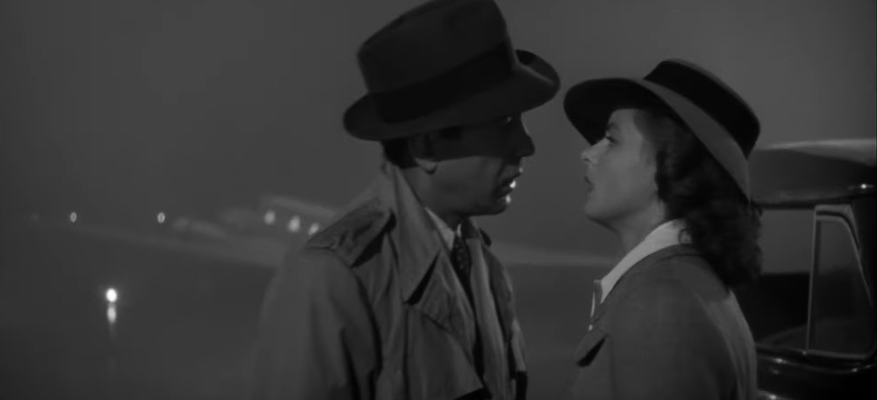
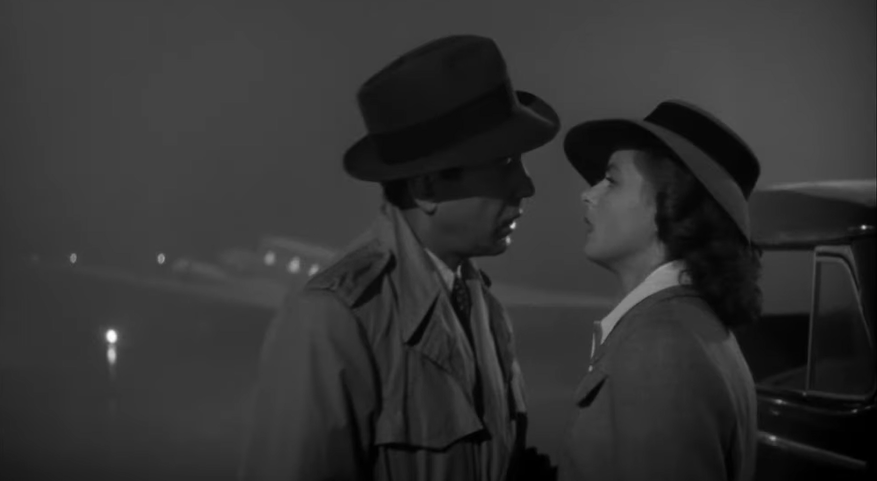
What does the word ‘desire’ mean to you? Desire is definitely a strong feeling. It makes me think of old movies – something about those clinching embraces. To desire something is to want it strongly, ardently. It’s wishing for and hoping for something to happen. It’s a longing and a yearning for something or someone. It’s deep, and it impels us and motivates us to take hold of what we want. It’s often shows us what we’re living for. Desire like that can be really good for us.
Film still from ‘Casablanca’ featuring Humphrey Bogart and Ingrid Bergman
But as good as our desires can be, they can also become corrupted or misdirected. Or they can originate from our earthly, sinful natures – our flesh. [Note: In Christian thought our tendency as humans is towards being entirely self-orientated: to the cost of ourselves and others. It is referred to in the Bible as ‘sin’ or our ‘flesh’, earthly not heavenly. These are seemingly out-dated concepts, but can explain how it’s possible to live devoid of higher ideals unless we discover a better, transcendent purpose for our lives and existence.] Rather than a longing or yearning to be fulfilled by God, we harbour desires where instead we crave or lust after something or someone. Wanting to obtain these things and take hold of them for ourselves. And it leads us into sin (which takes us away from God), which is not good for us. We need wisdom to control them.
What Are You living for?
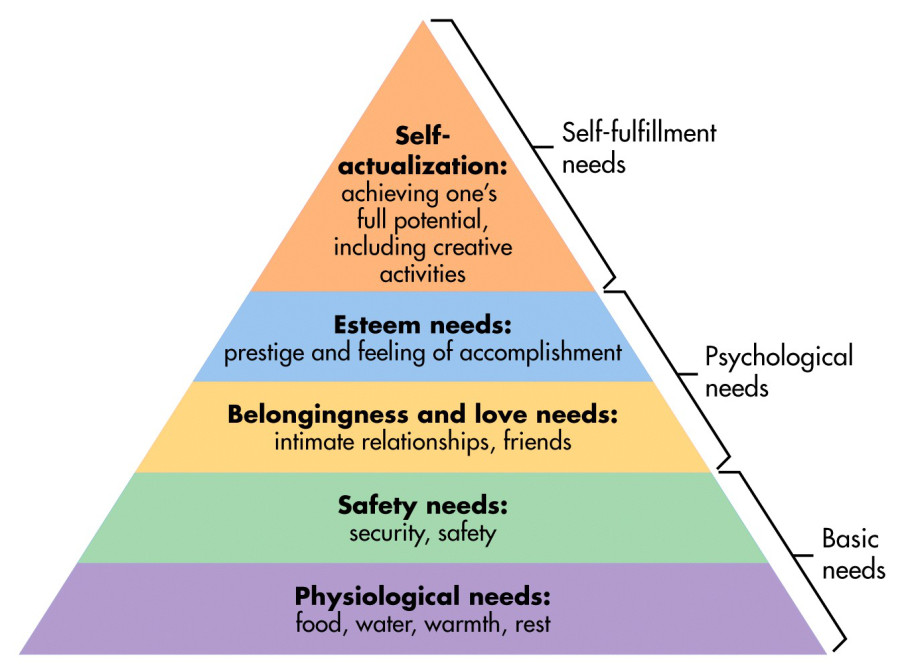
You may be familiar with Maslow’s hierarchy of needs. Abraham Maslow was an American psychologist practising in the mid 20th century. He came up with this idea in psychology called his ‘theory of human motivation’. It explains that people are motivated to meets their needs in a particular order, depicted as a pyramid. You have physiological needs first; food, water, warmth, rest. Then safety and security, belonging and love (friendships and relationships). Then self-esteem, prestige and feelings of accomplishment. And at the top of the pyramid we reach ‘Self-Actualisation’. Where we fulfil our potential, becoming our truest selves. The theory is that we are driven forward in life by this desire to self-actualise.
I’m no psychologist, and I’m not sure that this can be applied universally. But it’s certainly a motivation for many people, especially in our culture. Companies make their marketing and advertising appeals based on this intrinsic desire and motivation. That in buying their product, or ‘doing their thing’, we’ll fulfil our desires. And we’ll affirm or become our truest selves.
Two Types of Chaos
In school I learnt that entropy is when particles (because they have their own energy) diffuse from high density to low density. From being very close together to being very spread out. That’s how your air freshener spreads through the house. More specifically, entropy is a measure of disorder. It measures the capacity of particles to assume any number of disordered and chaotic possibilities.
Chaos is one way to describe the nature of sin. Through sin, one type of chaos entered the world. One which is constantly dismantling the good order of the universe [which Christians believe was] created by God. Sin’s chaotic end point is disorder, destruction and death.
In the beginning God’s good creation started with another type of chaos – the early ‘chaos’ of the cosmos. Like having a great idea and scribbling everything in your head onto a piece of paper, before bringing shape to it.
This creative chaos was symbolised by the ‘waters’. And [in the story of Creation told in Genesis] the Holy Spirit was brooding over them. It was a pregnant chaos, full of divine energy, potential and possibility. The energy of this chaos was driving towards order, not disorder. Growing more organised, gaining clarity, structure, shape and form. It was multiplying for good, and building the good things of God.
But chaos isn’t easy to control, whether constructive or destructive. It has its own energy. And I think it’s similar with our desires, they have their own energy. Our combined desires can be a positive or negative force for our lives, driving us towards God’s good order or towards disorder. But ultimately directing our lives and our futures.
The Heart of the Matter
[The Bible’s] wisdom cautions us: ‘Above all else, guard your heart, for everything you do flows from it’ – Proverbs 4:23
In his autobiography, Surrender, Bono – lead singer of Irish rock band, U2 – describes having life-saving heart surgery. In his words they needed to fix a blister on his aorta and a heart valve gone wrong. Both of which threatened to end his life if not treated quickly. His simple explanation made me think; he says “The aorta is… your lifeline, carrying the blood oxygenated by your lungs and becoming your life”. And what pumps this life around your body? Your heart.
Both Bono and the writer of this proverb show us how critical our hearts are, albeit in different ways. The Message version says to ‘Keep vigilant watch over your heart, that’s where life starts’. In the same ways, our desires originate in our hearts, the centre of our beings. And they become our life. Your very life, eternal – flows out from there. And God places the utmost priority on it.
Our desires – the things we hope for – are meant to be satisfied too, through Jesus. [Note: Christians believe that Jesus is God’s son, who died, and was resurrected by God’s power; overcoming the disorder, destruction and death wrought by sin]. We don’t guard our hearts to lock down our desires, but to curate them, (like precious pieces of art).
Proverbs 13:12 says: ‘Hope deferred makes the heart sick…. Without our hopes and desires being fulfilled our hearts will sicken and suffer, God knows this. This proverb develops the idea further saying, ‘but a longing fulfilled is a tree of life’.
A tree of life – it calls us back to Genesis. A longing fulfilled is Eden; it’s how things were created to be. And what else is a tree of life? Wisdom is a tree of life. Fulfilled longings, Wise Living – this is God’s original design, and it’s the redeemed heaven and earth – the ‘Kingdom of God’. [Note: this is a way the Bible and Christians describe God’s intended way of life].
‘Hope deferred makes the heart sick, but a longing fulfilled is a tree of life.
Proverb 13:12
Desire Gone Wrong
Desires can go wrong – we can overlay wrong desires onto some very genuine and legitimate needs. We can turn our desires into entitlements. A desire that started as something supple can become rigid and calcified, demanding and lustful. Desires are also subjective, they are different from person to person. And a presenting desire – might actually be driven by a need for something else, like connection, or understanding perhaps.
We’re to exercise wisdom, not foolishness. Although sin plays a significant part in desire-gone-wrong, being foolish isn’t necessarily sin. But the ultimate folly is to allow sin to rule our desires. That’s why we are to guard our hearts so carefully.
Like Adam and Eve, in the abstract, it’s perfectly easy to accept God’s wisdom and guidelines without question. We earnestly pay lip service to it. If we’re Christians, we believe that we believe it! And we want to obey it. But what’s more difficult is when we’re faced with a situation when we know what the wise thing is, but our not-so-good desires get in the way. We can unwittingly entertain evil desires. So that in the moment, rather than making a wise choice, we make a foolish choice.
James 1:14 captures the conflict we find ourselves in ‘…but each person is tempted when they are dragged away by their own evil desire and enticed. Then, after desire has conceived, it gives birth to sin; and sin, when it is full-grown, gives birth to death’.
He goes on to remind us that when faced with that choice we’re not to be deceived (as Adam and Eve were). God does give us good gifts, to satisfy us and fulfil our longings. He hasn’t suddenly changed, he’s not going to leave us in the lurch. No matter how persuaded we might be.
“Don’t be deceived, my dear brothers and sisters. Every good and perfect gift is from above, coming down from the father of the heavenly lights, who does not change like shifting shadows“.
James 1:16
Foolishness Can FEEL Like Wisdom
There’s another problem here as well.
In Genesis, the enemy threw God’s wisdom into doubt. He twisted it, framing it as something negative that withheld truth and prevented insight. What a snake! He cast aspersions on God’s nature, suggesting: “How can He be generous and giving? No, He’s mean and miserly!” He enticed them: if they ate the fruit of the tree of knowledge, they could be the ones to decide what wisdom looked like, not God. They could be all-knowing, they could be equal to God. They could be gods themselves. He succeeded in convincing Adam and Eve to turn their backs on God’s wisdom and the good order of his creation.
That’s human nature isn’t it? We want to be the ones to decide how we live, we want to determine what’s good for us, and what is wise. The Bible warns us against this: Proverbs 26:12 says ‘Do you see a person wise in their own eyes? There is more hope for a fool than for them’.
So you might say that to be wise in your own eyes is the most foolish thing of all.
Come With Me to Corinth
New Testament Corinth was a Brave New World. It was a modern capital in the ever-expanding Roman Empire. The Corinthians were certainly ‘wise in their own eyes’. They were full-out living their own wisdom and living it to the max. It was a lifestyle, an art-form even. The attitudes of today, pale in comparison to the Corinthians. Even to people of the time, Corinth was morally off the chart, the word to ‘Corinthianise’ literally means to live a promiscuous life, which gives you an idea of their lifestyles.
Into this context, steps Paul. He arrived to visit the newly formed Corinthian church, and to encourage the believers there. What he found was that for all their human wisdom and sophistication at the time, the Corinthians were being foolish. Paul knew it. One of the major mindsets he confronted was in their sense of self-determination, the right to do what they wanted. Their mantra was “I have the right to do anything”. And though they were exercising a type of freedom, Paul challenges them that the choices they were making were not actually beneficial to them. They weren’t wise. There was more to freedom than a technicality. They were not living in their freedom wisely or well, they were being foolish.
He reflects this to them saying: ‘”I have the right to do anything”, you say – but not everything is beneficial. “I have the right to do anything” – but I will not be mastered by anything. You say “Food for the stomach, and the stomach for food, and God will destroy them both”. The body, however is not meant for sexual immorality but for the Lord, and the Lord for the body’. 1 Corinthians 6:12
The new Christians in the church at Corinth hadn’t shaken off the values of the surrounding culture. Underpinning their ‘right to do anything’ was not freedom. They were enslaved to the culture – to individualism. They lived a hedonistic lifestyle, verging on being nihilistic. In Corinth, the believers were living out of step with their professed Hope in Jesus. There was so much more to life and they were in danger of becoming enslaved all over again, this time to their own desires.
I wonder if into the culture had seeped a pervasive belief; What does it matter what I do with my body if it’s just going to be destroyed? What does it matter if all I really am is firewood? I’ll rather invest in the mind, in ideas, and my body can do whatever it likes.
You see, Corinth had had a chequered past. In 146 BC it had been torched, burned to the ground and laid to waste – its inhabitants either killed or sold as slaves. It was a city destroyed. In 44 BC, desolate, it was colonised by Julius Caesar who rebuilt it to became the capital of the Roman province of Achaia. In a relatively short amount of time Corinth had become a major port, place of trade, and cultural centre – to become a very wealthy city.
Corinthians and Culture
The culture was shaped by ancient worship of Aphrodite, the greek Goddess of love, beauty, pleasure and procreation. And though Aphrodite’s temple had been destroyed, it was rebuilt in Roman times – its culture of promiscuity along with it. In terms of religion Corinth had gone from pantheism to a fusion, which combined the worship of the twelve Olympians of the Greeks, with the paganism of the Romans. Add to that the fact that Corinth was a melting pot of every culture that the Roman empire had conquered and you have a very heady mix.
Although they venerated intellect and learning in the ancient Greek tradition, alongside this ran a belief that the body was of minimal importance, they reduced it to something carnal and animalistic, whose appetites must be fed. Keep the body’s desires satisfied, well-fed and quiet so we can focus on bigger things. This was considered morally correct as you pursued higher things like knowledge and the teachings of the philosophers. But this was a foolish approach.
This holds up a mirror to our own culture. We tend to say now, “it’s fine as long as it doesn’t hurt anybody”. Parents teach their children this, this is our moral compass in this society. Where the Corinthians said “I have the right to do anything”. We might say “You do you”. We consider there being nothing wrong with this. No harm no foul. But the Bible makes the point that if it’s hurting you, it is a problem. And that includes your eternal soul. You may not be sinning against others but it is foolish to be sinning against yourself. [In the context of the prevailing culture and presenting issues at the time] Paul urged the Corinthians to ‘Flee from sexual immorality. All other sins a person commits are outside the body, but whoever sins sexually, sins against their own body’. And what you’re doing might be technically permitted, it may not be sinful, you may even be doing it with the best of intentions but is it wise in the end?
While the Corinthian believers were continuing to live in light of their culture, Paul was passionate about them living in light of eternity. Jesus was resurrected body, soul and spirit and we are saved, and will be resurrected body, soul, and spirit. God considers the body to be as holy and precious as our eternal souls, which he died for. [In the biblical and hebraic worldview we are one within ourselves,] those parts are indivisible, we are integrated beings. Paul knew that as believers, our context is eternity, and the thing the Jesus prized most highly, dying so we could have it was eternal life. So for the Corinthians to live with the belief that their bodies were nothing more than firewood didn’t align with the awesome reality of resurrection.
Plant Your Flag
Mountaineers have a practice of planting a flag to show how high they’ve climbed, and to mark how far they’ve come on the journey. We can think of the Christian life as a journey to the summit of a mountain. And it can feel like a long, arduous journey. The problem with trying to control and manage our desires, with their chaos, is that it gets tiring. Sometimes we just want to set up camp rather than keep going. Here and no further, thank you very much. I’m not prepared for it to cost me any more, I’m not going to give up the chance to have what I desire now. I’m not going any further.
And so, even though we’re called to reach the summit, we risk settling.
Where would you plant your flag? What are your non-negotiables? When it really comes to it what desires are driving your life? Wanting a relationship, to be married, sex, the fulfilling job, recognition, a big salary, ease, comfort, being right, holding onto that grudge, staying in unforgiveness or self-pity, the excuse of your past failures, getting the last word, that habit. There are many who decide that there are things they just will not give up or lose, they plant their flags on any number of things – some are good, but just at the wrong time, or in the wrong order.
Mark 8:36 says ‘What good is it for someone to gain the whole world, yet forfeit his soul’.
If we recognise any of these things the good news is that Jesus is faithful to forgive us and restore us.
So what’s the solution?
We’re Not Meant to Control Our Desires
You may know C.S Lewis’s book ‘The Great Divorce’. It’s set in a dream which starts in a joyless city, a ‘Grey Town’, where passengers are boarding a bus, before it heads off into the sky. When they get to their destination, they realise they are in a beautiful country. And we discover that they are in fact ghosts. The country is so solid and shining and real that the grass hurts their feet. Many can’t bear it, and in the end almost all of them decide to turn around to go back ‘home’.
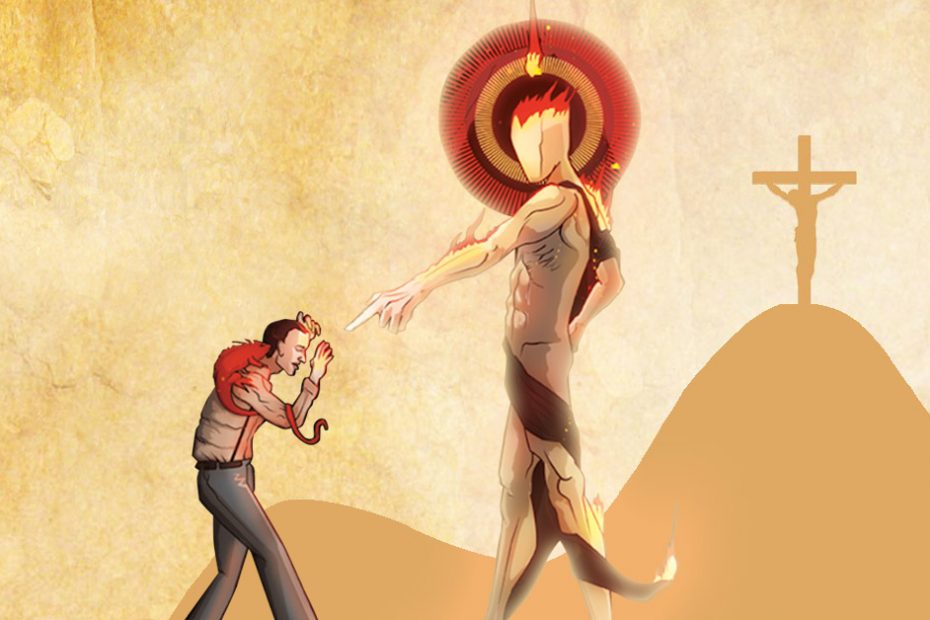
Towards the end of the book we meet a character who is caught in indecision. He has a desire to press on, to be all he could truly be, and he is so close. But he can’t enter into this fulfilment without making a choice. He is very attached to a small red lizard that sits on his shoulder, it’s been there a long time. It constantly whispers lustful things into his ear. The man can’t continue onwards if the lizard stays with him, it’s just not possible. The lizard must die. An angel standing opposite him offers to kill the lizard, and there ensues a long conversation back and forth between them about why he doesn’t think it’s a good idea for the angel to kill the lizard, while the angel tries to reason with him. The man just can’t live without it. Eventually the angel persuades him, and though it hurts him it has the most amazing effect. He’s made a wise choice. And something extraordinary happens. The man is transformed into a huge shining, solid person, he’s no longer a ghost – he’s like the people in this beautiful land, and the lizard, thought dead comes to life as a beautiful solid stallion.
Colossians 3:5 says: ‘Put to death, therefore, whatever belongs to your earthly nature: sexual immorality, impurity, lust, evil desires and greed, which is idolatry. Because of these, the wrath of God is coming. You used to walk in these ways, in the life you once lived. But now you must also rid yourselves of all such things as these: anger, rage, malice, slander, and filthy language from your lips. Do not lie to each other, since you have taken off your old self with its practices and put on the new self, which is being renewed in knowledge in the image of its Creator.’
Illustration depicting a scene from The Great Divorce.
Wisdom is putting to death whatever belongs to our earthly natures. We can’t control the chaos of our desires, but we can control this choice. We can choose to ‘crucify our flesh,’ and our competing desires. To end the chaos, placing ourselves in God’s redemptive order. Where are you coddling your flesh, rather than crucifying it?
But we don’t crucify our earthly desires to end up with nothing. We do so, because God wants to give us something far better in place of them. To put them to death is to allow God to resurrect our desires, to rescue them from being the insubstantial versions we thought were so satisfying, utterly transforming them. A stallion just doesn’t compare to a lizard, it’s completely different. Unless we let go of our old selves and take up our new selves, we can’t fulfil our God-given potential.
Flip the pyramid
Returning to Maslow’s hierarchy of needs:Jesus turns this on its head.
He starts with our desire for self-actualisation, and all the ways we pursue that through our desires good and bad. He transforms it, and in turn our potential, ridding us of the chaos caused by sin and competing desires. He re-establishes his good created order in our lives, resurrecting our desires. He fulfils our longings so they become a tree of life, and shows us how to live wisely.
Our salvation through Jesus fulfils our deepest longings and changes the paradigm we’re living in. Jesus prioritises the resurrected, eternal life over everything else. He came to give us life, and life in abundance. We don’t self-actualise through finding ourselves, but through finding Him. And not through holding onto our lives with their desires, but in letting them go, so they can die and be raised to life. It was only by being crucified and dying that Jesus was able to be resurrected to eternal life, and us with him. We become our truest selves.
And rather than the ever-narrowing pyramid where we’re driven towards self-actualisation, we find that eternal life flows from us and multiplies out exponentially, as we continue to seek first His kingdom and his righteousness. Having been crucified with him, along with our desires, we now radiate out his resurrection life. We are solid, real people. And the picture looks very different from here.
In Conclusion
I’m going to borrow a quote here. Last week I was at an event for founders and entrepreneurs, and the keynote speaker, quoted Jamal Edwards MBE, who was a British music entrepreneur and DJ. He tragically died in 2022 leaving an incredible legacy, having done an incredible amount of good for his community and beyond, inspiring many many people. He said this:
“Set goals so high they demand an entirely different version of you.”
Jamal Edwards MBE
And hearing that while I was working on this talk just made me think. God has such a vision for us and our lives that it demands an entirely different version of us. One that we find when we are crucified with him, and when we let go of our desires, releasing them so he can transform them and us with his resurrection power into something extraordinary.





 Alex Noel