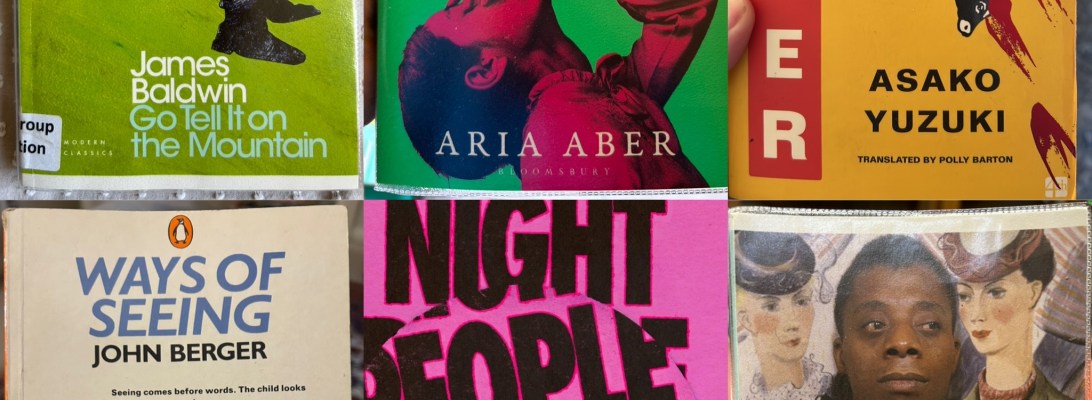
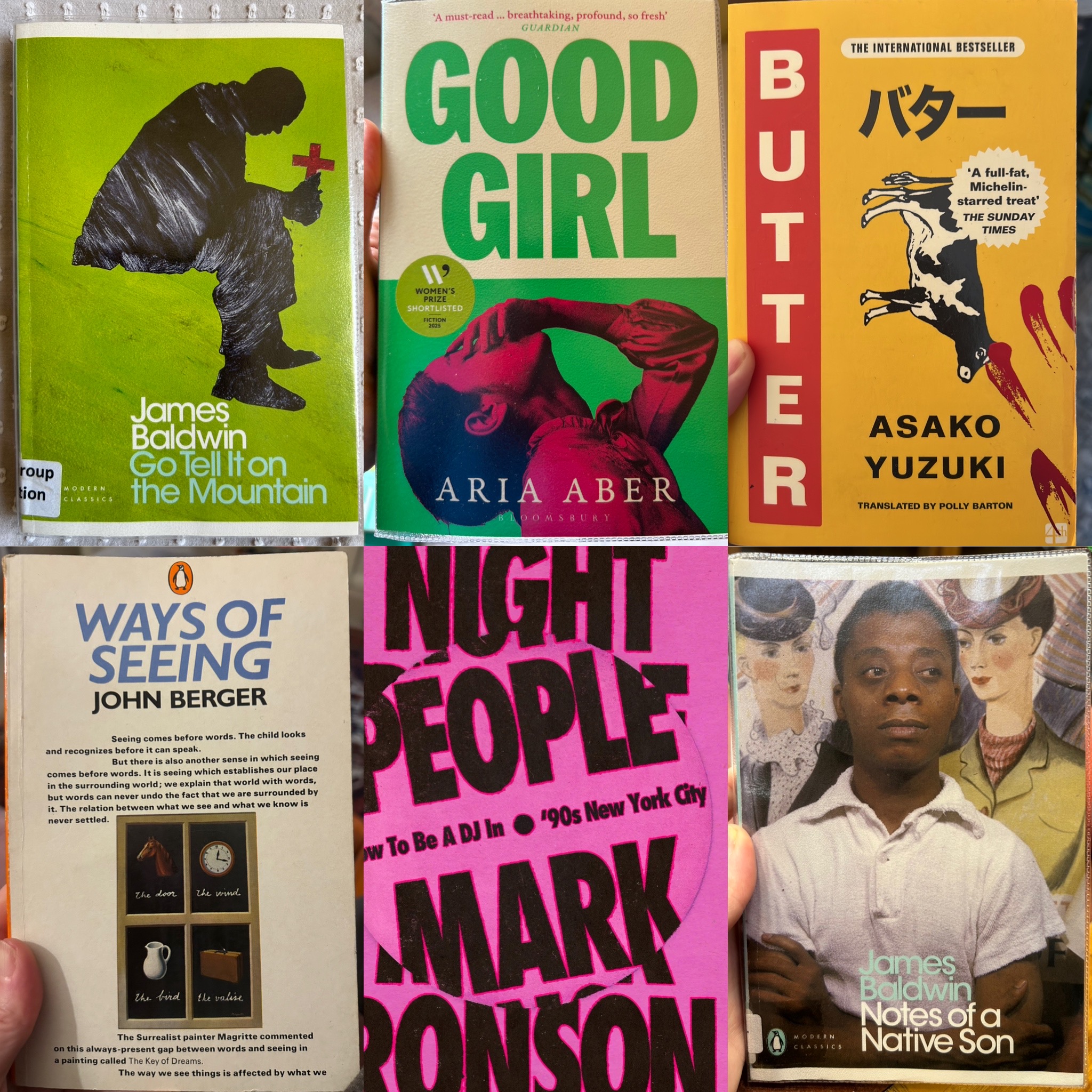
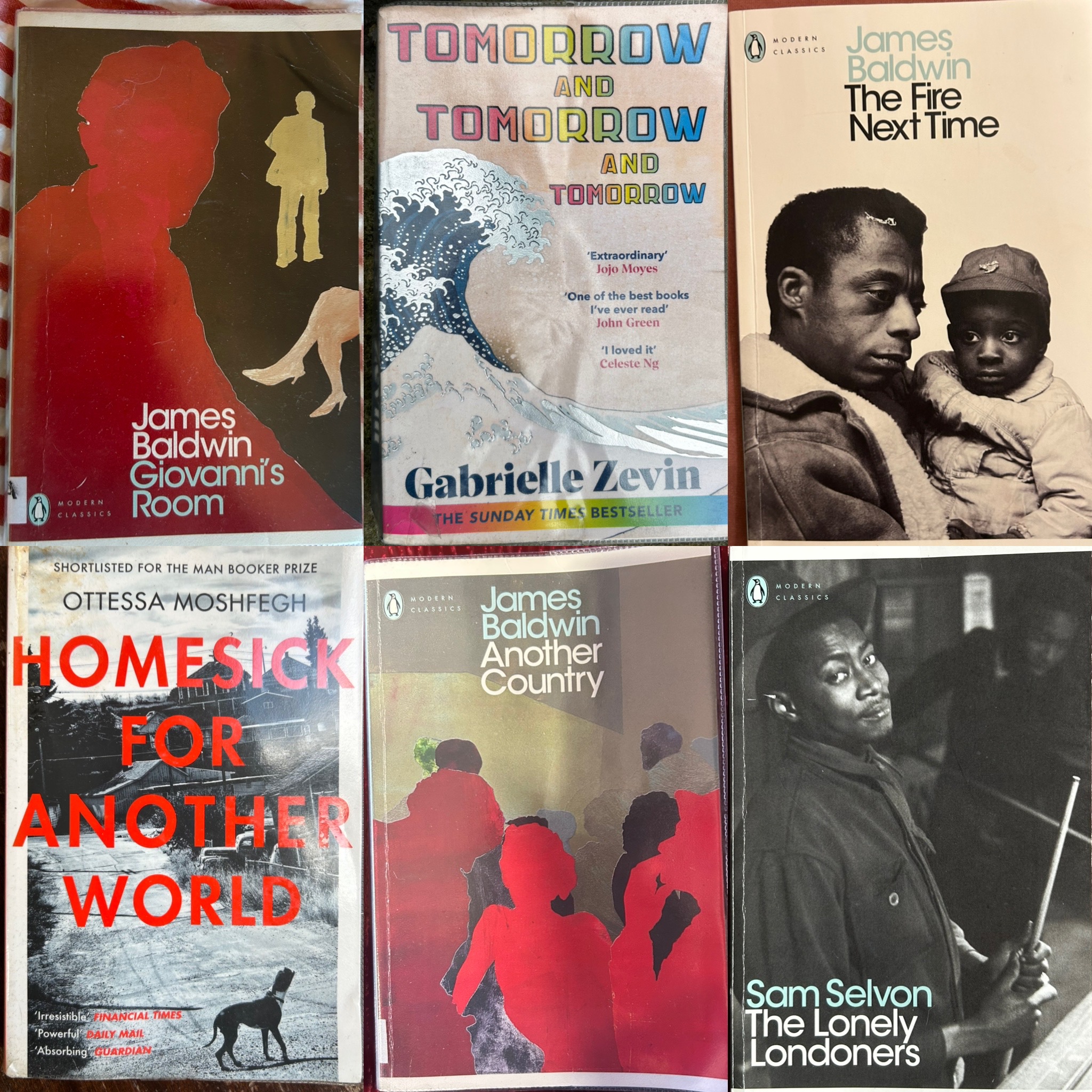
Below you’ll find some of the books I’ve read and enjoyed over the last few months… plus a few ‘next ups’ (Good Girl and Butter) and one currently in progress. Those I’ve read already come highly recommended. As for the others, I’ll just have to let you know about those. In any case, this is a shameless article about books, and for yesterday’s World Book Day no less, but it is also about literacy and something I’m really excited to be part of this year. Read on to find out more.
Book list
Go Tell it on the Mountain – James Baldwin
Good Girl – Aria Aber
Butter – Asako Yusuki
Ways of Seeing – John Berger
Night People – Mark Ronson
Notes of a Native Son – James Baldwin
Giovanni’s Room – James Baldwin
Tomorrow and Tomorrow and Tomorrow – Gabrielle Zevin
The Fire Next Time – James Baldwin
Homesick for Another World – Ottessa Moshfegh
Another Country – James Baldwin
The Lonely Londoners – Sam Selvon
When I posted this list on Instagram one friend responded wryly (and accurately): “Have you considered reading any James Baldwin :)” And yes, there is A LOT of James Baldwin, I’m definitely going through a phase. Let me explain.
Escaping the algorithm
A few months ago I decided to escape the algorithm that would invariably send me adverts for all the latest book releases, and instead let ‘IRL’ guide my reading choices. So rather than being influenced by digital marketing (which in theory I’m all for especially if you’re the one trying to market a great idea or a product you really believe in) I decided to let myself be directed by my immediate surroundings. And it has been so refreshing.
Alongside being a writer and digital marketer, I do quite a bit of cat sitting. Often I will be staying in other people’s homes and looking after their cats. Last summer, rather than buying the latest book on Amazon, I decided to limit my reading choices to either the bookshelf in the living room, or the books in the bedroom I was sleeping in. This approach has introduced me to a panoply of new authors and books I’ve only ever glanced at before. I also joined my local library, which happens to be quite large with lots of choice. So that too, has been a brilliant non-digital / real-world / analogue (*delete as appropriate) way to find new books to read which doesn’t depend on endlessly scrolling my social feeds.
And so, when it came to choosing my next great read, I would take my time, and stand quietly in front of the bookshelves. Just letting my attention rest on books I’d not seen before, or those I had heard of and always wanted to read. No hurry, or compulsion. I then might take a book off the shelves, hold it for a moment, turn it over in my hands and read the back, before skimming a few pages and deciding whether to read this one or not. And then I’d either set it down on the coffee table or at my bedside ready to read later, or put it carefully back on the shelf. This approach has been leading me to lots of great books that I don’t think I would have read otherwise. Perhaps I thought they were too old-school, or they just didn’t come into focus long enough for me to notice.
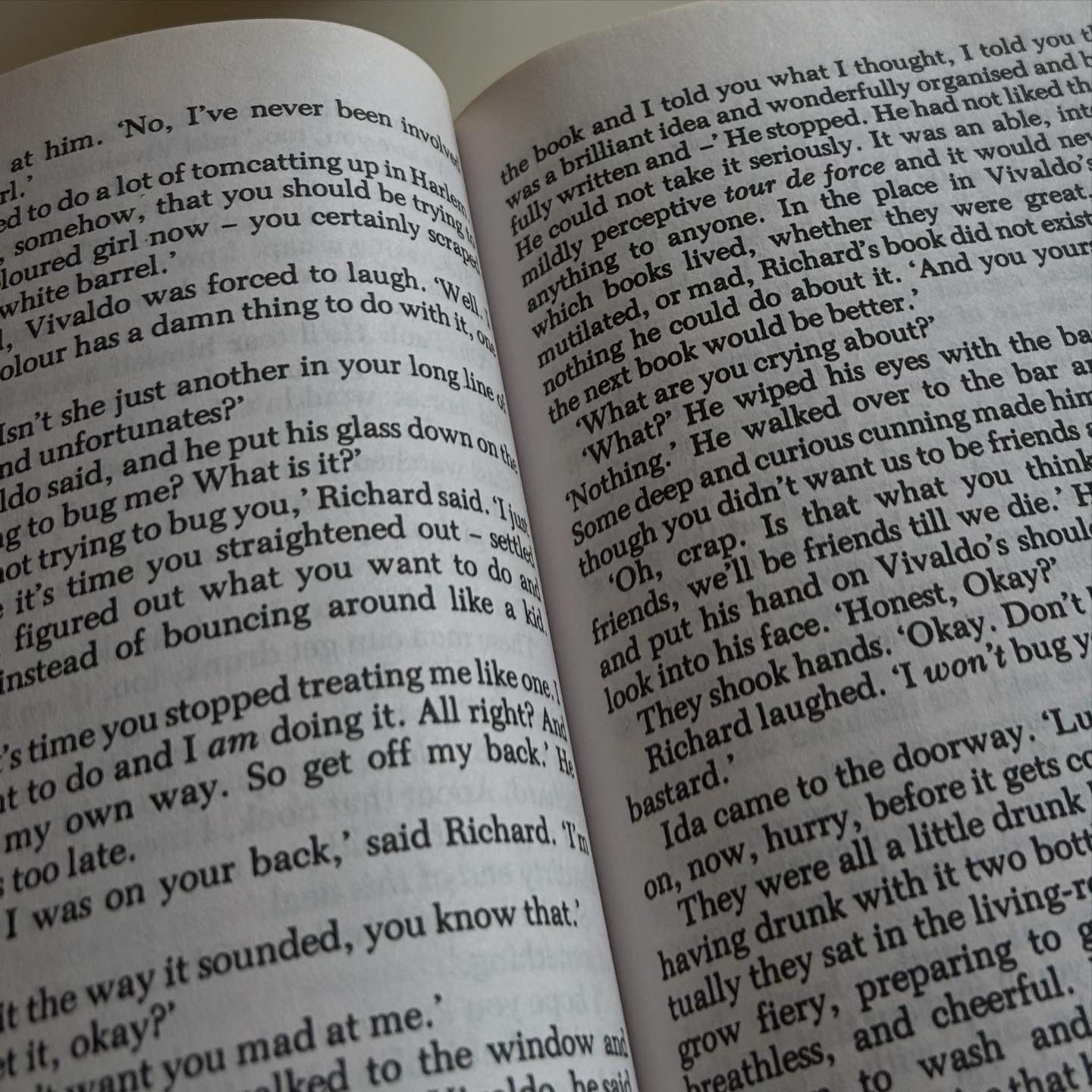
This is how I finally read a book by the great James Baldwin. And I can tell you now, his writing has impacted me more than I could ever imagine since I read him for the first time last Autumn. Better late, than never. And this feels like just the right time in so many ways. I started off with reading Another Country which I found on a library shelf, and was a very good place to start. I have since read four more books by him; The Fire Next Time, Giovanni’s Room, Notes of a Native Son. And I’m currently reading Go Tell it on the Mountain. The way he conveyed and expressed meaning; his craft, blows me away. I’m basically in love with his writing; it is tender, heart-breaking, incisive, inspiring, angering, confronting. It is very very good.
Music and social commentary
There are two things I especially love about his writing:
Firstly, it feels like music to me: the phrasing, the cadence, the rhythm and the way the words sound together. Most of all it feels like jazz, there’s that sense of push and pull, and a freshness that reminds me of improvisation. As someone who’s really ‘into’ music, the experience of reading words that feel musical really resonated with me. One thing I take a lot of pleasure in when I write, is channelling my musicality into it. When I wanted to understand more of this I discovered that James Baldwin’s writing style was strongly influenced by music, he said this: “I think I really helplessly model myself on jazz musicians and try to write the way they sound”. And boy, did he…
Secondly, what I’ve read so far (and there’s a lot more to read), whether fiction, essays or memoir – contains a searing social commentary on the world he moved through. His insights into what it means to be American and a person of colour are totally confronting, accompanied by a clear-eyed perspective on white sensibilities and how they have shaped the dominant culture in the West. It has shed a lot of light on our present moment and the way in which American culture imagines itself. He was an observer, a true artist, and someone who didn’t conform. He could put himself into the shoes of people very different to him to connect with them – writing with an empathy and tenderness which drew out their essential humanity. This approach is so inspiring, as is the way he used his creativity to hold up a mirror to society, where would we be without it? His work stands the test of time and still feels so relevant, and I’m learning so much from it.
There’s a lot more to say about James Baldwin and each of these books I list above, but that’s for another time. And now for what I mentioned at the beginning:
Writing and reading are totally intertwined, you can’t do one well without the other, (whichever tools you’re using). That’s why, this year I’ve become a National Year of Reading champion with the National Literacy Trust. If you’re looking for someone to talk enthusiastically about books, reading… (and writing), and literacy in general – do get in touch. I’d love to help!
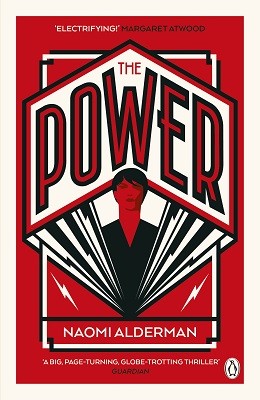
It’s no small coincidence that having devoured every episode so far of Succession’s final season, with its jostling for position and power-games, that I would be in mind for a bit more. As I was scrolling through a myriad of options for Something Great to Watch, I came across The Power. Released on Prime at the end of March, it’s the TV adaptation of Naomi Alderman’s brilliant book of the same name, which I read a few years ago.
Where Succession deals with posturing for control of the Roy family’s patriarchal media empire, The Power charts the complete undoing of patriarchal society as we know it. Set in a dystopian future, this piece of speculative fiction follows the unfolding events of a global crisis, happening in the wake of an unconventional women’s uprising.
The Power on Amazon Prime trailer, starring Toni Collette and John Leguizamo among others
To say that I am excited to watch the TV adaptation is an understatement, and judging from the trailer (above) it looks like pretty compelling viewing. But however faithful it is to the book, by all accounts, The Power really benefits from being read. Not only to experience its characters in more depth, but to properly digest its details and themes. And so as not to miss the challenges and implications of what it explores, despite its unmistakeable entertainment value. Read my thoughts on the book below – warning: some spoilers ahead.
The Story of The Power
I initially dismissed The Power by Naomi Alderman as popular fiction. I thought it was a sort of feminist chick-lit, which I wasn’t particularly interested in (the chick-lit that is, not the feminism). Thankfully, a friend strongly recommended I read it, lending me her book, so I had no excuse.
It turned out to be a great recommendation. As I often gravitate towards books about politics and society, philosophy and spirituality, whether fact or fiction, this was right up my street. Incidentally I also enjoy crime novels and thrillers, sci-fi (within reason) and the classics. (And a good autobiography never goes amiss). I really like dystopian fiction – probably because it draws on so many of these elements, arranging them in such a way that it brings a new perspective on current circumstances.
And I’m a firm believer that any creative work, whether it’s a book, film, art, spoken word or music has the potential to speak into the issues of life and society. In a way that often cuts through the noise and rhetoric, getting straight to the heart of the issue. In this, The Power has already made a significant impact. It was described by one critic as “one of those essential feminist works that terrifies and illuminates, enrages and encourages.”
The story is set in a near future. In the best tradition of dystopian fiction it is a world that is at once foreign and familiar, new and relatable. This, along with Alderman’s writing, helps to make the circumstances and premise of the book oddly plausible. Within the first chapter I’d already accepted its dystopian ‘reality’ without much argument. Women discovering that they have the capacity to generate electricity thanks to a vestigial muscle, an electrical ’skein’ on their collar bones, seemed reasonable enough.
This new ‘power’ is awakened in a sort of adolescent coming-of-age which gives women and girls a new and shocking ability (literally). Once they come to terms with this electrical upgrade in their bodies, they discover its potential as an in-built self-defence mechanism and even a weapon, putting them on a physical par with their male counterparts.
It empowers many to address ingrained fears and imbalances. Suddenly aware of a subtle, second-nature timidity in themselves they have never questioned until now. By learning to harness this new ability they realise they can combat their intimidation and address the oppression they experience from the men and society around them.
The Power interweaves the stories of several female characters in whom this new ability has suddenly awakened. In the book, Alison escapes an abusive home by electrocuting her uncle while he assaults her. She befriends Roxy, the tough-as-nails daughter of a London crime family. Who, in spite of her inner strength and resolve, becomes one of the most vulnerable in this new reality. Margot is a government official who is grasping to maintain her position and tow the party line (while struggling to keep her emergent power under wraps). And her daughter, Jocelyn, is right in the midst of her teenage angst, never mind everything else that’s going on.
There’s also Tunde, a male journalist who follows the ensuing uprising across the globe in the wake of what is coined ‘The Day of the Girls’.
The book isn’t just about how this new-found power impacts relationships with men though. It explores this, but in addition it looks at how this power changes women themselves and how they relate to each other. There’s a religious angle too. One character believes she can channel a deity figure called Mother Eve, inspiring devotion from thousands of women as the antithesis of a patriarchal god. It gives them a new found sense of purpose and calling. Despite this hopeful transcendence, there is a dangerous and sinister side to the origin of this figure. You wonder at its true agenda and how trustworthy it is as it marshals women to become increasingly militant. The transformation of society is near total but unsettlingly it mirrors the characteristics of patriarchy, now in female form.
The Power (And Power Itself)
The Power goes beyond simplistically confirming the potential seen as inherent in women’s feminism. And does more than explore its imagined capacity to overthrow established male power structures. It actually asks some really difficult questions about the nature of power itself.
The chaos that ensues after the ‘Day of the Girls’ is also the book’s challenge. The issue isn’t just about who holds power. It’s not simply about men abusing positions of authority or the patriarchy being at fault. That’s not to say that these systems (and the individuals within them) aren’t capable of doing egregious harm. But the books posits that a total transfer of power from men to women wouldn’t create the easy utopia one might imagine either. It is about the nature of power itself and its ability to corrupt whomever holds it. Along with the systems established to operate it.
For me, the book is a brilliant exercise in challenging perception. It does this by totally upending what we experience in society, and know to be the status quo. The Day of the Girls is no gradual or incremental change towards equality. It is a sudden and overwhelming shift to an opposite, providing the starkest of contrasts. To imagine a world where women hold the utmost power and what kind of society it would create for us is extraordinary to consider. Not least because it highlights how much we continue to accept as normal. And quite how much remains unchallenged in what is essentially still a patriarchy. As a woman, to imagine myself in a situation where I have complete societal superiority and advantage is mind-blowing. Yet also extremely discomforting as I consider all the pitfalls that holding power has. Those which society bears witness to on an almost daily basis.
I found myself asking, ‘What would I do if patriarchy was completely overturned?’ If women were suddenly, by default superior and in charge, by some unearned biological advantage, as the book explores. Could we be just as susceptible to the misuse of power? Just as likely to subjugate and do harm to those who have less or no power at all? It’s a sobering thought. Our human commonality making us all vulnerable to this regardless of gender.
It underlines that any kind of ‘-archy’ (that is, ‘system of governing rule’), regardless of how it is organised and who’s in charge, is open to corruption and abuse of power. The historian and moralist, known as Lord Acton, expressed this opinion in a letter to Bishop Mandell Creighton in 1887. It forms the basis of the well-known proverb:
“Power tends to corrupt, and absolute power corrupts absolutely.
Lord Acton
With this in mind it can seem that creating a genuinely fair and equal society for all is an unachievable utopia. Despite the checks and balances that exist in the constitution and through the law, in parliamentary processes and in democratic procedures, power is always prone to corrupt those who hold it. At large and small scales, and in every sphere.
But there is an alternative to the idea of overturning established power structures, and the corrupting nature of power itself. One which doesn’t end in one group or gender gaining superiority over another. It would take the mechanism designed to overthrow established power and turns it upside down and inside out…
Putting Power Aside
During the recent crowning of King Charles III, (go with me on this) there was a part which seemed like something of an irony. Whatever you may think about the monarchy; at his coronation, the new king made a disarmingly profound statement. He pledged that “I don’t come to be served but to serve”. In doing this, he committed himself to an important principle; that his rule and reign would be underpinned by service to others. This intention means that he doesn’t assume power because of his privilege and position as king. Instead he is responsible to lay these things aside and prioritise serving others. He doesn’t expect people to serve him. The idea is that it’s volitional and reciprocal.
This is inspired by Jesus, and taken from his words in the Bible, something which infused much of the coronation service. Mark 10:41-45 says, “Even the Son of Man [how Jesus often referred to himself] did not come to be served, but to serve, and to give his life as a ransom for many”. By way of explanation: Philippians 2:6-11 says, “Who, being in very nature God, [he] did not consider equality with God something to be used to his own advantage; rather, he made himself nothing by taking the very nature of a servant, being made in human likeness. And being found in appearance as a man, he humbled himself by becoming obedient to death— even death on a cross!”
The determination to put power aside and serve other offers us the ultimate solution. It neutralises the self-interest inherent in the corrupting forces of power, and renders them inert. Instead of power being something lauded over others, grasped or wielded, it becomes a creative medium; something that is generative and multiplying. It makes it a force for the good of others, serving their best interests, enabling them to flourish. By adopting this approach to power we’re not assuming or jostling for position, because it removes the need for competition and one-upmanship. There is nothing to overthrow or invert because no-one is claiming power as their own in the first place. And I wonder what that world would look like.
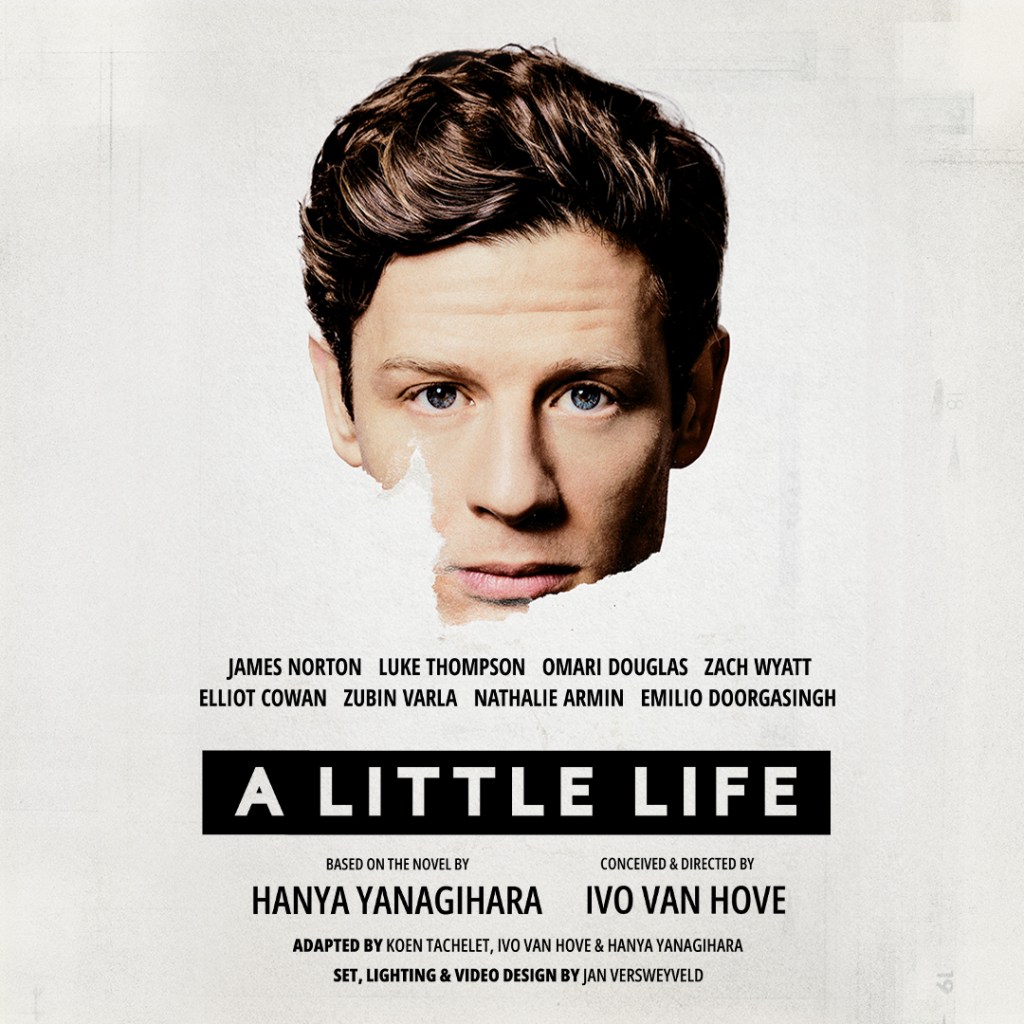
A Little Life, the book by author Hanya Yanagihara and now the play, directed by Ivo Van Hove, have acquired not a little notoriety. Both are sure to divide opinion and have definitely got people talking.
It was with some trepidation that I agreed to go and see the play of A Little Life over Easter weekend at the Harold Pinter theatre.
The friend who invited me gave appropriate disclaimers and warnings about the content. This included the fact that the seats she’d managed to get for us would be right on the stage, front row. We would almost be part of the play ourselves.
In the name of being culturally brave I said yes. And in the face of reports of the book’s traumatising effect, which would only be heightened in the play, (plus a lot of nudity – apparently) I decided that it was All Art Anyway, and the best way to approach it was as an opportunity to have a significant life experience. Neither of us had read the book yet, so we committed ourselves to that too. We formed a book club and read the not-so-little, A Little Life. Mainly as an exercise to prepare ourselves for the play.
To my surprise I absolutely devoured the book. In spite of its size, I finished it in a little over two weeks, utterly compelled to keep reading. A Little Life is an irony; for the book is well over 700 pages long, and the story is one of enormous scope. Initially daunted I found myself skipping through the pages at pace, keenly drawn into the world of the book’s main characters; JB, Willem, Malcolm and Jude, as early 20-somethings (the book spans their lifetimes)… their flat-shares, first jobs and friendships. Seeing their lives and the self-sustaining world they are creating for themselves evolve, in a forever-noughties New York.
The World of New York
Despite the city looming large over the book, there is nothing to anchor this story to any specific time or era as defined by the events of the wider world. These are absent and it’s only through scarce references to phones or emails (or certain expressions they have) that you have any idea as to when exactly this story is set. Even so it all feels very relatable. You can see and feel Hanya Yanagihara’s New York – as timeless as it is, thanks to the visually rich and evocative prose. In some way this insulation from the outside world reflects the insularity of the group’s story and their experience together. It sets the stage for our players.
The narrative landscape at the outset is broad; it warmly opens windows into the lives of this circle of four young male friends. Their characters, thoughts and relationships evidencing themselves as they talk, socialise, and daydream on trains. On moving to New York, they party together, begin projects, move houses and start new jobs, all four of them firmly on a path towards success. Their lives revolve almost exclusively around each other. We see them all at various times through one another’s eyes; Jean-Baptise (JB) the painter; Willem the actor, Malcolm the architect and… Jude.
Jude, the mystery. While his three friends are knowable – their backgrounds, ethnicities and demographies as unavoidable as open books, they in turn know nothing of Jude and his origins. It frustrates them more than it concerns them. At one point JB takes this to task saying “…we don’t know what race he is, we don’t know anything about him. Post-sexual, post-racial, post-identity, post-past…”, christening him “The Postman”. This is a postmodernist accuracy, and yet arguably wrong of Jude for whom all these are very present, as we will discover.
Jude. The ambitious and talented lawyer; working first for the US Attorney’s Office and then later ‘selling his soul’ and moving to a prestigious corporate law firm. There he develops, over time, a reputation of being both ruthless and brilliant. As notable as it is; it is not this impressive professional life that comes to matter here, but the emerging shadows and secrets from his past. And the growing dichotomy of the man he is and the man he isn’t. At one point, Harold (his adoptive father) notes that he has never known anyone so bifurcated. It is around Jude whom this story comes to revolve. Initially told from multiple perspectives, the narrative shrinks decisively as the book goes on. In concern for one very central figure, sidelining the others, it focuses its attention on one defining story. That of Jude St Francis.
Early Observers, the Artistic Eye
JB’s attention is an early portent of this. His artistic eye recognises early on the hypnotic centrality of Jude’s character to this group. He holds the role of the group’s observer, capturing and documenting the interactions between his other three friends. The photos he takes, and the paintings he makes from them, are enigmatic and wistful. While featuring his friends, they are insatiably focused on Jude. JB’s lens begins, inevitably, to expose what Jude is desperately trying to hide, much to his chagrin. Despite his ongoing attempts to keep them at bay, the shadows are creeping, and his trauma is seeping through the cracks.
Admittedly, the success these friends experience between them: Top Attorney, Celebrated Artist, A-list Actor and Brilliant Architect is rare to find in any one group alone. And yet, rather than these achievements, it is the shadows in Jude’s past that come to define them all, as it does him. He can never outrun them. Nor does he try to for his own sake, he copes, he manages. He will only attempt it for the sake of others – his best friend, Willem especially. He has imbibed his past so completely that it has become him, and despite so many good people telling him otherwise he cannot help but internalise its messages. That he is worthless and fundamentally flawed beyond redemption. The shame, and his belief that he was somehow complicit in the actions of others towards him, to the point of deserving them, have soaked him through. He is so utterly a victim of his past that he cannot separate himself from it. Not able to find even a millimetre of perspective. Or to see himself and his experiences with a modicum of self-compassion. He is subsumed and it is the trauma within him that holds everyone’s gaze, even though they don’t realise what they are looking at.
His past, we discover, is horrifying. It is relentlessly abusive. And wholly traumatising. You find yourself asking, ‘How could one person be so unlucky?’, ‘How could he attract so much malicious intent from those charged with his care?’ And ‘how could so much abuse happen to one single person’? Jude’s trauma is extreme, and dare I say it, clichéd. Yanagihara has said that Jude came to her fully formed, (and admitted that she didn’t really research his character). His trauma is equal and opposite in its extremity to the love, friendship and success he experiences with the friends around him. ‘How could one person be so fortunate in such dedicated friends?’ It would seem that this more than adequately atones for the pain and trauma in his past, but it doesn’t. Because to him it is still present – in the chronic pain and shame. And in the very identity he has formed. The resultant trauma itself is an ongoing abuse.
The book has its share of familiar tropes, which makes it feel unreal at times. Yanagihara has commented to say that the extremes were intentional. Because of these it would almost better succeed at being a fairytale or allegory, if allowed. Good versus bad. This idea did help to reconcile what at times could feel so clumsy and far-fetched as to lack any of the nuance of real life.
Fixing Tendencies
Be warned, this story will draw out any tendencies to ‘fix’. It will simultaneously appeal to, and deeply frustrate anyone who likes tidy endings and neat closure, but isn’t that all of us? Whether a problem presents itself in the form of a person or an issue – we want to solve it. But what if it turns out to be a ‘gravity problem’ – a grander, more complex issue beyond our control? This is somehow the nature of Jude’s trauma. In truth it is beyond the experience and control of any of his friends, but somehow they keeping trying to fix it. They’re at risk of becoming enablers – his doctor, Andy, is a case in point. Stretching the boundaries of professional responsibility again and again in the name of loyalty and friendship, in the hope of being the one to offer Jude redemption.
We all long for redemption – it’s key to so many narratives. It’s so expected that sometimes we take it for granted. It is the concluding resolve we expect to hear at the end of a piece of music, or the neat conclusion at the end of a film, or a familiar bedtime story. But A Little Life has no resolution, no redemption – and this anticipation will simply not be satisfied. It is the discordant note hanging in the air. And it’s this that really makes this book get under your skin. It’s shocking and uncomfortable. As is the play – it’s exposing. I’m sure this is part of the reason for its popularity… it can’t help but divide opinion, to get people thinking and talking. Just take a look at the reviews.
It is so tempting to think ‘If Only’. If only things could be different for the sake of Jude and his friends. If only he could make different choices, if only he could see how much he’s loved, if only he could find something worth living for. But this is not where the story is going, and as much as you try to hold it back, there is a desperate inevitability about the trajectory of Jude’s life. The reader, the viewer – this audience watching Jude’s life unfold, unwittingly find themselves colluding with his friends in their sense of defensive hope.
As much as this is a story about Jude and how his past trauma defines him, it is also about his friends. It emerges through their own stories that there are significant reasons why they are so drawn to Jude. And why they stay. This includes Harold; losing his young son due to a rare genetic condition, he has experienced a loss he has never recovered from. And in Jude he gets to make right the failures he sees in himself and attempt to change what happened. Jude himself becomes increasingly disabled as the book goes on, both because of the chronic pain he experiences and the damage done to his body by a deliberate car accident, as well as an undefined disease he lives with. And then there’s the psychological pain, and the deliberate and brutal self-harm he inflicts on himself as much as a coping mechanism as a way to act out his self-hatred. Harold holds him through all of it, never able to make it go away.
Willem, Jude’s closest friend, his confidante and later in the book, his partner, grew up with a disabled brother, who also died young. In the absence of his parents (first emotionally absent then physically) he cared for his brother, forging the strongest of bonds with him. Only to be told, tragically whilst he was away at college that he had died. It becomes clear that it was the needs of his brother that had held his family together, and linked him to his parents. Without his brother, he is cut adrift. He partly relives this connection and bond through his friendship with Jude.
We see this most poignantly in Willem and Harold, who remain closely connected to Jude’s main narrative as the book goes on, but there are other figures, always helping, always finding a way. For without the pasts they are trying to correct, there is no story. It’s a double-edged sword, they evidently love Jude and care for him, they rescue him again and again. From himself but also for themselves. He is fulfilling a need in them. How otherwise, could they have the patience or compassion to give so much to him. As he continues to reject their help and advice, while stubbornly refusing to help himself – whether unwilling or unable to do so. And so it is that the codependencies we see in this group were already formed before they met Jude. The pathways were already trodden, through other, earlier experiences that in some way they are all revisiting and attempting to resolve.
In the end it is JB who has seen it all clearly – observing with the distance and perspective of the artist over many years, producing a vast body of work in the process. And it’s interesting that it is JB who frustrates and challenges Jude the most. He sees through him. And he won’t let Jude be a victim, he won’t pander to him. At times it seems cruel, but in doing so he just might be the one who loves Jude the most. He sees that Jude is complicit in his own suffering. Clinging to his own narratives, his own beliefs and the conclusions he has formed about himself to obscure the truth. The truth that he is valued and loved and redeemable. As a result he remains a victim and prisoner of his past. Never transitioning to become a survivor and overcomer. Either because he won’t or just can’t, and we will never know. This is the greatest tragedy of A Little Life.
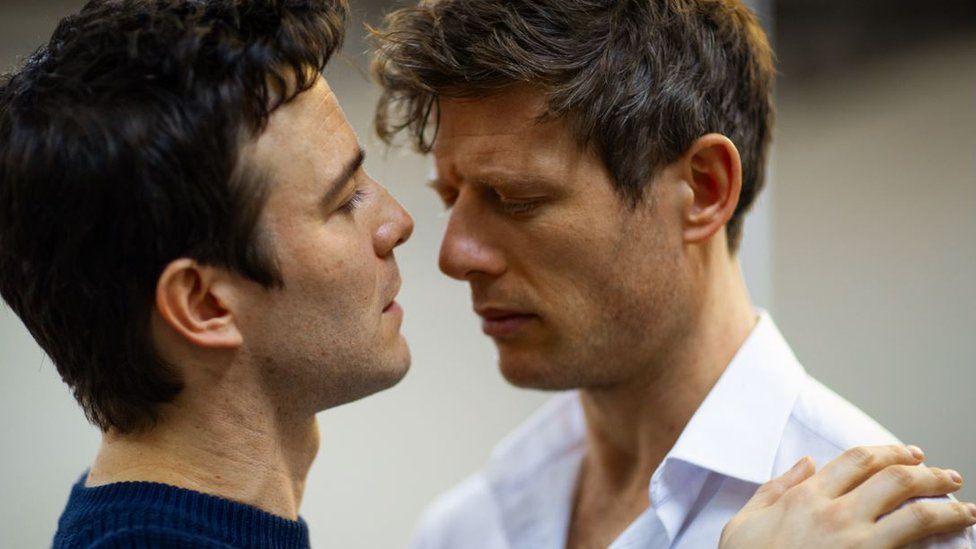
Seeing the story living and breathing on the stage added solidity and shading to the characters. Sitting on the stage brought the story to life even more and dispelled some of the extremes of the book. It brought out the subtlety and nuance. These could be real people. All with their own stories, hardships and traumas. It was invigorating to be so close and feel part of it – the action so near you could reach out and touch it. The actors’ skill in portraying these characters was unmistakable. They were captivating – incarnating and inhabiting the characters, and embodying their pain and frustrations. No more than James Norton as Jude, but also Luke Thompson as Willem and Zubin Varla as Harold. While unfortunately more peripheral, but no less present; Omari Douglas as JB and Zach Wyatt as Malcolm shone in their roles too, as did the rest of the cast. The staging, and clever touches which included cooking on stage added to the sensory nature of everything happening in front of us. Which ran to the scenes of abuse which couldn’t appear more realistic.
Art and The Viewer
Here was a piece of Art. If treated as such, A Little Life becomes less about the integrity of the narrative and character arcs; or about the wondering Why and If Only. And more about the place and response of the ‘viewer’ in interacting with the story and its themes. Could the book be designed first and foremost to elicit a reaction, to unsettle and to cause the viewer to become uncomfortable, agitating those deeper questions and frustrations? To hold up a mirror.
In this it reminds me of artist, Anish Kapoor’s work. Marsyas, his 2002-2003 Tate Modern installation, monumentalised the disembodied sinews caused by self-flagellation. Stretching out across the huge space of the Turbine Hall, were taut ribbons of red resembling huge pieces of muscle and tissue. You could almost feel it in your body. Later his retrospective at the Royal Academy featuring malleable sculptures of red wax moving through the galleries in negative space, so viscerally representative of blood and tissue. They produced a strong, almost guttural reaction in the viewer. The associations were many and varied. A pellet of red wax fired periodically against a wall – evoked a sense of shock and associations of bodily suffering, war, death, atrocities and pain.
Is this the purpose of A Little Life? Primarily as Art, to evoke such a reaction, so visceral and bodily, to the painful results of a life of trauma that has no resolve, no possible redemption. Being beyond escape it leaves a desolate, empty aftermath where all efforts have counted for nothing. Are we in the place of Jude’s friends as they are reduced to powerless observers? Their good and desperate interventions only ever delaying the inevitable, never stopping it. The hopeless trajectory is set and in the end there is nothing they can do. There is no redemption.
A Little Life at Easter
Seeing the play over Easter weekend highlighted a poignant contrast for me. In the Christian faith Easter Saturday is traditionally the darkest day of all. Jesus lay dead in a tomb, all hope was lost. He had been whipped brutally and repeatedly, the skin ripped from his back. He had been ridiculed and abused, to then be nailed to a cross and left to die, hanging by his hands until his lungs were crushed under the weight of his own body. Crucifixion was reserved for the most despised and maligned in society. Jesus’ followers and disciples had been so full of hope, but they were left standing bereft in the bleak reality of his death – how could this be the end? So desolate, so empty, so pointless.
In the case of A Little Life, that is the end. It offers us no redemption. And forces us to confront the reality that there are some things that cannot be rescued or redeemed, such is their inevitability. And that is true. It just makes the tragedy of Jude’s life even greater.
By contrast, Easter offers us hope and healing. Easter Sunday marks the day that every seemingly inevitable trajectory towards death and destruction was turned around. Jesus, who had died on the cross, was resurrected to life, transformed and renewed by God’s power. And because of that it fundamentally shifts the end point of our past pain and trauma. And the power it has to rob us of the goodness of life now and in the future. This may surprise you to hear but it was an unavoidable connection for me to make between the play’s conclusion and the good news of the Christian message being celebrated that weekend.
The irony of Jude’s suffering – which served no ultimate purpose, was so jarring against the passionate death of Jesus. Who chose to suffer and died willingly, giving up his life for our ultimate redemption. Then against the odds, rising again, carrying us with him in his resurrection to renewed life.



 Alex Noel