Things Can Only Get Better

Listen to the talk here – recorded 2nd June 2024 (NB moderate audio quality), or read below:

A number of biblical characters – including Noah – blazed a trail ahead of Christ – somehow pointing to or depicting key aspects of Jesus’s character, purpose or ministry. Other words and phrases to describe this are ‘prefiguration’ or ‘type of Christ’ or ‘forerunner’. These are like echoes that go across the Bible showing us something about Jesus, and acting as signposts towards him. See also Not So Sorry and Single which looks at Ruth’s story.


Meaning-making creatures

We are meaning-making creatures. We look for meaning, and God appeals to this part of our design by hiding ‘Easter Eggs’ or symbols – for those who are looking; like an artist, filmmaker or writer might hide them in their work. Throughout the Bible these hint and speak of the conclusion of the story; and of our ultimate hero and protagonist, Jesus.

God is happy for these mere humans; imperfect, created beings to be the first to demonstrate what his son came to fulfil. They go ahead of him. God didn’t need his own son to be there, right from the outset – first in line, dominating or pushing to the front…Jesus came after them all. They showed us first, what Jesus would be like – which he later fulfilled.

Adam was the first ever human, and Noah came 9 generations after him. Adam’s family line went: Adam – Seth – Enoch – Keenan – Mahalelel – Jared – Enoch – Methuselah – Lamech – NOAH.

Genesis 5v29 says that Lamech, Noah’s father: “‘named him Noah and said, “He will comfort us in the labour and painful toil of our hands caused by the ground the Lord has cursed.’”. 

So here’s one of our first clues. Because what does this tell us? In part; Noah, like Jesus, would provide comfort and relief from the consequences of the fall and the problem of sin. 

The Human Condition

Things had got really bad in the 9 generations since Adam. Genesis 6v5 says, “The Lord saw how great the wickedness of the human race had become on earth, and that every inclination of the thoughts of the human heart were only evil all the time”. 

Here the human condition is laid out for us. If you read this verse slowly – it is exhaustive in explaining just how bad things were, it leaves no stone unturned in underlining how consumed humans were by wickedness and evil.

Every inclination of the thoughts of the human heart were only evil all the time.’ 

What did God say when he created Adam? That it was ‘very good’. But the goodness of the first human had been utterly consumed by evil. There was no good left in him whatsoever.

Genesis goes on to say;  The Lord regretted that he had made human beings on the earth, and his heart was deeply troubled.”

I find this extraordinary because to me it reveals the transparency and vulnerability of God. These are recognisably human responses and emotions. It’s easy to overlook how human God is – obviously he’s not human, but we are made in his likeness. We can forget that he experiences feelings like joy, disappointment, anger. Here he feels REGRET, and his heart was DEEPLY TROUBLED. These are big emotions. Let’s imagine what that’s actually like – for God to regret something he’s done and to be deeply troubled. Think back to those times of regret in your life, or when you have been deeply troubled. It’s not nice.

Regret means feeling sad, repentant, disappointed about what you did or weren’t unable to do. But is also rings of despair: the complete loss or absence of hope.

God was facing the mega failure of Project Earth – it was created to be this incredible expression of the love experienced within the Godhead. He was about to lose everything he’d created. There was a spiralling moral cost to his project, humanity was haemorrhaging morality.

Catastrophic failure

God was facing a catastrophic failure. What is that? 

When we talk of catastrophic failure we often think of things like machines, rockets, aeroplanes, buildings and structures, pipelines, technology… or submersibles. The definition of a catastrophic failure is – ‘a sudden and total failure which cannot be put right, and from which recovery is impossible’. And a catastrophic failure often leads to something called a ‘cascading systems failure’ – where all interconnected systems fail too. A computer would completely crash, a building would collapse, a pipeline would rupture, a submersible would implode with no survivors.

God’s creation had developed a deep flaw, it was the problem of evil and sin that had taken root and it was causing this catastrophic failure – it could not be put right and was beyond recovery. The free will God had given Adam and Eve meant that humankind could choose whether to obey or disobey God. And the result of the Fall – their disobedience, had compounded; wickedness upon wickedness upon wickedness – to become a screaming feedback loop.

Genesis 6v7 says “So the Lord said, “I will wipe from the face of the earth the human race I have created—and with them the animals, the birds and the creatures that move along the ground—for I REGRET that I have made them.”” (Interestingly the whole of creation is implicated here.)

Genesis 6v11-12 explains further. It says “Now the earth was corrupt in God’s sight and was full of violence. God saw how corrupt the earth had become, for all the people on earth had corrupted their ways.” So God said, “I am going to put an end to all people, for the earth is filled with violence because of them. I am surely going to destroy both them and the earth.””

The word that stands out here to me is VIOLENCE. What is violence? Violence is intentional destruction. The World Health Organisation offers an insightful definition of violence which is: “the intentional use of physical force or power, threatened or actual, against oneself, another person, or against a group or community, that either results in or has a high likelihood of resulting in injury, death, psychological harm, maldevelopment, or deprivation.” So if the earth was full of violence according to that definition, it was absolutely dreadful. People were doing violence to themselves, to each other and to their communities.

God had give humankind dominion over the earth, they were to steward it but they had misused this power, turning it over to violence. Like I said earlier, all the good there had been was now consumed by wickedness. The inevitable trajectory of everything on earth was already destruction – before it was ever flooded it. So at this point there was no option other than to pull the plug. And the sooner the better. 

But Noah

Then we hear these words: ‘But Noah’. This is the game changer. Genesis 6v8 says: “But Noah found favour in the eyes of the Lord”.

One man, among the entire human race had found favour in God’s eyes. Along with his family. Noah used his free will to choose to live righteously and to follow God.

Genesis 6v9 tells us more. It says: Noah was a righteous man, blameless among the people of his time, and he walked faithfully with God.” To remain blameless in those days was quite a feat, with everything that was going on. And because of that choice, Noah became God’s lifeline. He restored God’s hope in humanity.

This points to Jesus. Jesus went voluntarily to the cross. he presented himself to God, surrendering himself saying: “Here I am, I have come to do your will”. Yes he was the son of God, but he too had free will. Noah had chosen the same.

So our righteousness and obedience create possibilities for God. Our faith and faithfulness enable God to move. 

The earth and the human race was already burned up and destroyed by wickedness. But Noah was a single glowing ember, one righteous man. He was the smouldering wick, and the bruised reed. And here we glimpse one of God’s ‘WHYs’ – In Isaiah and several of the gospels it says “A bruised reed he will not break, a smouldering wick he will not snuff out…” until he has brought about justice and victory – ultimately in Jesus. But he wasn’t going to snuff out even the vaguest hope that things could continue.

Righteousness and Relationship

Like Christ – Noah is a singular saving figure in his generation. Noah’s righteousness restored him to relationship with God. Jesus did this ultimately but Noah points to the restored relationship that comes through Christ’s righteousness. God talks with him. They are friends. ‘He walked faithfully with God.’ Here God is talking with Noah, sharing himself, his disappointments and then also his plans. Noah gives God hope, and from that glowing ember, new possibilities are born.

This story shows too how we’re partners with God in his plans and purposes. God prepared a life raft for Noah and his family. Yes he saved them but at the same time Noah’s righteousness offered God the potential to redeem humanity. He saved God right back. That feels a bit sacrilegious to say that, but this mutuality is really evident. Jesus does this too. This mutuality is a principle that runs through scripture, it’s integral to God’s values and to his design-rules. It’s at the heart of marriage and relationships: mutuality, mutual submission, mutual saving. God wants participants, collaborators, and volitional followers, friends, lovers. It was a huge risk encoding free will into the core of creation, it can and did go so very wrong but when people choose God, the outcome is awe-inspiring and wonderful. And as Noah signals, it was worth the risk. 

Instructions for an Ark

So God gives Noah instructions to build an Ark. The Ark itself points us to Christ as well. He is our Ark. He saves us as we place our faith and obedience in him. While Noah built a physical ark, Jesus through his death and resurrection was building a spiritual ark with eternal significance. It would mark an end to the problem of sin forever, ending the wickedness in the hearts of humanity. It was complete Salvation.

This also sets a precedent; that God is an Ark Builder. His inclination, his leaning, and his nature is always towards providing rescue. He will delay judgement as long as possible – he is merciful. We need to participate, but he will always provide the means of rescue. Jesus is our Ark – our rescue. 

Warren Buffett; a businessman, investor and philanthropist, who is known for his business know-how and wisdom (he’s also incidentally the 9th-richest person in the world and 93 years old). He cam up with something called ‘The Noah Rule’, which is that ‘predicting rain doesn’t count; building arks does’. And this rule is seen as key to surviving adversity. He described how his company, Berkshire Capital had a terrible year after 9/11 happened. He’d actually predicted many of the market events that happened before that terrible event in September 2001 (and as a result). But he acknowledged that he “didn’t convert thought to action”, and he violated what he termed ‘the Noah Rule’. 

For him the rain came, but he hadn’t built an Ark. 

Bias to action

Genesis 6 v 22 says Noah did everything just as God commanded him”. Noah built an ark. This took trust, faith and obedience – born out of his righteous and relationship with God. This was the same for Jesus as he approached the cross. 

Faith has a bias to action. It’s called obedience. As it says in James, ‘faith without action is dead’. Faith is action. Why was Noah featured in the Hebrews ‘faith hall of fame’? Because he built an ark… Hebrews 11v7 says “By faith Noah, when warned about things not yet seen, in holy fear built an ark to save his family. By his faith he condemned the world and became heir of the righteousness that is in keeping with faith.” 

He was the forerunner of faith – he demonstrated what faith in action can accomplish. Jesus later would do this again and again (and other figures too). Jesus demonstrated this in miracles but also through his whole life. He was characterised by faith in action and his life on earth culminated with the miracle of resurrection. Death could not hold him. Acts 2:24 says “But God raised him from the dead, freeing him from the agony of death, because it was impossible for death to keep its hold on him”. 

And as the waters rose, with Noah and his family and all the animals inside the ark – did this not also foreshadow and point to Jesus’s death and resurrection? These echoes across the Bible.

Standing alone

So, the rains came down and flood came up. And in Genesis 7v23 it says, Only Noah was left and those with him in the ark”. And there’s something here in there being a certain ‘aloneness’ in following God, and his righteousness. Earlier, Genesis describes how Noah was alone in his generation, in this moment he stands alone too.

And I’m also conscious of the silence there must have been. Water is quiet. The silence would have been deafening, you would feel so alone. Jesus too stood alone on the cross, raised up in death.

And I think that this silence points to Easter Saturday. That bleakest of days – forever marked by Jesus’s death. The disciples thought it was all over. Perhaps floating on that silent sea, Noah did too.

And for me, I imagine zooming out and looking at the earth as if from a satellite or space station. Not that they would have existed then! And seeing the entire earth submerged; no land, no nothing, just water covering the earth. And perhaps even indistinguishable from the vastness of space around it. The earth had all but ceased to exist. And then seeing this tiny pinprick, barely visible. The Ark. A seed of hope – all but dead – floating on that vast sea, but full of possibility nonetheless. It carried all the potential for new life.

Seeds of Faith

The ark was like a single seed, with all the DNA locked inside for life, packed with potential. A tiny mustard seed.

God is both at the vast macro level – the Universal. But he is also in the minute – in the micro level. He came to earth as a tiny foetus after all. And from the vantage point of space in the moment, the ark is a literal but microscopic seed of hope in the midst of despair and destruction. One seed of faith, one person, one possibility. 

Where does God see possibility? Wherever there is faith, there’s potential for God to move. Even in death and destruction, God will find potential. In a seed, in an ark floating with no obvious hope of making landfall, in a tomb even. God’s potential has no limits; no ceiling. No devastation is too great. All that is needed for God to move is faith, even faith the size of a mustard seed.

A New Beginning

What does this mean for us? When you think it’s all over: you’ve exhausted all your options or things have gone beyond the realms of what’s humanly possible, remember that faith makes it possible for God to move.

And that changes everything: it changes illness, infertility, loss, trauma, grief, hopelessness, death, failure, unemployment, homelessness, broken relationships, desperation and despair. Because Noah shows us that wherever there is faith, there is the potential for God to move. And to create a new beginning. 

© Alexandra Noel – all rights reserved 2024

Two-Tone & The People Who Made it

Walking through the City on a cold February day, with Liverpool Street station behind me; I look for glimpses of the Barbican’s unmistakeable brutalism peering out between the surrounding glass and steel. Its architecture a monument to post-war rebuilding and a vision of 1980s aspirational living (it opened in 1982), it serves as a counterpoint to the austerity that revealed itself in the ‘winter of discontent’ of 1978-9. The late 70s were largely characterised by an influx of migrants, trade union strikes, brewing racial tensions and anti-government protests; creating an atmosphere not dissimilar to that of the last few years, and paved the way for the nascent Thatcherism that soon followed.

On an otherwise-average weekday, the Barbican is buzzing when I arrive. Navigating the Escher-like maze of walkways, hallways and stairways is easier than it seems. Soon I find the Barbican Music Library – a quiet haven sequestered within the main library. Here is the reason for my visit: a lovingly curated exhibition charting the rise and influence of Two-tone; the multicultural music genre which signalled that racial integration was not only possible – it was serious fun.

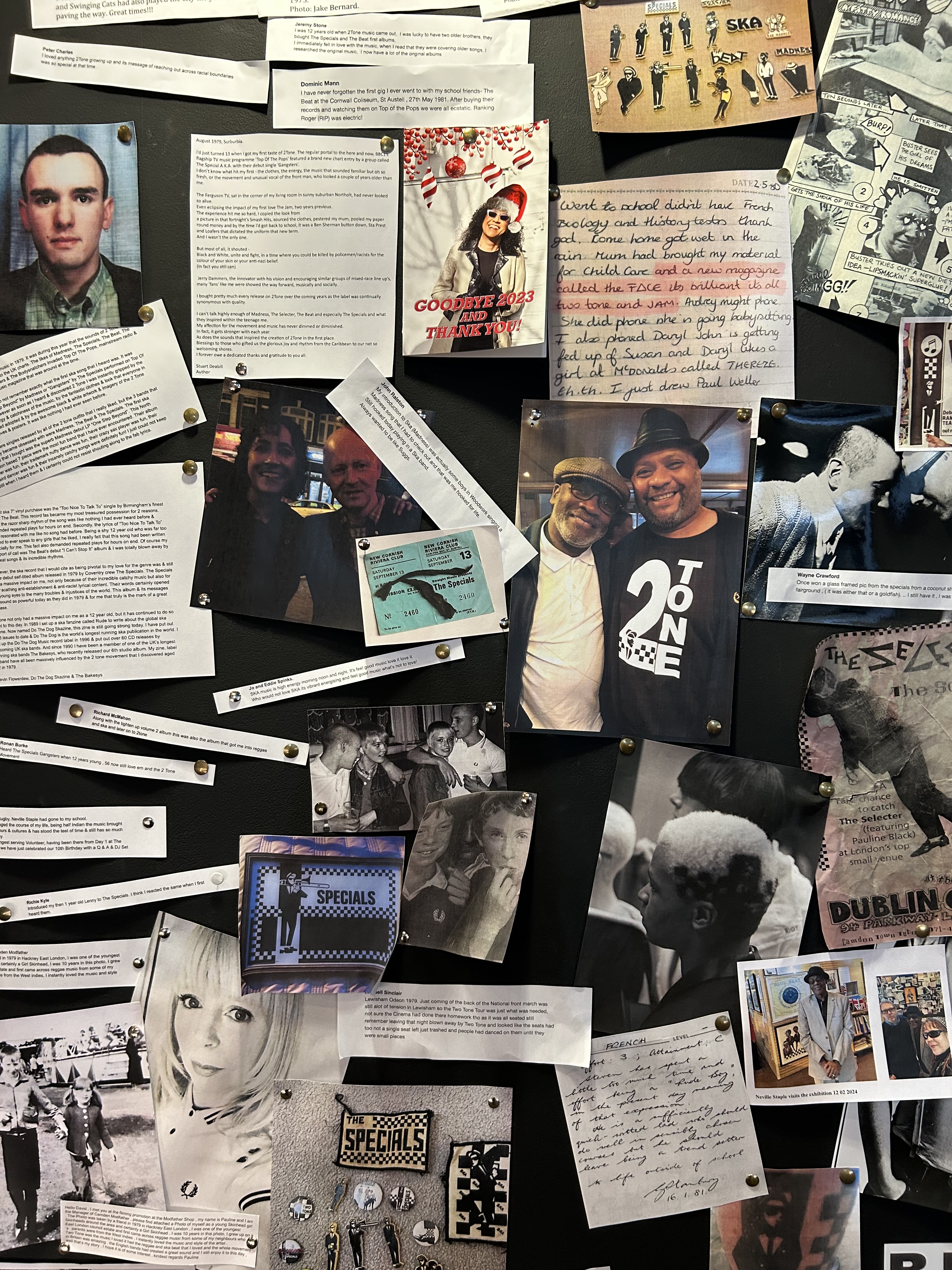
The exhibition celebrates Two-tone music and the whole cultural scene that surrounded it; featuring an impressive array of memorabilia, stories and reminiscences from musicians, writers and plenty of fans. These are not only to be found in the displays – where individual stories tell of unforgettable experiences, but also in the pages of the visitors’ book packed with more memories of those times. The evident gratitude people feel for the exhibition and the opportunity to collectively remember, makes it clear that this is something special.

It also serves up a rich slice of recent British history and pays tribute to those who travelled to the UK from the Caribbean to support the war efforts of the first and second world wars, and to rebuild war-torn Britain afterwards. Amongst this contribution to British society, was the music which laid the foundations for Two-tone and more besides.

2 Tone Records – the eponymous music label, was launched by Jerry Dammers of The Specials in 1979. Based in Coventry it attracted groups and performers who had embraced Jamaican ska, rocksteady, reggae and dub – brought to the UK from the Caribbean, and combined it with Punk, and New Wave, music synonymous with the UK . This fusion came to define the two-tone sound. Though the label itself was short-lived (closing in 1981 after only two years); it left an indelible mark on the UK’s musical, and socio-political landscape.

The Specials performing their own brand of Two-tone

Delving into the wider context: war-time evoked strong feelings of patriotism across the British empire of the time. And thousands of men from the West Indies volunteered to fight against Britain’s enemies, eager to contribute to the war effort. Expecting to join established British regiments, they were kept back from active combat in WW1, and instead assigned to labouring and logistical roles until King George V intervened. As a result the British West Indies Regiment was formed as a distinct unit. Remarkably 15,600 men enlisted from across the Caribbean forming 11 battalions; with Jamaica contributing the majority. Three battalions were deployed to Egypt. While playing a ‘supporting role’ in the theatre of war, they fought the Ottoman Turks in Palestine and Jordan, distinguishing themselves by their courage and skilfulness in the particularly challenging desert conditions. This marked a turning point in British military history, including and recognising the essential contribution of non-white troops to the overall war effort.

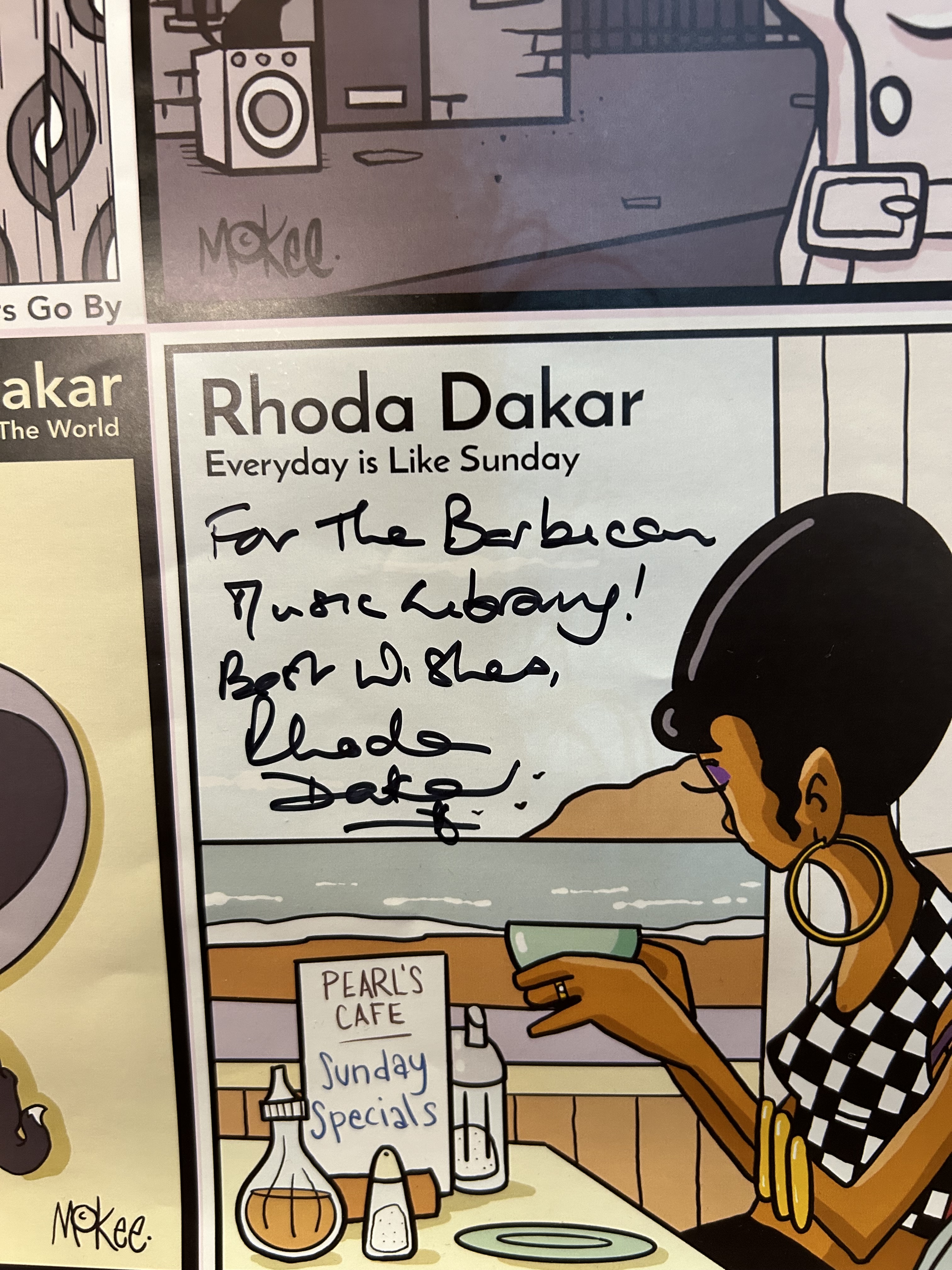
Lead singer of the Bodysnatchers, Rhoda Dakar – a major contributor to the exhibition, shares her family’s story – especially that of her father Rudolph Dakar, known as André. It is intrinsically woven through the events of wartime Europe: “My father, having joined the British West Indian Regiment and gone off to Europe to fight in WW1, returned to Jamaica with his Military Medal but never settled. He arrived in London but left to travel around Europe; France, Belgium, Italy and all the way to Hungary.” 

In the 1920s André and his french-speaking Belgian wife – a pianist, settled in Paris where he built his music career, penning lyrics and writing songs. In the Paris of the 20s and 30s he was celebrated alongside other artists and luminaries of the time such as Louis Armstrong and Josephine Baker – his contemporaries in the Paris jazz scene. However, the outbreak of WWII forced him and his wife to the UK (he held a British passport). However, they weren’t received or celebrated in the same way they were in France. Rhoda describes his comparison of Paris and London: ‘He always said “in France if you speak French, you’re a Frenchman. In England you’re just another black man”’. 

Nonetheless, André Dakar made his way in London, and became a well-known figure emceeing a music night called The Antilles, and subsequently hosting a jazz club in Piccadilly. Rhoda remembers that he was always impeccably turned out. He was also fully furnished with stories of the politicians, actors, journalists, artists and musicians he encountered, including the occasional clandestine visit from a royal. During the 50s and 60s he turned to film and television which included appearing in The Avengers and Danger Man.

Another featured story is told by the broadcaster, writer and DJ, Tony Minvielle. His dad arrived in 1960 from St Lucia, securing a job as a printer – unusual for a person of colour – and was working his way up to becoming a Master Printer, attending the London College of Printing. His mum arrived in 1961 (also from St Lucia) and became a seamstress. But in 1966 his father was hit by a car, and tragically died of his injuries. This left his mum (then only 23) to raise Tony on her own, who managed with the help of several ‘aunties’ and working multiple jobs, but it wasn’t easy. When she faced racism she face it head-on, with an approach of “no messin’”. Soul and reggae music was always playing on their ‘radiogram’ at home; and Tony recalls how joyful and soothing he found it.

In their reminiscences, fans of Two-tone recall the influx of Jamaican culture into the UK, and how it made an indelible mark on life in London, and other cities – like Bristol – with significant Caribbean communities. Memories include hearing Ska and Bluebeat blaring from windows in London’s east end, seeing “snappily dressed [Jamaican] rude boys hanging out on street corners” speaking in Jamaican patois – and being irrepressibly drawn to the culture, readily adopting its style and music.

Many recollections focus on 1979, when Two-tone music burst onto the UK scene. Highlights were of seeing The Specials – either live, or on Top of the Pops, and how they embodied this new youth movement combining British and Jamaican heritage; the music, the clothes and the sensibilities – bringing the two cultures together (which the documentary ‘Dance Craze’ details). And this in stark opposition to the extreme nationalism and racism promoted by the National Front and similar organisations.

It can’t be emphasised enough how important Two-tone was to society at the time – both politically and socially. Britain in the late 70s was a burgeoning multicultural nation. But for the most part young people weren’t overthinking things; they were just mixing and absorbing each others’ cultures. Many of those who got into Two-tone, already had their musical roots in Punk – and were open to exploring new sounds. In fact, embracing a changing UK was to increase the energy, vitality and political relevance of Punk. David Burke who curates the exhibition with Mark Baxter shares that: “If punk was my first crush, then ska and soul would be my life partner, my religion and my guide, to hopefully living a life that embraced all cultures and influences.”

The name ‘Two-tone’ was derived from the racial mix of the groups, as well as the black and white outfits they wore; emblematic of their mission and values. It offered a beacon of hope amidst the racial tensions. But the vision of multiracial harmony epitomised by the bands just couldn’t be matched by their audiences. Fights would regularly break out in venues, often sparked by interlopers who fundamentally disagreed with what they were witnessing on stage – and who resisted it as a genuine vision for life in the UK. Rhoda Dakar tells of a gig she performed with the BodySnatchers which had to end abruptly because of fighting in the audience. Events like this would eventually signal the end of Two-tone, because they couldn’t continue on. 

In the end several bands, including the BodySnatchers, broke up in despair of the situation. And 2 Tone Records shut down in 1981. But as this exhibition shows, its legacy remains; not only in the music and memories, but in a set of values which welcomes immigrants to the UK, embraces their multicultural influences, dares to create something new, and in so doing adds a greater richness to society.

© Alexandra Noel – all rights reserved 2024.

Album Review: Tangk – Idles

With their 5th album, TANGK, released on 16th February: IDLES are in a completely different mood.

TANGK album cover artwork. Courtesy of partisanrecords.com

Opener ‘Idea 01’ sets the tone with a lighter more lyrical feel. Dispensing with the reinforcing guitar-on-bass-on-kick-drum which characterises their distinctive sound; the open syncopated rhythm is disarming. Piano carries more of the percussive weight of this album too, also marking a more melodic direction. It builds to such a dense flurry in places that it’s almost overwhelming.

They continue their use of distortion, synths and electronic sounds from their previous album, Crawler. It intensifies with ‘Gift Horse’ – less raw, and more richly layered. The texturing creates a polyphonic soundscape, a welcome reprieve from the singular pile-driving rhythms, no longer needed to drive their point home.

But still marching forward nonetheless, always in motion.

Lead singer Joe Talbot is singing these days too, rather than shouting. His melody lines soar above the instruments. You can’t talk about IDLES without Talbot. He is the driving force and energy. A relentless kick drum in human form, he’s evidently more at rest now. More reconciled. No longer caught up in the thick of his trauma and triggered anxiety.

Their music has found its soul – looked itself in the mirror and discovered an interior life. Even in the high energy songs, there is a meditative quality. And there’s unquestionable joy too.

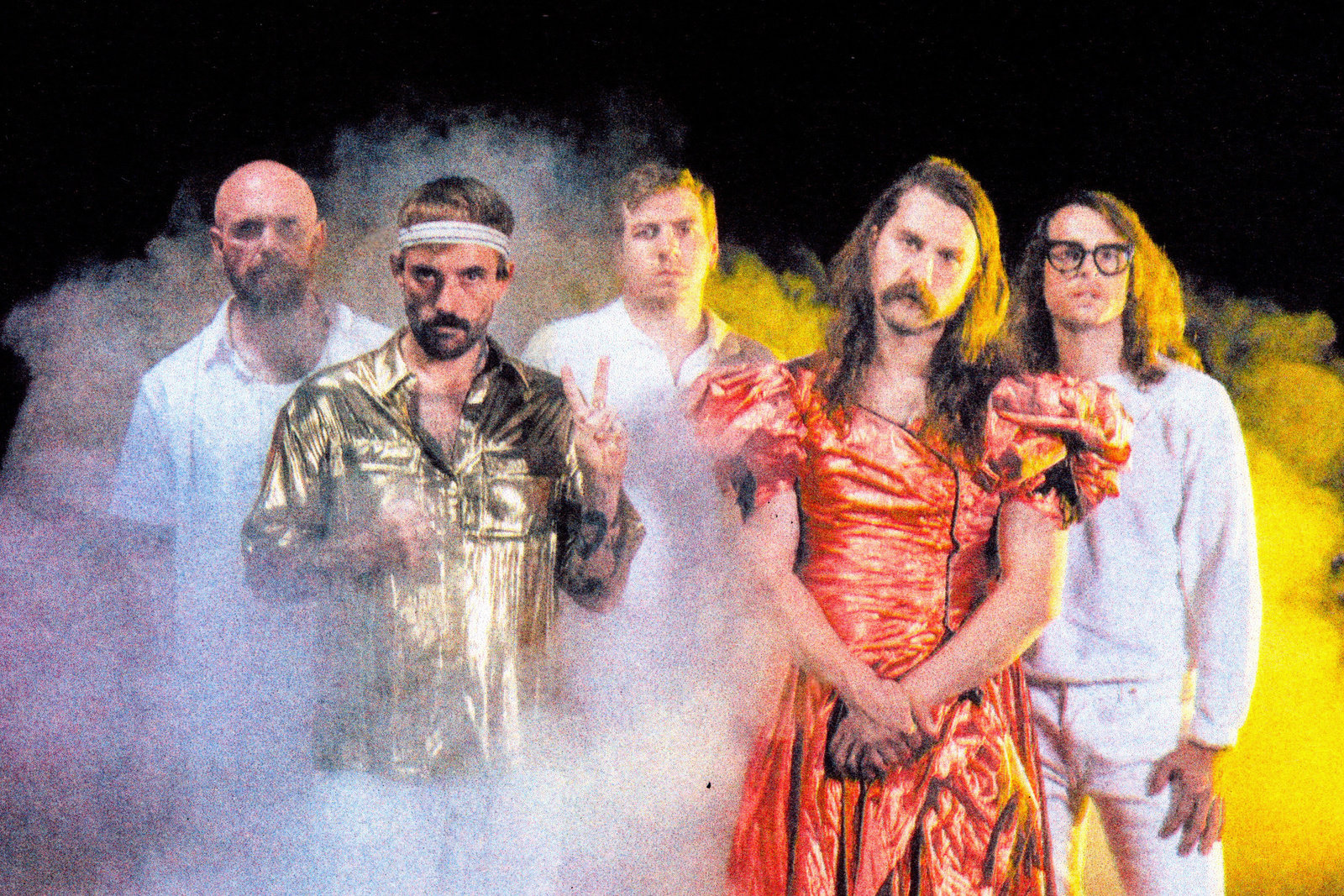
IDLES. Courtesy of partisanrecords.com

‘Pop Pop Pop’ makes you want to dance. Could that be said about their previous albums? Jumping, stomping perhaps… but dancing? No. It soars, it inspires: “Love is the thing”, Talbot sings.

‘Roy’ is a nostalgic 50s ballad, tempered by heavily distorted guitar. There are shades of rock and roll and references to the Kinks in song ‘Hall and Oates’. While ‘Grace’ channels Manic Street Preachers and Radiohead.

Talbot sings in a purring falsetto showing his vocal versatility to imbue lyrics with any emotion he chooses. You lean in as he repeats, “Love is the thing”.

Nostalgia is there in ‘Dancer’ too, a collaboration with LCD Soundsystem. The rush of strings at the outset evokes romantic old musicals, soon interrupted by thudding drums and pick-struck bass – “cheek to cheek and hip to hip” (a chorus of voices sing). Though the darker themes still tug, this album undoubtedly expresses a newfound freedom.

On ‘Gospel’ it’s hard not to picture late-night sessions at an old piano. It’s a more soulful sound, worshipful even. There’s an ethereal bitter-sweetness too.

Is Talbot still angry? I don’t know. But it’s more reflective now, empowered, repentant – the sober judgement that comes after the big fight. This is where you make your decisions and set your intentions. You have found your clarity.

‘Jungle’ combines all these elements, with a characteristic sense of urgency. “Save me from me, I’m found I’m found I’m found”, Talbot sings inferring a spiritual journey. From cosmic abandonment to coming home. Finally feeling heard, ‘Gratitude’ picks it up with driving metronomic beats, and thrashing guitars.

The final song ‘Monolith’ imposes itself with distorted piano and guitar strings struck like deadened bells. Metallic and space-like, it has an otherworldly quality. It ends implausibly with saxophone – a subtle reference to John Coltrane.

Talbot has transcended.

TANGK is IDLES’ Love Supreme.

© Alexandra Noel. All rights reserved February 2024

My Google Up-skilling Story

as shared with AllBright’s Reignite Programme

I first shared my up-skilling story at an online ‘INSPIRE’ event for the 50 learners on the 2023 Google x AllBright Reignite programme (where I was later to become Course Mentor). The group was working their way through the same Digital Marketing and E-Commerce Google professional certificate that I had completed in late 2022.

At the event I spoke with Ella Vize, then Head of Academy at AllBright. This article captures what I shared.

Tell us about yourself and your up-skilling journey.

My professional background is within creative, marketing and project management; working for corporates, charities, and with entrepreneurs and creative founders. I’d been part of companies’ marketing functions before – both in client services and managing creative teams – so after a career hiatus and lots of soul-searching I had decided that I wanted to go back into marketing. This seemed like a good route without having to completely start again. But this time I wanted to be a practitioner. Once I’d made my decision and started taking action, one thing after another opened up.

Woman plans her route on a climbing wall.

You had a break in your career prior to undertaking the Google certificate course, can you tell us a bit about your personal experience and career break.

My career break wasn’t exactly by choice. I didn’t decide to go travelling or anything like that. ‘Life’ happened. In mid-2021, just as it seemed we were coming out of the Pandemic, with things opening up and life getting back to normal: both my parents caught Covid. My mum wasn’t as bad but my dad became very very ill. There were multiple complications which meant he had five separate periods in hospital. At the time he was also my Mum’s main helper as she had struggled increasingly with her mobility over the preceding few years. It was definitely a crisis: I shelved any plans I had for my career and turned to looking after my parents. In the end it took about a year for them to get back on track and rehabilitate which I was closely involved in. Now they have a good set up and are doing well.

I realised afterwards that these kind of experiences aren’t divorced from our professional lives. Whether it’s caring for our elderly parents, raising children, or navigating personal challenges; we’re made, as people, ‘in the trenches’ of daily life. It forms character, it forms the ability to fully take responsibility and it forms leadership. Even that phrase we have: ‘taking time out of work to…. [fill in the blank]’ is an inaccuracy. We are far more integrated than that. So the experience you gain in your ‘off’ seasons contributes to your ‘on’ seasons in terms of professional work, and vice versa. It’s all experience – work is work, whether it’s professional (and paid), or not.

How did you come to find the Google certificate course? 

I first came across Google Professional Certificates at a jobs fair. At first glance it looked great but I wasn’t sure there was anything for me specifically. After making my decision to return to marketing I looked again at the courses on offer and to my amazement they’d added Digital Marketing and E-Commerce. It was a no-brainer – exactly what I was looking for at the right time. I had the chance to revisit first principles and to up-skill in things I’d never done before. The Google Professional Certificate in Digital Marketing and E-Commerce enabled me to do both – I completed the course in November 2022.

During the course I learnt so much. The self-paced format meant I could fit it around my schedule and do more whenever I had the chance. I was hungry to get on with it. I was learning a huge amount and reinforcing some really important professional foundations. There were parts where I had more innate knowledge and ability, and parts that were completely new. There were things I loved and breezed through, and areas that were more challenging. Ironically mastering the more difficult sections has served me particularly well. For example the metrics and analytics module was the most intense to get through but now I have it I use this almost on a daily basis and it’s really enjoyable.

I loved hearing the stories of Google professionals – I was so encouraged by the different paths they had taken. So many career trajectories are non-linear and it was both fascinating and encouraging for me to realise that many of those featured, who had found their way into Digital Marketing had done so via a really unusual and interesting route. No one story was typical. I also really enjoyed the energy and encouragement of the trainers. In addition to what I was learning and practising, at that point in my life I really needed a ‘Hype Man’ or ‘Hype Woman’ and they certainly delivered. I started to feel more excited about the future and about the possibilities this would create. It has helped me rebuild my career and get my confidence back.

Indoor female climber decides which route to take similar to upskilling or making a career change.

What has your career journey been like pre and post completing your Google certificate course? 

Before upskilling I was definitely faltering a bit in my career. Even before the Pandemic (which was something in itself to navigate) I’d already lost a bit of direction. I’d had some big successes but I’d also had some major professional setbacks. And I’d tried a couple of avenues since which weren’t getting any ‘traction’. So my confidence had been battered. I was burnt out and beginning to wonder if this was it?

Also, I still hadn’t found a way to reconcile the two different parts of my skillset – being analytical on the one hand and creative on the other. Most of all I needed to acknowledge my creative side which I’d mostly put on the back burner in favour of more ‘sensible’ jobs. The Pandemic presented the opportunity to explore my creativity. And up-skilling in digital marketing has brought everything together. It has united my analytical and creative skillsets which has been one of the biggest game changers.

The course has been integral to my career journey since. I quickly got on with setting up a freelance business which has been a great way to test out my new-found skills. I designed my own website – which has opened up opportunities to do it for other people. I launched as a freelance Digital Marketer and Writer at the beginning of 2023. I started earning immediately; I found clients through my network and have continued working and gaining further experience. It’s been great to have this set of skills which enable me to help solve people’s problems. I’ve had some really interesting clients and projects and been able to incorporate other skills such as my coaching, project management and consultancy. Nothing is wasted.

Has completing the course boosted your confidence in your career and or skills & knowledge?

Yes. It absolutely has. I’ve gained a really holistic sense of confidence. It’s a confidence in my skills and knowledge which only continues to grow the more I do the work. It’s a confidence in my ability to learn and bounce back – there’s a proven sense of resilience there.

A game changer for me was adopting a growth mindset. Rather than feeling stuck I began seeking out more learning opportunities. I realised that one of the most important abilities I had was the ability to learn. This makes me excited for the future and how my career would develop from here – never stop learning.

I also began to shake off some of the negative messaging I’d taken on from the experiences and setbacks I’d had. Rather than believing I was a failure – I was able to reframe this: perhaps things had failed for good reason, and I could use them as a signpost towards new opportunities. I was able to repurpose negative feedback I’d received in a way that meant I could determine what I took on board: only accepting things that would actually be helpful for my growth, and leaving the rest.

Along the way too I learnt that it was important for me not to give myself away and rely on others for validation and approval. Instead I needed this from myself, and from people I really trusted – who I knew had my back. It felt like an important shift in terms of how I built a sense of confidence. I’ve gained a great deal of self-belief and self-confidence in being able to navigate challenging situations, find a way through and come out the other side. I now know I can trust myself to handle whatever comes my way.

© Alexandra Noel – All rights reserved. February 2024

A New Approach to Feedback

The Creative Act: A Way of Being – written by music producer Rick Rubin – is not only beautifully designed but a unique and enlightening perspective on creativity.

Image courtesy of Penguin Press

It was also great to listen to Rick being interviewed on Jay Shetty’s On Purpose podcast. I found it inspiring stuff (also providing me with some useful thoughts for a content strategy I’m working on for a client). During their far-ranging conversation I was really pleased to be reminded of one of the best approaches to FEEDBACK I’ve ever heard.

Enabling you to “play Big”

I first came across this approach reading Tara Mohr‘s brilliant book Playing Big a few years ago. (I love these connections). The advice she gives, which Rick Rubin echoes, is this:

“Feedback doesn’t tell you about yourself. It tells you about the person giving the feedback. In other words, if someone says your work is gorgeous, that just tells you about *their* taste. If you put out a new product and it doesn’t sell at all, that tells you something about what your audience does and doesn’t want. When we look at praise and criticism as information about the people giving it, we tend to get really curious about the feedback, rather than dejected or defensive”.

Tara Mohr

Reframing Feedback

Reframing the purpose of feedback in this way makes ALL the difference. Tara offers further advice (see below) on navigating feedback in this article and in her book.

“1.  REFRAME the feedback:
 The feedback doesn’t tell you any facts about you; it tells you something about the perspective of the person giving the feedback. Reframe the feedback as information about them. What does this tell you about their priorities or preferences?

2.  Is the feedback truly RELEVANT? Women forget to ask this, and instead feel they have to incorporate all feedback. We need to ask: is this feedback essential to incorporate in order to achieve my goals? Those goals might include professional ones (like getting work published) or personal ones (like a loving relationship with family members.) If the feedback is not truly relevant to your aims, you have permission to not attend to it.

3.  REVISE your approach. If your answer to #2 is yes, then you can think about how you can revise your approach to work with/relate to this person more effectively, now that you know more about their needs and perspective. Going back to #1, the feedback isn’t a verdict on how you measure up – it just tells you how to be more impactful in your relationship with them.”

Photo by Annau00eblle Quionquion on Pexels.com

Allowing IT to Serve You

Ultimately feedback needs to serve you. So by getting curious about the person giving the feedback, and taking on board the aspects of their feedback that best serve you, you’re less likely to invest so much weight in their opinions. Effectively you ‘unhook’ from the power that either their praise or criticism might have, and you’re able to determine how best to utilise it.

© Alexandra Noel – All Rights Reserved 2023

Who’s Got The Power?

It’s no small coincidence that having devoured every episode so far of Succession’s final season, with its jostling for position and power-games, that I would be in mind for a bit more. As I was scrolling through a myriad of options for Something Great to Watch, I came across The Power. Released on Prime at the end of March, it’s the TV adaptation of Naomi Alderman’s brilliant book of the same name, which I read a few years ago.

Where Succession deals with posturing for control of the Roy family’s patriarchal media empire, The Power charts the complete undoing of patriarchal society as we know it. Set in a dystopian future, this piece of speculative fiction follows the unfolding events of a global crisis, happening in the wake of an unconventional women’s uprising.

The Power on Amazon Prime trailer, starring Toni Collette and John Leguizamo among others

To say that I am excited to watch the TV adaptation is an understatement, and judging from the trailer (above) it looks like pretty compelling viewing. But however faithful it is to the book, by all accounts, The Power really benefits from being read. Not only to experience its characters in more depth, but to properly digest its details and themes. And so as not to miss the challenges and implications of what it explores, despite its unmistakeable entertainment value. Read my thoughts on the book below – warning: some spoilers ahead.

The Story of The Power

I initially dismissed The Power by Naomi Alderman as popular fiction. I thought it was a sort of feminist chick-lit, which I wasn’t particularly interested in (the chick-lit that is, not the feminism). Thankfully, a friend strongly recommended I read it, lending me her book, so I had no excuse.

The Power by Naomi Alderman book cover in red and black design.

It turned out to be a great recommendation. As I often gravitate towards books about politics and society, philosophy and spirituality, whether fact or fiction, this was right up my street. Incidentally I also enjoy crime novels and thrillers, sci-fi (within reason) and the classics. (And a good autobiography never goes amiss). I really like dystopian fiction – probably because it draws on so many of these elements, arranging them in such a way that it brings a new perspective on current circumstances.

And I’m a firm believer that any creative work, whether it’s a book, film, art, spoken word or music has the potential to speak into the issues of life and society. In a way that often cuts through the noise and rhetoric, getting straight to the heart of the issue. In this, The Power has already made a significant impact. It was described by one critic as “one of those essential feminist works that terrifies and illuminates, enrages and encourages.”

The story is set in a near future. In the best tradition of dystopian fiction it is a world that is at once foreign and familiar, new and relatable. This, along with Alderman’s writing, helps to make the circumstances and premise of the book oddly plausible. Within the first chapter I’d already accepted its dystopian ‘reality’ without much argument. Women discovering that they have the capacity to generate electricity thanks to a vestigial muscle, an electrical ’skein’ on their collar bones, seemed reasonable enough.

This new ‘power’ is awakened in a sort of adolescent coming-of-age which gives women and girls a new and shocking ability (literally). Once they come to terms with this electrical upgrade in their bodies, they discover its potential as an in-built self-defence mechanism and even a weapon, putting them on a physical par with their male counterparts.

It empowers many to address ingrained fears and imbalances. Suddenly aware of a subtle, second-nature timidity in themselves they have never questioned until now. By learning to harness this new ability they realise they can combat their intimidation and address the oppression they experience from the men and society around them.

The Power interweaves the stories of several female characters in whom this new ability has suddenly awakened. In the book, Alison escapes an abusive home by electrocuting her uncle while he assaults her. She befriends Roxy, the tough-as-nails daughter of a London crime family. Who, in spite of her inner strength and resolve, becomes one of the most vulnerable in this new reality. Margot is a government official who is grasping to maintain her position and tow the party line (while struggling to keep her emergent power under wraps). And her daughter, Jocelyn, is right in the midst of her teenage angst, never mind everything else that’s going on.

Hands shooting electrical sparks. Detail of an illustration in Magic, 1400s-1950s edited by Noel Daniel. Köln: Taschen, 2009.

There’s also Tunde, a male journalist who follows the ensuing uprising across the globe in the wake of what is coined ‘The Day of the Girls’.

The book isn’t just about how this new-found power impacts relationships with men though. It explores this, but in addition it looks at how this power changes women themselves and how they relate to each other. There’s a religious angle too. One character believes she can channel a deity figure called Mother Eve, inspiring devotion from thousands of women as the antithesis of a patriarchal god. It gives them a new found sense of purpose and calling. Despite this hopeful transcendence, there is a dangerous and sinister side to the origin of this figure. You wonder at its true agenda and how trustworthy it is as it marshals women to become increasingly militant. The transformation of society is near total but unsettlingly it mirrors the characteristics of patriarchy, now in female form.

The Power (And Power Itself)

The Power goes beyond simplistically confirming the potential seen as inherent in women’s feminism. And does more than explore its imagined capacity to overthrow established male power structures. It actually asks some really difficult questions about the nature of power itself.

The chaos that ensues after the ‘Day of the Girls’ is also the book’s challenge. The issue isn’t just about who holds power. It’s not simply about men abusing positions of authority or the patriarchy being at fault. That’s not to say that these systems (and the individuals within them) aren’t capable of doing egregious harm. But the books posits that a total transfer of power from men to women wouldn’t create the easy utopia one might imagine either. It is about the nature of power itself and its ability to corrupt whomever holds it. Along with the systems established to operate it.

For me, the book is a brilliant exercise in challenging perception. It does this by totally upending what we experience in society, and know to be the status quo. The Day of the Girls is no gradual or incremental change towards equality. It is a sudden and overwhelming shift to an opposite, providing the starkest of contrasts. To imagine a world where women hold the utmost power and what kind of society it would create for us is extraordinary to consider. Not least because it highlights how much we continue to accept as normal. And quite how much remains unchallenged in what is essentially still a patriarchy. As a woman, to imagine myself in a situation where I have complete societal superiority and advantage is mind-blowing. Yet also extremely discomforting as I consider all the pitfalls that holding power has. Those which society bears witness to on an almost daily basis.

I found myself asking, ‘What would I do if patriarchy was completely overturned?’ If women were suddenly, by default superior and in charge, by some unearned biological advantage, as the book explores. Could we be just as susceptible to the misuse of power? Just as likely to subjugate and do harm to those who have less or no power at all? It’s a sobering thought. Our human commonality making us all vulnerable to this regardless of gender.

It underlines that any kind of ‘-archy’ (that is, ‘system of governing rule’), regardless of how it is organised and who’s in charge, is open to corruption and abuse of power. The historian and moralist, known as Lord Acton, expressed this opinion in a letter to Bishop Mandell Creighton in 1887. It forms the basis of the well-known proverb:

“Power tends to corrupt, and absolute power corrupts absolutely.

Lord Acton

With this in mind it can seem that creating a genuinely fair and equal society for all is an unachievable utopia. Despite the checks and balances that exist in the constitution and through the law, in parliamentary processes and in democratic procedures, power is always prone to corrupt those who hold it. At large and small scales, and in every sphere.

But there is an alternative to the idea of overturning established power structures, and the corrupting nature of power itself. One which doesn’t end in one group or gender gaining superiority over another. It would take the mechanism designed to overthrow established power and turns it upside down and inside out…

Putting Power Aside

During the recent crowning of King Charles III, (go with me on this) there was a part which seemed like something of an irony. Whatever you may think about the monarchy; at his coronation, the new king made a disarmingly profound statement. He pledged that “I don’t come to be served but to serve”. In doing this, he committed himself to an important principle; that his rule and reign would be underpinned by service to others. This intention means that he doesn’t assume power because of his privilege and position as king. Instead he is responsible to lay these things aside and prioritise serving others. He doesn’t expect people to serve him. The idea is that it’s volitional and reciprocal.

This is inspired by Jesus, and taken from his words in the Bible, something which infused much of the coronation service. Mark 10:41-45 says, “Even the Son of Man [how Jesus often referred to himself] did not come to be served, but to serve, and to give his life as a ransom for many”. By way of explanation: Philippians 2:6-11 says, “Who, being in very nature God, [he] did not consider equality with God something to be used to his own advantage; rather, he made himself nothing by taking the very nature of a servant, being made in human likeness. And being found in appearance as a man, he humbled himself by becoming obedient to death— even death on a cross!”

The determination to put power aside and serve other offers us the ultimate solution. It neutralises the self-interest inherent in the corrupting forces of power, and renders them inert. Instead of power being something lauded over others, grasped or wielded, it becomes a creative medium; something that is generative and multiplying. It makes it a force for the good of others, serving their best interests, enabling them to flourish. By adopting this approach to power we’re not assuming or jostling for position, because it removes the need for competition and one-upmanship. There is nothing to overthrow or invert because no-one is claiming power as their own in the first place. And I wonder what that world would look like.

© Alexandra Noel – All rights reserved. 23rd May 2023

A (Not So) Little Life

A Little Life, the book by author Hanya Yanagihara and now the play, directed by Ivo Van Hove, have acquired not a little notoriety. Both are sure to divide opinion and have definitely got people talking.

A Little Life promotional image, with James Norton.

It was with some trepidation that I agreed to go and see the play of A Little Life over Easter weekend at the Harold Pinter theatre.

The friend who invited me gave appropriate disclaimers and warnings about the content. This included the fact that the seats she’d managed to get for us would be right on the stage, front row. We would almost be part of the play ourselves.

In the name of being culturally brave I said yes. And in the face of reports of the book’s traumatising effect, which would only be heightened in the play, (plus a lot of nudity – apparently) I decided that it was All Art Anyway, and the best way to approach it was as an opportunity to have a significant life experience. Neither of us had read the book yet, so we committed ourselves to that too. We formed a book club and read the not-so-little, A Little Life. Mainly as an exercise to prepare ourselves for the play.

To my surprise I absolutely devoured the book. In spite of its size, I finished it in a little over two weeks, utterly compelled to keep reading. A Little Life is an irony; for the book is well over 700 pages long, and the story is one of enormous scope. Initially daunted I found myself skipping through the pages at pace, keenly drawn into the world of the book’s main characters; JB, Willem, Malcolm and Jude, as early 20-somethings (the book spans their lifetimes)… their flat-shares, first jobs and friendships. Seeing their lives and the self-sustaining world they are creating for themselves evolve, in a forever-noughties New York. 

The World of New York

Despite the city looming large over the book, there is nothing to anchor this story to any specific time or era as defined by the events of the wider world. These are absent and it’s only through scarce references to phones or emails (or certain expressions they have) that you have any idea as to when exactly this story is set. Even so it all feels very relatable. You can see and feel Hanya Yanagihara’s New York – as timeless as it is, thanks to the visually rich and evocative prose. In some way this insulation from the outside world reflects the insularity of the group’s story and their experience together. It sets the stage for our players. 

The narrative landscape at the outset is broad; it warmly opens windows into the lives of this circle of four young male friends. Their characters, thoughts and relationships evidencing themselves as they talk, socialise, and daydream on trains. On moving to New York, they party together, begin projects, move houses and start new jobs, all four of them firmly on a path towards success. Their lives revolve almost exclusively around each other. We see them all at various times through one another’s eyes; Jean-Baptise (JB) the painter; Willem the actor, Malcolm the architect and… Jude. 

Jude, the mystery. While his three friends are knowable – their backgrounds, ethnicities and demographies as unavoidable as open books, they in turn know nothing of Jude and his origins. It frustrates them more than it concerns them. At one point JB takes this to task saying “…we don’t know what race he is, we don’t know anything about him. Post-sexual, post-racial, post-identity, post-past…”, christening him “The Postman”. This is a postmodernist accuracy, and yet arguably wrong of Jude for whom all these are very present, as we will discover.

Jude. The ambitious and talented lawyer; working first for the US Attorney’s Office and then later ‘selling his soul’ and moving to a prestigious corporate law firm. There he develops, over time, a reputation of being both ruthless and brilliant. As notable as it is; it is not this impressive professional life that comes to matter here, but the emerging shadows and secrets from his past. And the growing dichotomy of the man he is and the man he isn’t. At one point, Harold (his adoptive father) notes that he has never known anyone so bifurcated. It is around Jude whom this story comes to revolve. Initially told from multiple perspectives, the narrative shrinks decisively as the book goes on. In concern for one very central figure, sidelining the others, it focuses its attention on one defining story. That of Jude St Francis.

Early Observers, the Artistic Eye

JB’s attention is an early portent of this. His artistic eye recognises early on the hypnotic centrality of Jude’s character to this group. He holds the role of the group’s observer, capturing and documenting the interactions between his other three friends. The photos he takes, and the paintings he makes from them, are enigmatic and wistful. While featuring his friends, they are insatiably focused on Jude. JB’s lens begins, inevitably, to expose what Jude is desperately trying to hide, much to his chagrin. Despite his ongoing attempts to keep them at bay, the shadows are creeping, and his trauma is seeping through the cracks.

Admittedly, the success these friends experience between them: Top Attorney, Celebrated Artist, A-list Actor and Brilliant Architect is rare to find in any one group alone. And yet, rather than these achievements, it is the shadows in Jude’s past that come to define them all, as it does him. He can never outrun them. Nor does he try to for his own sake, he copes, he manages. He will only attempt it for the sake of others – his best friend, Willem especially. He has imbibed his past so completely that it has become him, and despite so many good people telling him otherwise he cannot help but internalise its messages. That he is worthless and fundamentally flawed beyond redemption. The shame, and his belief that he was somehow complicit in the actions of others towards him, to the point of deserving them, have soaked him through. He is so utterly a victim of his past that he cannot separate himself from it. Not able to find even a millimetre of perspective. Or to see himself and his experiences with a modicum of self-compassion. He is subsumed and it is the trauma within him that holds everyone’s gaze, even though they don’t realise what they are looking at.

His past, we discover, is horrifying. It is relentlessly abusive. And wholly traumatising. You find yourself asking, ‘How could one person be so unlucky?’, ‘How could he attract so much malicious intent from those charged with his care?’ And ‘how could so much abuse happen to one single person’? Jude’s trauma is extreme, and dare I say it, clichéd. Yanagihara has said that Jude came to her fully formed, (and admitted that she didn’t really research his character). His trauma is equal and opposite in its extremity to the love, friendship and success he experiences with the friends around him. ‘How could one person be so fortunate in such dedicated friends?’ It would seem that this more than adequately atones for the pain and trauma in his past, but it doesn’t. Because to him it is still present – in the chronic pain and shame. And in the very identity he has formed. The resultant trauma itself is an ongoing abuse. 

The book has its share of familiar tropes, which makes it feel unreal at times. Yanagihara has commented to say that the extremes were intentional. Because of these it would almost better succeed at being a fairytale or allegory, if allowed. Good versus bad. This idea did help to reconcile what at times could feel so clumsy and far-fetched as to lack any of the nuance of real life.

Fixing Tendencies

Be warned, this story will draw out any tendencies to ‘fix’. It will simultaneously appeal to, and deeply frustrate anyone who likes tidy endings and neat closure, but isn’t that all of us? Whether a problem presents itself in the form of a person or an issue – we want to solve it. But what if it turns out to be a ‘gravity problem’ – a grander, more complex issue beyond our control? This is somehow the nature of Jude’s trauma. In truth it is beyond the experience and control of any of his friends, but somehow they keeping trying to fix it. They’re at risk of becoming enablers – his doctor, Andy, is a case in point. Stretching the boundaries of professional responsibility again and again in the name of loyalty and friendship, in the hope of being the one to offer Jude redemption.

We all long for redemption – it’s key to so many narratives. It’s so expected that sometimes we take it for granted. It is the concluding resolve we expect to hear at the end of a piece of music, or the neat conclusion at the end of a film, or a familiar bedtime story. But A Little Life has no resolution, no redemption – and this anticipation will simply not be satisfied. It is the discordant note hanging in the air. And it’s this that really makes this book get under your skin. It’s shocking and uncomfortable. As is the play – it’s exposing. I’m sure this is part of the reason for its popularity… it can’t help but divide opinion, to get people thinking and talking. Just take a look at the reviews. 

It is so tempting to think ‘If Only’. If only things could be different for the sake of Jude and his friends. If only he could make different choices, if only he could see how much he’s loved, if only he could find something worth living for. But this is not where the story is going, and as much as you try to hold it back, there is a desperate inevitability about the trajectory of Jude’s life. The reader, the viewer – this audience watching Jude’s life unfold, unwittingly find themselves colluding with his friends in their sense of defensive hope.

As much as this is a story about Jude and how his past trauma defines him, it is also about his friends. It emerges through their own stories that there are significant reasons why they are so drawn to Jude. And why they stay. This includes Harold; losing his young son due to a rare genetic condition, he has experienced a loss he has never recovered from. And in Jude he gets to make right the failures he sees in himself and attempt to change what happened. Jude himself becomes increasingly disabled as the book goes on, both because of the chronic pain he experiences and the damage done to his body by a deliberate car accident, as well as an undefined disease he lives with. And then there’s the psychological pain, and the deliberate and brutal self-harm he inflicts on himself as much as a coping mechanism as a way to act out his self-hatred. Harold holds him through all of it, never able to make it go away.

Luke Thompson and James Norton as Willem and Jude in A Little Life.

Willem, Jude’s closest friend, his confidante and later in the book, his partner, grew up with a disabled brother, who also died young. In the absence of his parents (first emotionally absent then physically) he cared for his brother, forging the strongest of bonds with him. Only to be told, tragically whilst he was away at college that he had died. It becomes clear that it was the needs of his brother that had held his family together, and linked him to his parents. Without his brother, he is cut adrift. He partly relives this connection and bond through his friendship with Jude.

We see this most poignantly in Willem and Harold, who remain closely connected to Jude’s main narrative as the book goes on, but there are other figures, always helping, always finding a way. For without the pasts they are trying to correct, there is no story. It’s a double-edged sword, they evidently love Jude and care for him, they rescue him again and again. From himself but also for themselves. He is fulfilling a need in them. How otherwise, could they have the patience or compassion to give so much to him. As he continues to reject their help and advice, while stubbornly refusing to help himself – whether unwilling or unable to do so. And so it is that the codependencies we see in this group were already formed before they met Jude. The pathways were already trodden, through other, earlier experiences that in some way they are all revisiting and attempting to resolve. 

In the end it is JB who has seen it all clearly – observing with the distance and perspective of the artist over many years, producing a vast body of work in the process. And it’s interesting that it is JB who frustrates and challenges Jude the most. He sees through him. And he won’t let Jude be a victim, he won’t pander to him. At times it seems cruel, but in doing so he just might be the one who loves Jude the most. He sees that Jude is complicit in his own suffering. Clinging to his own narratives, his own beliefs and the conclusions he has formed about himself to obscure the truth. The truth that he is valued and loved and redeemable. As a result he remains a victim and prisoner of his past. Never transitioning to become a survivor and overcomer. Either because he won’t or just can’t, and we will never know. This is the greatest tragedy of A Little Life.

Seeing the story living and breathing on the stage added solidity and shading to the characters. Sitting on the stage brought the story to life even more and dispelled some of the extremes of the book. It brought out the subtlety and nuance. These could be real people. All with their own stories, hardships and traumas. It was invigorating to be so close and feel part of it – the action so near you could reach out and touch it. The actors’ skill in portraying these characters was unmistakable. They were captivating – incarnating and inhabiting the characters, and embodying their pain and frustrations. No more than James Norton as Jude, but also Luke Thompson as Willem and Zubin Varla as Harold. While unfortunately more peripheral, but no less present; Omari Douglas as JB and Zach Wyatt as Malcolm shone in their roles too, as did the rest of the cast. The staging, and clever touches which included cooking on stage added to the sensory nature of everything happening in front of us. Which ran to the scenes of abuse which couldn’t appear more realistic.

A Little LIfe cast members. L-R Elliot Cowan, Nathalie Armin, Luke Thompson, James Norton, Omari Douglas, Zach Wyatt and Emilio Doorgasingh.

Art and The Viewer

Here was a piece of Art. If treated as such, A Little Life becomes less about the integrity of the narrative and character arcs; or about the wondering Why and If Only. And more about the place and response of the ‘viewer’ in interacting with the story and its themes. Could the book be designed first and foremost to elicit a reaction, to unsettle and to cause the viewer to become uncomfortable, agitating those deeper questions and frustrations? To hold up a mirror.

In this it reminds me of artist, Anish Kapoor’s work. Marsyas, his 2002-2003 Tate Modern installation, monumentalised the disembodied sinews caused by self-flagellation. Stretching out across the huge space of the Turbine Hall, were taut ribbons of red resembling huge pieces of muscle and tissue. You could almost feel it in your body. Later his retrospective at the Royal Academy featuring malleable sculptures of red wax moving through the galleries in negative space, so viscerally representative of blood and tissue. They produced a strong, almost guttural reaction in the viewer. The associations were many and varied. A pellet of red wax fired periodically against a wall – evoked a sense of shock and associations of bodily suffering, war, death, atrocities and pain.

Is this the purpose of A Little Life? Primarily as Art, to evoke such a reaction, so visceral and bodily, to the painful results of a life of trauma that has no resolve, no possible redemption. Being beyond escape it leaves a desolate, empty aftermath where all efforts have counted for nothing. Are we in the place of Jude’s friends as they are reduced to powerless observers? Their good and desperate interventions only ever delaying the inevitable, never stopping it. The hopeless trajectory is set and in the end there is nothing they can do. There is no redemption.

A Little Life at Easter

Seeing the play over Easter weekend highlighted a poignant contrast for me. In the Christian faith Easter Saturday is traditionally the darkest day of all. Jesus lay dead in a tomb, all hope was lost. He had been whipped brutally and repeatedly, the skin ripped from his back. He had been ridiculed and abused, to then be nailed to a cross and left to die, hanging by his hands until his lungs were crushed under the weight of his own body. Crucifixion was reserved for the most despised and maligned in society. Jesus’ followers and disciples had been so full of hope, but they were left standing bereft in the bleak reality of his death – how could this be the end? So desolate, so empty, so pointless. 

In the case of A Little Life, that is the end. It offers us no redemption. And forces us to confront the reality that there are some things that cannot be rescued or redeemed, such is their inevitability. And that is true. It just makes the tragedy of Jude’s life even greater.

By contrast, Easter offers us hope and healing. Easter Sunday marks the day that every seemingly inevitable trajectory towards death and destruction was turned around. Jesus, who had died on the cross, was resurrected to life, transformed and renewed by God’s power. And because of that it fundamentally shifts the end point of our past pain and trauma. And the power it has to rob us of the goodness of life now and in the future. This may surprise you to hear but it was an unavoidable connection for me to make between the play’s conclusion and the good news of the Christian message being celebrated that weekend. 

The irony of Jude’s suffering – which served no ultimate purpose, was so jarring against the passionate death of Jesus. Who chose to suffer and died willingly, giving up his life for our ultimate redemption. Then against the odds, rising again, carrying us with him in his resurrection to renewed life.

© Alexandra Noel – All Rights Reserved 2023

Human Desire: Approach with Wisdom

We all have human desires; some are good, some not-so-good. But they are often unwieldy. Trying to be wise in our approach to them can really help us and benefit those around us. But what is wisdom? Read on below.

Or you listen to the audio – this is a talk is from the ‘Get Wisdom’ series at St Albans, Fulham – a church community seeking to follow Jesus and better understand how to live like him.


What is Desire?

What does the word ‘desire’ mean to you? Desire is definitely a strong feeling. It makes me think of old movies – something about those clinching embraces. To desire something is to want it strongly, ardently. It’s wishing for and hoping for something to happen. It’s a longing and a yearning for something or someone. It’s deep, and it impels us and motivates us to take hold of what we want. It’s often shows us what we’re living for. Desire like that can be really good for us.

A black and white film still from Casablanca. A man desires a woman: they face either other wearing 1940s hats and clothes looking longingly into each others' eyes.
Film still from ‘Casablanca’ featuring Humphrey Bogart and Ingrid Bergman

But as good as our desires can be, they can also become corrupted or misdirected. Or they can originate from our earthly, sinful natures – our flesh. [Note: In Christian thought our tendency as humans is towards being entirely self-orientated: to the cost of ourselves and others. It is referred to in the Bible as ‘sin’ or our ‘flesh’, earthly not heavenly. These are seemingly out-dated concepts, but can explain how it’s possible to live devoid of higher ideals unless we discover a better, transcendent purpose for our lives and existence.] Rather than a longing or yearning to be fulfilled by God, we harbour desires where instead we crave or lust after something or someone. Wanting to obtain these things and take hold of them for ourselves. And it leads us into sin (which takes us away from God), which is not good for us. We need wisdom to control them.

What Are You living for?  

A graphic showing a multi-coloured stratified pyramid. The levels depict Maslow's Hierarchy of Needs. Image credit: the School of Life.

You may be familiar with Maslow’s hierarchy of needs. Abraham Maslow was an American psychologist practising in the mid 20th century. He came up with this idea in psychology called his ‘theory of human motivation’. It explains that people are motivated to meets their needs in a particular order, depicted as a pyramid. You have physiological needs first; food, water, warmth, rest. Then safety and security, belonging and love (friendships and relationships). Then self-esteem, prestige and feelings of accomplishment. And at the top of the pyramid we reach ‘Self-Actualisation’. Where we fulfil our potential, becoming our truest selves. The theory is that we are driven forward in life by this desire to self-actualise.

I’m no psychologist, and I’m not sure that this can be applied universally. But it’s certainly a motivation for many people, especially in our culture. Companies make their marketing and advertising appeals based on this intrinsic desire and motivation. That in buying their product, or ‘doing their thing’, we’ll fulfil our desires. And we’ll affirm or become our truest selves. 

Two Types of Chaos

In school I learnt that entropy is when particles (because they have their own energy) diffuse from high density to low density. From being very close together to being very spread out. That’s how your air freshener spreads through the house. More specifically, entropy is a measure of disorder. It measures the capacity of particles to assume any number of disordered and chaotic possibilities. 

Chaos is one way to describe the nature of sin. Through sin, one type of chaos entered the world. One which is constantly dismantling the good order of the universe [which Christians believe was] created by God. Sin’s chaotic end point is disorder, destruction and death. 

In the beginning God’s good creation started with another type of chaos – the early ‘chaos’ of the cosmos. Like having a great idea and scribbling everything in your head onto a piece of paper, before bringing shape to it.

This creative chaos was symbolised by the ‘waters’. And [in the story of Creation told in Genesis] the Holy Spirit was brooding over them. It was a pregnant chaos, full of divine energy, potential and possibility. The energy of this chaos was driving towards order, not disorder. Growing more organised, gaining clarity, structure, shape and form. It was multiplying for good, and building the good things of God.

But chaos isn’t easy to control, whether constructive or destructive. It has its own energy. And I think it’s similar with our desires, they have their own energy. Our combined desires can be a positive or negative force for our lives, driving us towards God’s good order or towards disorder. But ultimately directing our lives and our futures.

The Heart of the Matter

[The Bible’s] wisdom cautions us: ‘Above all else, guard your heart, for everything you do flows from it’ – Proverbs 4:23

In his autobiography, Surrender, Bono – lead singer of Irish rock band, U2 – describes having life-saving heart surgery. In his words they needed to fix a blister on his aorta and a heart valve gone wrong. Both of which threatened to end his life if not treated quickly. His simple explanation made me think; he says “The aorta is… your lifeline, carrying the blood oxygenated by your lungs and becoming your life”. And what pumps this life around your body? Your heart.

Both Bono and the writer of this proverb show us how critical our hearts are, albeit in different ways. The Message version says to ‘Keep vigilant watch over your heart, that’s where life starts’. In the same ways, our desires originate in our hearts, the centre of our beings. And they become our life. Your very life, eternal – flows out from there. And God places the utmost priority on it.

Our desires – the things we hope for – are meant to be satisfied too, through Jesus. [Note: Christians believe that Jesus is God’s son, who died, and was resurrected by God’s power; overcoming the disorder, destruction and death wrought by sin]. We don’t guard our hearts to lock down our desires, but to curate them, (like precious pieces of art).

Proverbs 13:12 says: ‘Hope deferred makes the heart sick…. Without our hopes and desires being fulfilled our hearts will sicken and suffer, God knows this. This proverb develops the idea further saying, ‘but a longing fulfilled is a tree of life’. 

A tree of life – it calls us back to Genesis. A longing fulfilled is Eden; it’s how things were created to be. And what else is a tree of life? Wisdom is a tree of life. Fulfilled longings, Wise Living – this is God’s original design, and it’s the redeemed heaven and earth – the ‘Kingdom of God’. [Note: this is a way the Bible and Christians describe God’s intended way of life].

‘Hope deferred makes the heart sick, but a longing fulfilled is a tree of life.

Proverb 13:12

Desire Gone Wrong

Desires can go wrong – we can overlay wrong desires onto some very genuine and legitimate needs. We can turn our desires into entitlements. A desire that started as something supple can become rigid and calcified, demanding and lustful. Desires are also subjective, they are different from person to person. And a presenting desire – might actually be driven by a need for something else, like connection, or understanding perhaps.

We’re to exercise wisdom, not foolishness. Although sin plays a significant part in desire-gone-wrong, being foolish isn’t necessarily sin. But the ultimate folly is to allow sin to rule our desires. That’s why we are to guard our hearts so carefully.

Like Adam and Eve, in the abstract, it’s perfectly easy to accept God’s wisdom and guidelines without question. We earnestly pay lip service to it. If we’re Christians, we believe that we believe it! And we want to obey it. But what’s more difficult is when we’re faced with a situation when we know what the wise thing is, but our not-so-good desires get in the way. We can unwittingly entertain evil desires. So that in the moment, rather than making a wise choice, we make a foolish choice.

James 1:14 captures the conflict we find ourselves in ‘…but each person is tempted when they are dragged away by their own evil desire and enticed. Then, after desire has conceived, it gives birth to sin; and sin, when it is full-grown, gives birth to death’. 

He goes on to remind us that when faced with that choice we’re not to be deceived (as Adam and Eve were). God does give us good gifts, to satisfy us and fulfil our longings. He hasn’t suddenly changed, he’s not going to leave us in the lurch. No matter how persuaded we might be. 

Don’t be deceived, my dear brothers and sisters. Every good and perfect gift is from above, coming down from the father of the heavenly lights, who does not change like shifting shadows“.

James 1:16

Foolishness Can FEEL Like Wisdom

There’s another problem here as well.

In Genesis, the enemy threw God’s wisdom into doubt. He twisted it, framing it as something negative that withheld truth and prevented insight. What a snake! He cast aspersions on God’s nature, suggesting: “How can He be generous and giving? No, He’s mean and miserly!” He enticed them: if they ate the fruit of the tree of knowledge, they could be the ones to decide what wisdom looked like, not God. They could be all-knowing, they could be equal to God. They could be gods themselves. He succeeded in convincing Adam and Eve to turn their backs on God’s wisdom and the good order of his creation.

That’s human nature isn’t it? We want to be the ones to decide how we live, we want to determine what’s good for us, and what is wise. The Bible warns us against this: Proverbs 26:12 says ‘Do you see a person wise in their own eyes? There is more hope for a fool than for them’. 

So you might say that to be wise in your own eyes is the most foolish thing of all.

Come With Me to Corinth

New Testament Corinth was a Brave New World. It was a modern capital in the ever-expanding Roman Empire. The Corinthians were certainly ‘wise in their own eyes’. They were full-out living their own wisdom and living it to the max. It was a lifestyle, an art-form even. The attitudes of today, pale in comparison to the Corinthians. Even to people of the time, Corinth was morally off the chart, the word to ‘Corinthianise’ literally means to live a promiscuous life, which gives you an idea of their lifestyles.

Into this context, steps Paul. He arrived to visit the newly formed Corinthian church, and to encourage the believers there. What he found was that for all their human wisdom and sophistication at the time, the Corinthians were being foolish. Paul knew it. One of the major mindsets he confronted was in their sense of self-determination, the right to do what they wanted. Their mantra was “I have the right to do anything”. And though they were exercising a type of freedom, Paul challenges them that the choices they were making were not actually beneficial to them. They weren’t wise. There was more to freedom than a technicality. They were not living in their freedom wisely or well, they were being foolish.

The book cover for Brave New World by Aldous Huxley, with bold graphics and a swirling red design.

He reflects this to them saying: ‘”I have the right to do anything”, you say – but not everything is beneficial. “I have the right to do anything” – but I will not be mastered by anything. You say “Food for the stomach, and the stomach for food, and God will destroy them both”. The body, however is not meant for sexual immorality but for the Lord, and the Lord for the body’. 1 Corinthians 6:12

The new Christians in the church at Corinth hadn’t shaken off the values of the surrounding culture. Underpinning their ‘right to do anything’ was not freedom. They were enslaved to the culture – to individualism. They lived a hedonistic lifestyle, verging on being nihilistic. In Corinth, the believers were living out of step with their professed Hope in Jesus. There was so much more to life and they were in danger of becoming enslaved all over again, this time to their own desires. 

I wonder if into the culture had seeped a pervasive belief; What does it matter what I do with my body if it’s just going to be destroyed? What does it matter if all I really am is firewood? I’ll rather invest in the mind, in ideas, and my body can do whatever it likes.

You see, Corinth had had a chequered past. In 146 BC it had been torched, burned to the ground and laid to waste – its inhabitants either killed or sold as slaves. It was a city destroyed. In 44 BC, desolate, it was colonised by Julius Caesar who rebuilt it to became the capital of the Roman province of Achaia. In a relatively short amount of time Corinth had become a major port, place of trade, and cultural centre – to become a very wealthy city. 

Corinthians and Culture

The culture was shaped by ancient worship of Aphrodite, the greek Goddess of love, beauty, pleasure and procreation. And though Aphrodite’s temple had been destroyed, it was rebuilt in Roman times – its culture of promiscuity along with it. In terms of religion Corinth had gone from pantheism to a fusion, which combined the worship of the twelve Olympians of the Greeks, with the paganism of the Romans. Add to that the fact that Corinth was a melting pot of every culture that the Roman empire had conquered and you have a very heady mix.

Although they venerated intellect and learning in the ancient Greek tradition, alongside this ran a belief that the body was of minimal importance, they reduced it to something carnal and animalistic, whose appetites must be fed. Keep the body’s desires satisfied, well-fed and quiet so we can focus on bigger things. This was considered morally correct as you pursued higher things like knowledge and the teachings of the philosophers. But this was a foolish approach.

This holds up a mirror to our own culture. We tend to say now, “it’s fine as long as it doesn’t hurt anybody”. Parents teach their children this, this is our moral compass in this society. Where the Corinthians said “I have the right to do anything”. We might say “You do you”. We consider there being nothing wrong with this. No harm no foul. But the Bible makes the point that if it’s hurting you, it is a problem. And that includes your eternal soul. You may not be sinning against others but it is foolish to be sinning against yourself. [In the context of the prevailing culture and presenting issues at the time] Paul urged the Corinthians to ‘Flee from sexual immorality. All other sins a person commits are outside the body, but whoever sins sexually, sins against their own body’. And what you’re doing might be technically permitted, it may not be sinful, you may even be doing it with the best of intentions but is it wise in the end?

While the Corinthian believers were continuing to live in light of their culture, Paul was passionate about them living in light of eternity. Jesus was resurrected body, soul and spirit and we are saved, and will be resurrected body, soul, and spirit. God considers the body to be as holy and precious as our eternal souls, which he died for. [In the biblical and hebraic worldview we are one within ourselves,] those parts are indivisible, we are integrated beings. Paul knew that as believers, our context is eternity, and the thing the Jesus prized most highly, dying so we could have it was eternal life. So for the Corinthians to live with the belief that their bodies were nothing more than firewood didn’t align with the awesome reality of resurrection.

Plant Your Flag

A man stands on a mountain rock, holding a red flag.

Mountaineers have a practice of planting a flag to show how high they’ve climbed, and to mark how far they’ve come on the journey. We can think of the Christian life as a journey to the summit of a mountain. And it can feel like a long, arduous journey. The problem with trying to control and manage our desires, with their chaos, is that it gets tiring. Sometimes we just want to set up camp rather than keep going. Here and no further, thank you very much. I’m not prepared for it to cost me any more, I’m not going to give up the chance to have what I desire now. I’m not going any further. 

And so, even though we’re called to reach the summit, we risk settling.

Where would you plant your flag? What are your non-negotiables? When it really comes to it what desires are driving your life? Wanting a relationship, to be married, sex, the fulfilling job, recognition, a big salary, ease, comfort, being right, holding onto that grudge, staying in unforgiveness or self-pity, the excuse of your past failures, getting the last word, that habit. There are many who decide that there are things they just will not give up or lose, they plant their flags on any number of things – some are good, but just at the wrong time, or in the wrong order.

Mark 8:36 says ‘What good is it for someone to gain the whole world, yet forfeit his soul’.

If we recognise any of these things the good news is that Jesus is faithful to forgive us and restore us.

So what’s the solution?

We’re Not Meant to Control Our Desires

You may know C.S Lewis’s book ‘The Great Divorce’. It’s set in a dream which starts in a joyless city, a ‘Grey Town’, where passengers are boarding a bus, before it heads off into the sky. When they get to their destination, they realise they are in a beautiful country. And we discover that they are in fact ghosts. The country is so solid and shining and real that the grass hurts their feet. Many can’t bear it, and in the end almost all of them decide to turn around to go back ‘home’.

Towards the end of the book we meet a character who is caught in indecision. He has a desire to press on, to be all he could truly be, and he is so close. But he can’t enter into this fulfilment without making a choice. He is very attached to a small red lizard that sits on his shoulder, it’s been there a long time. It constantly whispers lustful things into his ear. The man can’t continue onwards if the lizard stays with him, it’s just not possible. The lizard must die. An angel standing opposite him offers to kill the lizard, and there ensues a long conversation back and forth between them about why he doesn’t think it’s a good idea for the angel to kill the lizard, while the angel tries to reason with him. The man just can’t live without it. Eventually the angel persuades him, and though it hurts him it has the most amazing effect. He’s made a wise choice. And something extraordinary happens. The man is transformed into a huge shining, solid person, he’s no longer a ghost – he’s like the people in this beautiful land, and the lizard, thought dead comes to life as a beautiful solid stallion.

Colossians 3:5 says: ‘Put to death, therefore, whatever belongs to your earthly nature: sexual immorality, impurity, lust, evil desires and greed, which is idolatry. Because of these, the wrath of God is coming. You used to walk in these ways, in the life you once lived. But now you must also rid yourselves of all such things as these: anger, rage, malice, slander, and filthy language from your lips. Do not lie to each other, since you have taken off your old self with its practices and put on the new self, which is being renewed in knowledge in the image of its Creator.’

An illustration showing part of the CS Lewis's Great Divorce, where the man with a red lizard on his shoulder encounters an angel. In the background is a silhouette of hills and Jesus on the cross.
Illustration depicting a scene from The Great Divorce.

Wisdom is putting to death whatever belongs to our earthly natures. We can’t control the chaos of our desires, but we can control this choice. We can choose to ‘crucify our flesh,’ and our competing desires. To end the chaos, placing ourselves in God’s redemptive order. Where are you coddling your flesh, rather than crucifying it? 

But we don’t crucify our earthly desires to end up with nothing. We do so, because God wants to give us something far better in place of them. To put them to death is to allow God to resurrect our desires, to rescue them from being the insubstantial versions we thought were so satisfying, utterly transforming them. A stallion just doesn’t compare to a lizard, it’s completely different. Unless we let go of our old selves and take up our new selves, we can’t fulfil our God-given potential.

Flip the pyramid

Returning to Maslow’s hierarchy of needs: Jesus turns this on its head.

He starts with our desire for self-actualisation, and all the ways we pursue that through our desires good and bad. He transforms it, and in turn our potential, ridding us of the chaos caused by sin and competing desires. He re-establishes his good created order in our lives, resurrecting our desires. He fulfils our longings so they become a tree of life, and shows us how to live wisely.

Our salvation through Jesus fulfils our deepest longings and changes the paradigm we’re living in. Jesus prioritises the resurrected, eternal life over everything else. He came to give us life, and life in abundance. We don’t self-actualise through finding ourselves, but through finding Him. And not through holding onto our lives with their desires, but in letting them go, so they can die and be raised to life. It was only by being crucified and dying that Jesus was able to be resurrected to eternal life, and us with him. We become our truest selves. 

And rather than the ever-narrowing pyramid where we’re driven towards self-actualisation, we find that eternal life flows from us and multiplies out exponentially, as we continue to seek first His kingdom and his righteousness. Having been crucified with him, along with our desires, we now radiate out his resurrection life. We are solid, real people. And the picture looks very different from here.

In Conclusion

I’m going to borrow a quote here. Last week I was at an event for founders and entrepreneurs, and the keynote speaker, quoted Jamal Edwards MBE, who was a British music entrepreneur and DJ. He tragically died in 2022 leaving an incredible legacy, having done an incredible amount of good for his community and beyond, inspiring many many people. He said this:

“Set goals so high they demand an entirely different version of you.”

Jamal Edwards MBE

And hearing that while I was working on this talk just made me think. God has such a vision for us and our lives that it demands an entirely different version of us. One that we find when we are crucified with him, and when we let go of our desires, releasing them so he can transform them and us with his resurrection power into something extraordinary. 

That is wisdom.

© Alexandra Noel – All Rights Reserved 2023

Still Waiting For Christmas?

Animated image of Jesus asleep in a manger with Jerusalem in Israel in the background

We might spend all year waiting for Christmas. When Jesus was born on the first ever Christmas, Israel had already waited years for the gift of their Messiah.

Read article below or listen to the audio of the talk (delivered on Christmas morning 2022 at St Albans, Fulham):

I spent part of my childhood in Australia – on the other side of the world, and where currently it is summer not winter. Barbie on the beach anyone? When I was there, there was a children’s TV character called Mr Squiggle. In each show he would draw a picture which started out being totally unrecognisable. You’d wait with great anticipation, guessing ‘Is it a this?’ and ‘is it a that?’. If you were lucky you might guess it, but often it just looked like a jumble of lines. That was until, at the very end he would turn it upside down, and you would realise what the picture was that he had been drawing all along.

Israel was waiting for the picture in front of them to make sense. The Messiah they were longing for, the promised deliverer of Israel, wasn’t forthcoming at all. On top of years and years of division and battles, displacement and oppression, their story was continuing to play out in the worst possible way – Israel was now under occupation by a foreign power. And Israel was longing for a Saviour to come and dramatically overthrow the occupying Romans – gloriously emancipating them from the years of oppression, delivering them to live in their own land again, freely and peacefully. This hope was a nation-state scale hope – they wanted a mighty leader to politically and militarily liberate them – for all to see. Hadn’t Isaiah’s prophecy promised this? Didn’t it say that David’s throne would be restored? All those victories, their heroic warrior King – the glory days of Israel restored again.

But, the fulfilment of this promise was nowhere to be found at this Macro level. Instead: down and down, smaller and smaller, focussing finer and finer into the Micro, something was happening at the cellular level of Israel. Because quietly, anonymously, invisibly… in a hidden corner of the nation a young, inconsequential woman discovered she was pregnant with a microscopic foetus, suspended in secret. In her womb was the Son of God, the Saviour of Israel. The gargantuan hopes of a whole nation, a multitude of people with a long complicated history had not only been turned upside down but completely inverted. Their Saviour hadn’t arrived to dramatic fanfare in public glory, but into secret obscurity and vulnerability, and circumstantially, into shame. 

Not that they knew it at the time but their actual Saviour had arrived. Not as Powerful but powerless, not as Visible but invisible, not as Glorious but as shameful, not as Famous but as obscure, not from Without but from within. They couldn’t imagine this, let alone see it, but their hope for a Saviour was being fulfilled… it was nascent, in the form of an utterly dependent baby.

An animation still showing a sleeping Baby Jesus in a manger under a starry sky, with buildings in the foreground, telling the Christmas story.
The first Christmas: The Birth of Jesus: Luke 1-2 by The Bible Project.

What Israel was imagining its Saviour to be was perhaps a projection on to those ancient prophecies of some very human desires… of greatness and vindication and a grand notion of their identity, of Who they wanted to be, and How they wanted those hopes fulfilled. However, had the promise they were waiting for been fulfilled in the way they were imagining, their saviour would have been born of the same substance as the years of trouble they’d already endured. It’s likely their saviour would have been vainglorious, proud and insufficient to resolve their deepest longings. Disappearing as quickly as he had appeared, failing as quickly as he had succeeded, falling as quickly as he had risen. It’s likely this would have been a fragile, brittle, precarious answer to Israel’s predicament at best.

While the nation of Israel’s hopes for a saviour had grown nebulous and distorted over their years of waiting; their actual Saviour was multiplying and growing with purpose inside that young, pregnant woman. She was being enlarged in quite another way as she waited for Jesus to be born. Not only was her body being physically enlarged by her pregnancy as his life literally multiplied and grew inside her, but her very real sense of expectancy, and joy was increasing every day, along with God’s vision for the life planted within her. Israel’s Saviour would be born of an entirely different substance, of heaven and human humility. 

Because only this could really save Israel… because Israel actually needed saving from themselves. From their pride, rebellion and sinful humanity.  The ultimate answer to Israel’s predicament was the inverse of everything they were imagining. In order to truly deliver them, their Saviour would need to redeem them from the oppression of sin, rescue them from themselves, and transform their lives from within. His kingdom would multiply through surrendered lives, expanding horizons, as light does in the darkness – into all the earth and on into eternity. 

Though unaware, somewhere in Israel, a young woman was patiently waiting, incubating a Saviour, an answer, a solution… for Israel, and for the World. At a time when their own land felt so reduced and shrunken under occupation, and at a time of great distress; in the words of Isaiah, God had in fact, paradoxically ‘enlarged their nation and increased their joy’. He was enlarging Israel, along with Mary, in pregnant expectation. Their joyful expectation increasing while they wait for the time that Jesus is born, to them – when they finally recognise the picture that God has been drawing all along. Waiting for Christmas; the birth of Jesus – the Saviour of the World.

So, what are you waiting for? Waiting is often the incubator for God’s solution to our problems. For our redemption, and for His full answer to our predicament. It’s where our human desires are reckoned with. And it’s where, if we choose to surrender to the process, God refines us and aligns us with his redemptive purpose; enabling us to see what he’s doing. It’s where he enlarges our capacity to hold what he’s giving us and where he maximises the joy we’ll experience when it arrives. So whatever you are waiting for, be encouraged, because as Romans says ‘ …the longer we wait, the larger we become, and the more joyful our expectancy’. 

© Alexandra Noel – All rights reserved. 25th December 2022