
We all have human desires; some are good, some not-so-good. But they are often unwieldy. Trying to be wise in our approach to them can really help us and benefit those around us. But what is wisdom? Read on below.
Or you listen to the audio – this is a talk is from the ‘Get Wisdom’ series at St Albans, Fulham – a church community seeking to follow Jesus and better understand how to live like him.
What is Desire?
What does the word ‘desire’ mean to you? Desire is definitely a strong feeling. It makes me think of old movies – something about those clinching embraces. To desire something is to want it strongly, ardently. It’s wishing for and hoping for something to happen. It’s a longing and a yearning for something or someone. It’s deep, and it impels us and motivates us to take hold of what we want. It’s often shows us what we’re living for. Desire like that can be really good for us.

But as good as our desires can be, they can also become corrupted or misdirected. Or they can originate from our earthly, sinful natures – our flesh. [Note: In Christian thought our tendency as humans is towards being entirely self-orientated: to the cost of ourselves and others. It is referred to in the Bible as ‘sin’ or our ‘flesh’, earthly not heavenly. These are seemingly out-dated concepts, but can explain how it’s possible to live devoid of higher ideals unless we discover a better, transcendent purpose for our lives and existence.] Rather than a longing or yearning to be fulfilled by God, we harbour desires where instead we crave or lust after something or someone. Wanting to obtain these things and take hold of them for ourselves. And it leads us into sin (which takes us away from God), which is not good for us. We need wisdom to control them.
What Are You living for?
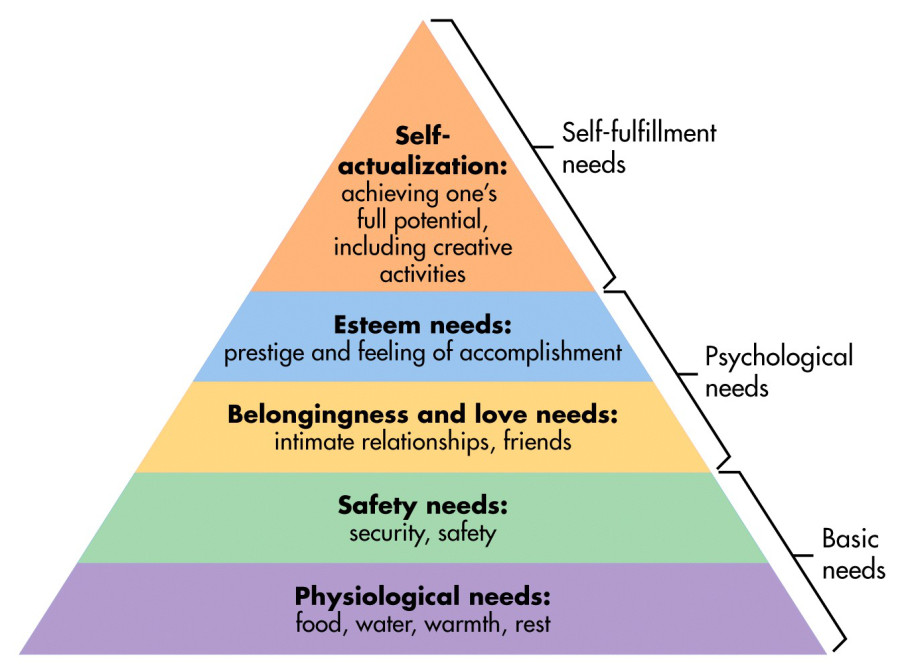
You may be familiar with Maslow’s hierarchy of needs. Abraham Maslow was an American psychologist practising in the mid 20th century. He came up with this idea in psychology called his ‘theory of human motivation’. It explains that people are motivated to meets their needs in a particular order, depicted as a pyramid. You have physiological needs first; food, water, warmth, rest. Then safety and security, belonging and love (friendships and relationships). Then self-esteem, prestige and feelings of accomplishment. And at the top of the pyramid we reach ‘Self-Actualisation’. Where we fulfil our potential, becoming our truest selves. The theory is that we are driven forward in life by this desire to self-actualise.
I’m no psychologist, and I’m not sure that this can be applied universally. But it’s certainly a motivation for many people, especially in our culture. Companies make their marketing and advertising appeals based on this intrinsic desire and motivation. That in buying their product, or ‘doing their thing’, we’ll fulfil our desires. And we’ll affirm or become our truest selves.
Two Types of Chaos
In school I learnt that entropy is when particles (because they have their own energy) diffuse from high density to low density. From being very close together to being very spread out. That’s how your air freshener spreads through the house. More specifically, entropy is a measure of disorder. It measures the capacity of particles to assume any number of disordered and chaotic possibilities.
Chaos is one way to describe the nature of sin. Through sin, one type of chaos entered the world. One which is constantly dismantling the good order of the universe [which Christians believe was] created by God. Sin’s chaotic end point is disorder, destruction and death.
In the beginning God’s good creation started with another type of chaos – the early ‘chaos’ of the cosmos. Like having a great idea and scribbling everything in your head onto a piece of paper, before bringing shape to it.
This creative chaos was symbolised by the ‘waters’. And [in the story of Creation told in Genesis] the Holy Spirit was brooding over them. It was a pregnant chaos, full of divine energy, potential and possibility. The energy of this chaos was driving towards order, not disorder. Growing more organised, gaining clarity, structure, shape and form. It was multiplying for good, and building the good things of God.
But chaos isn’t easy to control, whether constructive or destructive. It has its own energy. And I think it’s similar with our desires, they have their own energy. Our combined desires can be a positive or negative force for our lives, driving us towards God’s good order or towards disorder. But ultimately directing our lives and our futures.
The Heart of the Matter
[The Bible’s] wisdom cautions us: ‘Above all else, guard your heart, for everything you do flows from it’ – Proverbs 4:23
In his autobiography, Surrender, Bono – lead singer of Irish rock band, U2 – describes having life-saving heart surgery. In his words they needed to fix a blister on his aorta and a heart valve gone wrong. Both of which threatened to end his life if not treated quickly. His simple explanation made me think; he says “The aorta is… your lifeline, carrying the blood oxygenated by your lungs and becoming your life”. And what pumps this life around your body? Your heart.
Both Bono and the writer of this proverb show us how critical our hearts are, albeit in different ways. The Message version says to ‘Keep vigilant watch over your heart, that’s where life starts’. In the same ways, our desires originate in our hearts, the centre of our beings. And they become our life. Your very life, eternal – flows out from there. And God places the utmost priority on it.
Our desires – the things we hope for – are meant to be satisfied too, through Jesus. [Note: Christians believe that Jesus is God’s son, who died, and was resurrected by God’s power; overcoming the disorder, destruction and death wrought by sin]. We don’t guard our hearts to lock down our desires, but to curate them, (like precious pieces of art).
Proverbs 13:12 says: ‘Hope deferred makes the heart sick…. Without our hopes and desires being fulfilled our hearts will sicken and suffer, God knows this. This proverb develops the idea further saying, ‘but a longing fulfilled is a tree of life’.
A tree of life – it calls us back to Genesis. A longing fulfilled is Eden; it’s how things were created to be. And what else is a tree of life? Wisdom is a tree of life. Fulfilled longings, Wise Living – this is God’s original design, and it’s the redeemed heaven and earth – the ‘Kingdom of God’. [Note: this is a way the Bible and Christians describe God’s intended way of life].
‘Hope deferred makes the heart sick, but a longing fulfilled is a tree of life.
Proverb 13:12
Desire Gone Wrong
Desires can go wrong – we can overlay wrong desires onto some very genuine and legitimate needs. We can turn our desires into entitlements. A desire that started as something supple can become rigid and calcified, demanding and lustful. Desires are also subjective, they are different from person to person. And a presenting desire – might actually be driven by a need for something else, like connection, or understanding perhaps.
We’re to exercise wisdom, not foolishness. Although sin plays a significant part in desire-gone-wrong, being foolish isn’t necessarily sin. But the ultimate folly is to allow sin to rule our desires. That’s why we are to guard our hearts so carefully.
Like Adam and Eve, in the abstract, it’s perfectly easy to accept God’s wisdom and guidelines without question. We earnestly pay lip service to it. If we’re Christians, we believe that we believe it! And we want to obey it. But what’s more difficult is when we’re faced with a situation when we know what the wise thing is, but our not-so-good desires get in the way. We can unwittingly entertain evil desires. So that in the moment, rather than making a wise choice, we make a foolish choice.
James 1:14 captures the conflict we find ourselves in ‘…but each person is tempted when they are dragged away by their own evil desire and enticed. Then, after desire has conceived, it gives birth to sin; and sin, when it is full-grown, gives birth to death’.
He goes on to remind us that when faced with that choice we’re not to be deceived (as Adam and Eve were). God does give us good gifts, to satisfy us and fulfil our longings. He hasn’t suddenly changed, he’s not going to leave us in the lurch. No matter how persuaded we might be.
“Don’t be deceived, my dear brothers and sisters. Every good and perfect gift is from above, coming down from the father of the heavenly lights, who does not change like shifting shadows“.
James 1:16
Foolishness Can FEEL Like Wisdom
There’s another problem here as well.
In Genesis, the enemy threw God’s wisdom into doubt. He twisted it, framing it as something negative that withheld truth and prevented insight. What a snake! He cast aspersions on God’s nature, suggesting: “How can He be generous and giving? No, He’s mean and miserly!” He enticed them: if they ate the fruit of the tree of knowledge, they could be the ones to decide what wisdom looked like, not God. They could be all-knowing, they could be equal to God. They could be gods themselves. He succeeded in convincing Adam and Eve to turn their backs on God’s wisdom and the good order of his creation.
That’s human nature isn’t it? We want to be the ones to decide how we live, we want to determine what’s good for us, and what is wise. The Bible warns us against this: Proverbs 26:12 says ‘Do you see a person wise in their own eyes? There is more hope for a fool than for them’.
So you might say that to be wise in your own eyes is the most foolish thing of all.
Come With Me to Corinth
New Testament Corinth was a Brave New World. It was a modern capital in the ever-expanding Roman Empire. The Corinthians were certainly ‘wise in their own eyes’. They were full-out living their own wisdom and living it to the max. It was a lifestyle, an art-form even. The attitudes of today, pale in comparison to the Corinthians. Even to people of the time, Corinth was morally off the chart, the word to ‘Corinthianise’ literally means to live a promiscuous life, which gives you an idea of their lifestyles.
Into this context, steps Paul. He arrived to visit the newly formed Corinthian church, and to encourage the believers there. What he found was that for all their human wisdom and sophistication at the time, the Corinthians were being foolish. Paul knew it. One of the major mindsets he confronted was in their sense of self-determination, the right to do what they wanted. Their mantra was “I have the right to do anything”. And though they were exercising a type of freedom, Paul challenges them that the choices they were making were not actually beneficial to them. They weren’t wise. There was more to freedom than a technicality. They were not living in their freedom wisely or well, they were being foolish.

He reflects this to them saying: ‘”I have the right to do anything”, you say – but not everything is beneficial. “I have the right to do anything” – but I will not be mastered by anything. You say “Food for the stomach, and the stomach for food, and God will destroy them both”. The body, however is not meant for sexual immorality but for the Lord, and the Lord for the body’. 1 Corinthians 6:12
The new Christians in the church at Corinth hadn’t shaken off the values of the surrounding culture. Underpinning their ‘right to do anything’ was not freedom. They were enslaved to the culture – to individualism. They lived a hedonistic lifestyle, verging on being nihilistic. In Corinth, the believers were living out of step with their professed Hope in Jesus. There was so much more to life and they were in danger of becoming enslaved all over again, this time to their own desires.
I wonder if into the culture had seeped a pervasive belief; What does it matter what I do with my body if it’s just going to be destroyed? What does it matter if all I really am is firewood? I’ll rather invest in the mind, in ideas, and my body can do whatever it likes.
You see, Corinth had had a chequered past. In 146 BC it had been torched, burned to the ground and laid to waste – its inhabitants either killed or sold as slaves. It was a city destroyed. In 44 BC, desolate, it was colonised by Julius Caesar who rebuilt it to became the capital of the Roman province of Achaia. In a relatively short amount of time Corinth had become a major port, place of trade, and cultural centre – to become a very wealthy city.
Corinthians and Culture
The culture was shaped by ancient worship of Aphrodite, the greek Goddess of love, beauty, pleasure and procreation. And though Aphrodite’s temple had been destroyed, it was rebuilt in Roman times – its culture of promiscuity along with it. In terms of religion Corinth had gone from pantheism to a fusion, which combined the worship of the twelve Olympians of the Greeks, with the paganism of the Romans. Add to that the fact that Corinth was a melting pot of every culture that the Roman empire had conquered and you have a very heady mix.
Although they venerated intellect and learning in the ancient Greek tradition, alongside this ran a belief that the body was of minimal importance, they reduced it to something carnal and animalistic, whose appetites must be fed. Keep the body’s desires satisfied, well-fed and quiet so we can focus on bigger things. This was considered morally correct as you pursued higher things like knowledge and the teachings of the philosophers. But this was a foolish approach.
This holds up a mirror to our own culture. We tend to say now, “it’s fine as long as it doesn’t hurt anybody”. Parents teach their children this, this is our moral compass in this society. Where the Corinthians said “I have the right to do anything”. We might say “You do you”. We consider there being nothing wrong with this. No harm no foul. But the Bible makes the point that if it’s hurting you, it is a problem. And that includes your eternal soul. You may not be sinning against others but it is foolish to be sinning against yourself. [In the context of the prevailing culture and presenting issues at the time] Paul urged the Corinthians to ‘Flee from sexual immorality. All other sins a person commits are outside the body, but whoever sins sexually, sins against their own body’. And what you’re doing might be technically permitted, it may not be sinful, you may even be doing it with the best of intentions but is it wise in the end?
While the Corinthian believers were continuing to live in light of their culture, Paul was passionate about them living in light of eternity. Jesus was resurrected body, soul and spirit and we are saved, and will be resurrected body, soul, and spirit. God considers the body to be as holy and precious as our eternal souls, which he died for. [In the biblical and hebraic worldview we are one within ourselves,] those parts are indivisible, we are integrated beings. Paul knew that as believers, our context is eternity, and the thing the Jesus prized most highly, dying so we could have it was eternal life. So for the Corinthians to live with the belief that their bodies were nothing more than firewood didn’t align with the awesome reality of resurrection.
Plant Your Flag

Mountaineers have a practice of planting a flag to show how high they’ve climbed, and to mark how far they’ve come on the journey. We can think of the Christian life as a journey to the summit of a mountain. And it can feel like a long, arduous journey. The problem with trying to control and manage our desires, with their chaos, is that it gets tiring. Sometimes we just want to set up camp rather than keep going. Here and no further, thank you very much. I’m not prepared for it to cost me any more, I’m not going to give up the chance to have what I desire now. I’m not going any further.
And so, even though we’re called to reach the summit, we risk settling.
Where would you plant your flag? What are your non-negotiables? When it really comes to it what desires are driving your life? Wanting a relationship, to be married, sex, the fulfilling job, recognition, a big salary, ease, comfort, being right, holding onto that grudge, staying in unforgiveness or self-pity, the excuse of your past failures, getting the last word, that habit. There are many who decide that there are things they just will not give up or lose, they plant their flags on any number of things – some are good, but just at the wrong time, or in the wrong order.
Mark 8:36 says ‘What good is it for someone to gain the whole world, yet forfeit his soul’.
If we recognise any of these things the good news is that Jesus is faithful to forgive us and restore us.
So what’s the solution?
We’re Not Meant to Control Our Desires
You may know C.S Lewis’s book ‘The Great Divorce’. It’s set in a dream which starts in a joyless city, a ‘Grey Town’, where passengers are boarding a bus, before it heads off into the sky. When they get to their destination, they realise they are in a beautiful country. And we discover that they are in fact ghosts. The country is so solid and shining and real that the grass hurts their feet. Many can’t bear it, and in the end almost all of them decide to turn around to go back ‘home’.
Towards the end of the book we meet a character who is caught in indecision. He has a desire to press on, to be all he could truly be, and he is so close. But he can’t enter into this fulfilment without making a choice. He is very attached to a small red lizard that sits on his shoulder, it’s been there a long time. It constantly whispers lustful things into his ear. The man can’t continue onwards if the lizard stays with him, it’s just not possible. The lizard must die. An angel standing opposite him offers to kill the lizard, and there ensues a long conversation back and forth between them about why he doesn’t think it’s a good idea for the angel to kill the lizard, while the angel tries to reason with him. The man just can’t live without it. Eventually the angel persuades him, and though it hurts him it has the most amazing effect. He’s made a wise choice. And something extraordinary happens. The man is transformed into a huge shining, solid person, he’s no longer a ghost – he’s like the people in this beautiful land, and the lizard, thought dead comes to life as a beautiful solid stallion.
Colossians 3:5 says: ‘Put to death, therefore, whatever belongs to your earthly nature: sexual immorality, impurity, lust, evil desires and greed, which is idolatry. Because of these, the wrath of God is coming. You used to walk in these ways, in the life you once lived. But now you must also rid yourselves of all such things as these: anger, rage, malice, slander, and filthy language from your lips. Do not lie to each other, since you have taken off your old self with its practices and put on the new self, which is being renewed in knowledge in the image of its Creator.’
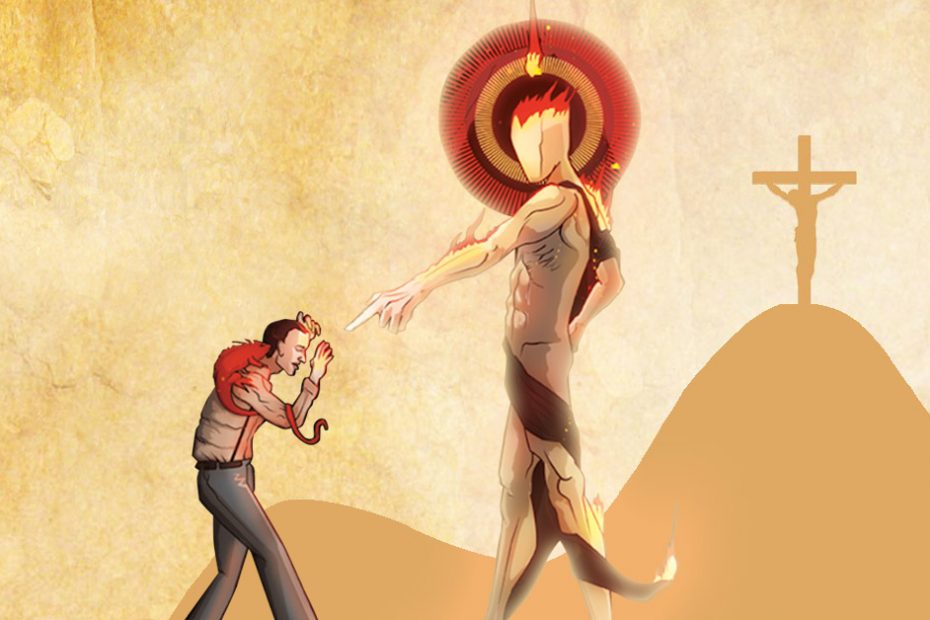
Wisdom is putting to death whatever belongs to our earthly natures. We can’t control the chaos of our desires, but we can control this choice. We can choose to ‘crucify our flesh,’ and our competing desires. To end the chaos, placing ourselves in God’s redemptive order. Where are you coddling your flesh, rather than crucifying it?
But we don’t crucify our earthly desires to end up with nothing. We do so, because God wants to give us something far better in place of them. To put them to death is to allow God to resurrect our desires, to rescue them from being the insubstantial versions we thought were so satisfying, utterly transforming them. A stallion just doesn’t compare to a lizard, it’s completely different. Unless we let go of our old selves and take up our new selves, we can’t fulfil our God-given potential.
Flip the pyramid
Returning to Maslow’s hierarchy of needs: Jesus turns this on its head.
He starts with our desire for self-actualisation, and all the ways we pursue that through our desires good and bad. He transforms it, and in turn our potential, ridding us of the chaos caused by sin and competing desires. He re-establishes his good created order in our lives, resurrecting our desires. He fulfils our longings so they become a tree of life, and shows us how to live wisely.
Our salvation through Jesus fulfils our deepest longings and changes the paradigm we’re living in. Jesus prioritises the resurrected, eternal life over everything else. He came to give us life, and life in abundance. We don’t self-actualise through finding ourselves, but through finding Him. And not through holding onto our lives with their desires, but in letting them go, so they can die and be raised to life. It was only by being crucified and dying that Jesus was able to be resurrected to eternal life, and us with him. We become our truest selves.
And rather than the ever-narrowing pyramid where we’re driven towards self-actualisation, we find that eternal life flows from us and multiplies out exponentially, as we continue to seek first His kingdom and his righteousness. Having been crucified with him, along with our desires, we now radiate out his resurrection life. We are solid, real people. And the picture looks very different from here.
In Conclusion
I’m going to borrow a quote here. Last week I was at an event for founders and entrepreneurs, and the keynote speaker, quoted Jamal Edwards MBE, who was a British music entrepreneur and DJ. He tragically died in 2022 leaving an incredible legacy, having done an incredible amount of good for his community and beyond, inspiring many many people. He said this:
“Set goals so high they demand an entirely different version of you.”
Jamal Edwards MBE
And hearing that while I was working on this talk just made me think. God has such a vision for us and our lives that it demands an entirely different version of us. One that we find when we are crucified with him, and when we let go of our desires, releasing them so he can transform them and us with his resurrection power into something extraordinary.
That is wisdom.
© Alexandra Noel – All Rights Reserved 2023
 Alex Noel